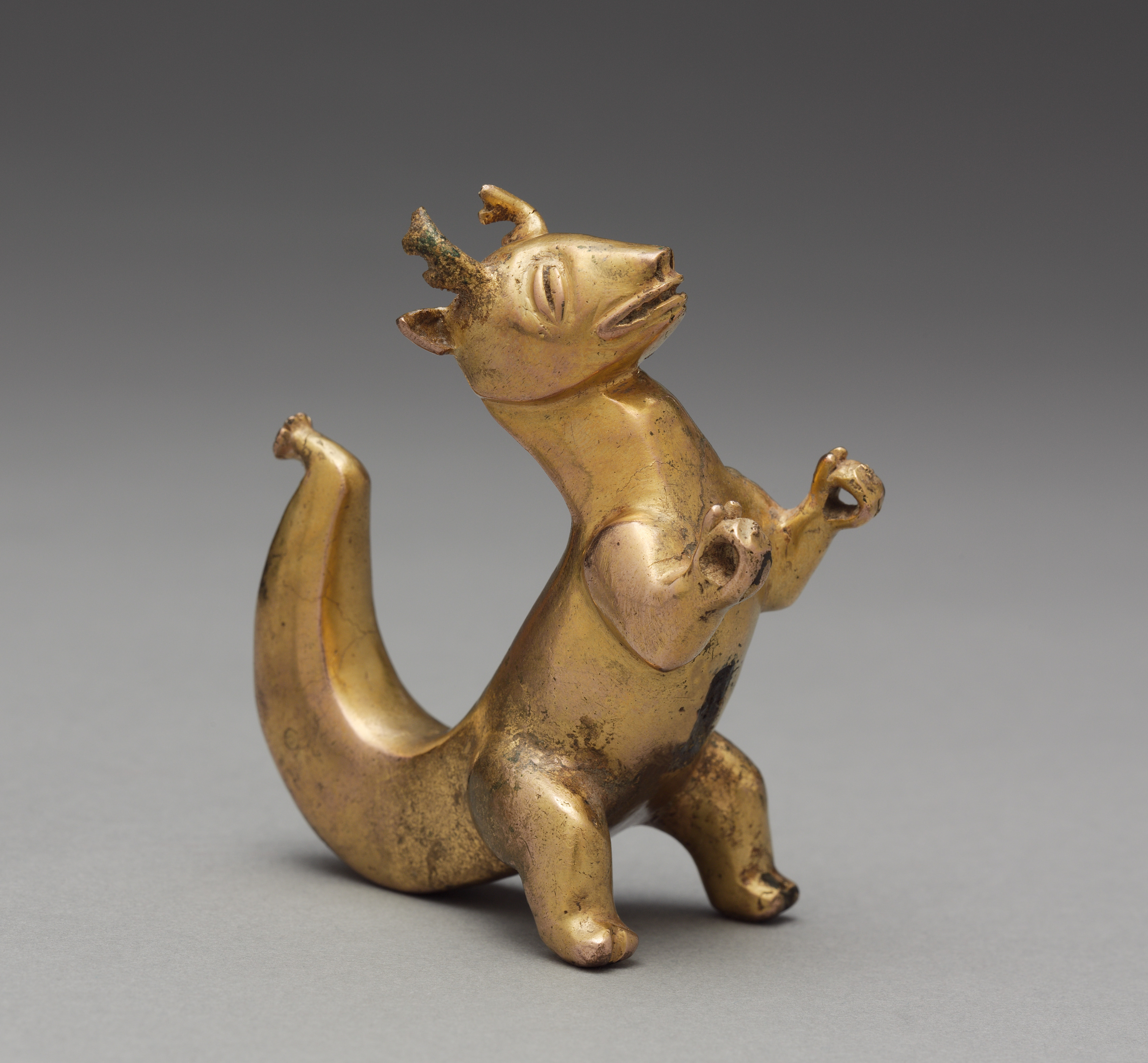
Executive Summary: The Pendant as Temporal Collision
In the rarefied domain of avant-garde fashion, the artifact is not merely an object of historical curiosity but a provocation—a catalyst for reimagining materiality, symbolism, and the very grammar of adornment. Zoey Fashion Lab is privileged to deconstruct a singular pendant originating from Panama, dated to the 5th–7th century, executed in cast gold. This piece, while geographically rooted in the Isthmian region, transcends its local provenance through an unmistakable international style—a visual lingua franca that speaks to power, cosmology, and the human obsession with permanence. The reference text, Archive Resonance: Mirror with Split-Leaf, provides a critical dialectic: on one face, a polished silver mirror inlaid with intricate gold palm-leaf motifs; on the other, a cold stone sarcophagus whose relief carvings narrate a life’s trajectory. Our pendant exists precisely within this tension—between reflection and burial, between the ephemeral gleam of gold and the immutable weight of narrative.
This analysis will dissect the pendant’s technical execution, its stylistic hybridity, and its potential for radical reinterpretation within a contemporary avant-garde framework. We will argue that this ancient object is not a relic to be preserved in amber but a living blueprint for subversive design—one that challenges the binary of ornament versus structure, and surface versus depth.
Technical Provenance: The Alchemy of Cast Gold
The pendant’s construction via lost-wax casting is a testament to the sophisticated metallurgical knowledge of pre-Columbian Panamanian cultures, likely associated with the Gran Coclé or Chiriquí traditions. This method, which involves sculpting a wax model, encasing it in clay, and then melting the wax to receive molten gold, is inherently a process of negative space—the void becomes the vessel. For Zoey Fashion Lab, this technical genesis is profoundly resonant. It aligns with our design philosophy of deconstructive construction, where absence is as critical as presence. The cast gold is not hammered or stamped; it is grown from a sacrificial model, imbuing the final piece with a unique, non-replicable texture—a fingerprint of the original artisan’s hand.
Material Duality: Beyond Surface Shine
Unlike the European tradition of gold as a symbol of divine light, the Panamanian context treats gold as a chthonic material—one associated with the underworld, with the transformative power of the sun’s journey through the earth. The pendant’s surface, likely unpolished in its original state, would have caught light in a fractured, almost volatile manner. This is not the smooth, mirror-like finish of the referenced silver mirror; it is a tactile topography of ridges, voids, and subtle irregularities. For our avant-garde application, we propose a finish that deliberately oxidizes portions of the gold, creating a chiaroscuro effect that shifts with movement—a wearable chiaroscuro that refuses static beauty. The technical choice of cast gold also implies a weight and density that challenges the contemporary preference for lightweight, mass-produced accessories. This pendant demands presence; it is a gravitational anchor on the body.
Stylistic Hybridity: The International Style of the Isthmus
The designation of an international style for this pendant is not an anachronism. During the 5th–7th centuries, the Isthmus of Panama was a nexus of trade routes connecting Mesoamerica, the Andes, and the Caribbean. This pendant’s iconography—likely featuring zoomorphic or anthropomorphic motifs abstracted into geometric spirals and volutes—shows a deliberate synthesis. We observe the split-leaf motif referenced in the archive text, a recurring symbol in both Mayan and Andean art, here rendered with a local, almost calligraphic flair. The pendant does not depict a specific animal or deity with naturalistic fidelity; instead, it abstracts the essence of movement—the coil of a serpent, the unfurling of a frond, the spiral of breath. This abstraction is the hallmark of an international style: a visual shorthand that transcends linguistic and cultural barriers.
The Mirror and the Sarcophagus: A Dialectical Reading
The archive reference forces us to view this pendant through a dual lens. On one side, the mirror—a tool of self-regard, of vanity, of the present moment. On the other, the sarcophagus—a vessel for the dead, a repository of memory, a narrative carved in stone. Our pendant occupies the liminal space between these two. Its gold surface acts as a mirror, reflecting the wearer’s current identity, yet its cast structure, with its dense, cellular texture, evokes the weight of ancestral memory. To wear this pendant in an avant-garde context is to acknowledge that fashion is a memento mori—a celebration of the ephemeral that is nonetheless built upon the bones of history. The split-leaf motif, which bifurcates and diverges, becomes a metaphor for the bifurcated self: the public persona (the mirror) and the private, historical self (the sarcophagus).
Avant-Garde Reinterpretation: Deconstruction as Resurrection
Zoey Fashion Lab proposes not a faithful reproduction but a radical deconstruction of this pendant’s principles. Our approach involves three key interventions:
1. Scale and Placement Subversion
We will magnify the pendant’s core motif—the split-leaf spiral—to an oversized, architectural scale, transforming it from a chest ornament into a shoulder cage or a corset structural element. The cast gold will be replaced with a hybrid composite: a base of recycled bronze, coated in a micro-thin layer of 24k gold leaf, then deliberately distressed to expose the darker underlayer. This is not a degradation but a stratigraphy—a visible archaeology of the material itself. The pendant’s original weight is exaggerated, forcing the wearer to adopt a slower, more deliberate posture—a kinetic commentary on the burden of history.
2. The Mirror-Sarcophagus Integration
We will create a two-faced garment component. The exterior features the pendant’s motif in high relief, with a polished gold surface that acts as a fragmented mirror. The interior, against the skin, will be embedded with a laser-etched relief of the sarcophagus’s narrative lines—invisible to the observer but felt as a tactile text on the wearer’s body. This inversion of the archive’s duality places the personal narrative (the sarcophagus) on the inside, and the public reflection (the mirror) on the outside. The wearer becomes a living archive, their body the interface between memory and spectacle.
3. Kinetic and Sonic Elements
Avant-garde fashion must engage all senses. We will incorporate micro-mechanical joints into the pendant’s structure, allowing the split-leaf elements to flutter with the wearer’s breath or pulse. This movement is not decorative; it is a direct homage to the lost-wax process, where the original wax model was destroyed to create the final piece. Our kinetic version is a perpetual becoming—a form that never settles, always on the verge of collapse and reformation. Additionally, the interior relief will be tuned to produce a faint, high-frequency resonance when struck—a ghostly chime that evokes the bells of ancient Panamanian shamans, used to mediate between worlds.
Conclusion: The Pendant as a Portal
This 5th–7th century Panamanian pendant is far more than a historical artifact. It is a theoretical object that collapses time, space, and material hierarchies. Its cast gold construction, international stylistic vocabulary, and the dialectical tension between mirror and sarcophagus make it an ideal progenitor for avant-garde fashion. At Zoey Fashion Lab, we do not seek to preserve the past but to weaponize it—to use its weight, its textures, and its symbolic density to challenge the superficiality of contemporary adornment. Our reinterpretation transforms the pendant from a static relic into a dynamic, wearable philosophy—one that forces the wearer and the observer to confront the uncomfortable, beautiful, and inescapable coexistence of the ephemeral self and the eternal archive. This is not fashion as decoration; it is fashion as archaeology of the future.