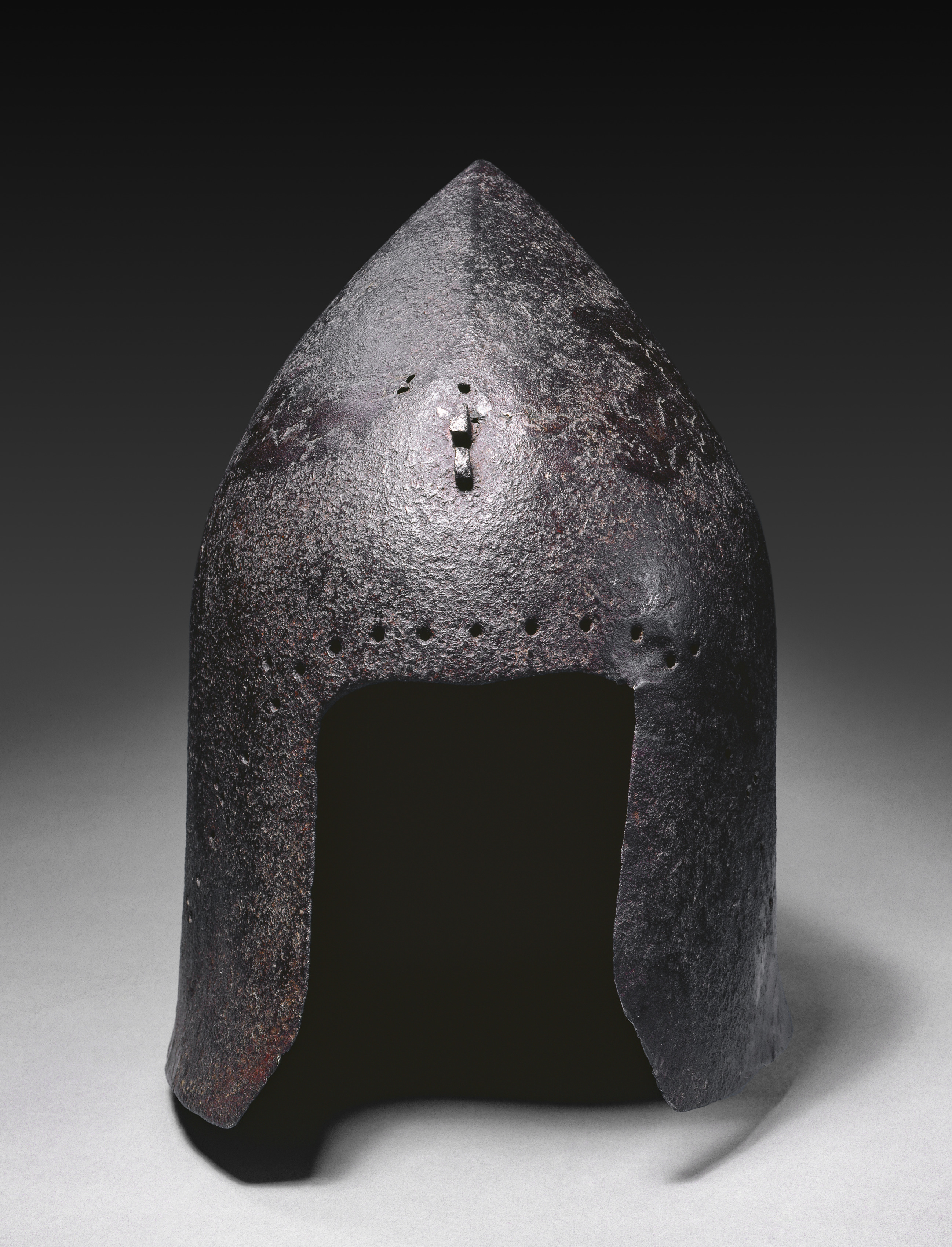
Deconstructing the Barbute: An Avant-Garde Analysis for Zoey Fashion Lab
At Zoey Fashion Lab, our mandate transcends mere garment construction. We engage in the archaeological excavation of form, extracting the latent DNA of historical artifacts to synthesize new, radical expressions of wearable art. Today, our subject is the Barbute, specifically the example recovered from the Venetian Garrison at Chalcis. This 14th-15th century iron helmet, a product of North Italian armories, is not merely a piece of protective equipment; it is a frozen moment of martial elegance, a study in geometric tension, and a profound source of inspiration for our forthcoming avant-garde collection. By dissecting its material, silhouette, and historical context, we will re-sequence its genetic code into a new strand of fashion DNA.
I. The Material Paradox: Iron as Textile
The Barbute is forged from iron, a material conventionally associated with rigidity, weight, and immutability. Yet, to the deconstructionist eye, this iron presents a paradox. It was hammered, shaped, and raised by skilled artisans into a form that mimics the organic contours of the human skull and face. This process—sinking, planishing, and polishing—is metallurgical tailoring. The iron was forced to yield to a three-dimensional pattern, creating a seamless, monolithic textile.
For Zoey Fashion Lab, this translates into a radical re-imagining of fabric. We propose a “liquid metal” approach, utilizing high-density jersey bonded with a metallic foil, or employing 3D-printed polymer composites that mimic the pitted, oxidized texture of the original artifact. The goal is not to reproduce the weight of iron, but to capture its visual and tactile authority. Our garments will drape with the fluidity of cloth while possessing the optical density of forged steel. We will explore seams that are not sewn but laser-welded, creating a fused, unbroken line that echoes the Barbute’s lack of a central seam. The iron’s characteristic patina—a map of oxidation and use—will be replicated through reactive dyes and burnout techniques, creating a surface that appears to have survived centuries of conflict.
II. The Silhouette: The T-Profile and the Visorless Gaze
The most distinctive feature of the Barbute is its T-shaped or Y-shaped opening, which exposes the eyes, nose, and mouth while protecting the cheeks and brow. This is not a mere functional cutout; it is a deliberate architectural statement. It creates a powerful, anonymous visage, stripping away individual identity to present a unified, intimidating front. The helmet’s profile is a smooth, sweeping curve from the crown to the nape, often extending into a pointed or rounded tail to protect the back of the neck.
In our avant-garde interpretation, this T-profile becomes the foundational cut for a new series of hoods, collars, and headpieces. We will translate the helmet’s protective shell into a high, sculptural collar that frames the face, leaving the center of the visage exposed while shielding the jawline and cheekbones. The effect is one of simultaneous vulnerability and impenetrability—the wearer is exposed yet armored. The garment’s shoulders will be extended and exaggerated to mimic the helmet’s flared base, creating a powerful, pyramidal silhouette that grounds the wearer. We will also explore the negative space of the visor. By cutting away fabric in sharp, angular T-shapes from the chest or back of a garment, we create a visual echo of the helmet’s opening, drawing the eye to the body’s own architecture.
The Chalcis Variant: A Study in Regional DNA
The specific provenance of our subject—the Venetian Garrison at Chalcis—adds a crucial layer of nuance. Chalcis, a key Venetian outpost in Euboea, was a crossroads of Eastern and Western military technology. The Barbute found there is not purely Italianate; it may show subtle Byzantine or even Ottoman influences in its curvature or the specific placement of its rivets. This hybridity is the New DNA Strand we seek to amplify.
This cultural fusion manifests in our collection through a juxtaposition of Western tailoring with Eastern drapery. The rigid, structured lines of the Barbute-inspired outer shell will be paired with voluminous, flowing inner layers that reference the silks and linens of the Levant. We will use intricate, geometric jacquard weaves that mimic the damascening patterns found on high-status armor, but rendered in soft, pliable yarns. The color palette will be drawn from the artifact itself: the deep greys and blacks of oxidized iron, punctuated by the warm ochre and verdigris of bronze fittings and the faded crimson of a soldier’s surcoat. This is not a costume; it is a dialogue between civilizations, mediated through the language of contemporary fashion.
III. Deconstructive Techniques: Unmaking the Armor
True avant-garde practice requires not just imitation, but dissolution. We will deconstruct the Barbute’s integrity to reveal its hidden structures. The helmet’s smooth exterior will be shattered, conceptually, into a series of articulated plates. These plates will be reattached using visible, industrial hardware—gunmetal grommets, exposed zip pulls, and leather lacing—to create garments that are modular and adjustable. The wearer becomes the armorer, able to reconfigure their own protective shell.
We will also explore the concept of “soft armor.” Using high-performance technical fabrics like Kevlar weaves and nylon ripstop, we will construct garments that offer the idea of protection without the literal weight. Padding will be exaggerated and exposed, reminiscent of the quilted gambesons worn beneath plate armor, but scaled up to a sculptural extreme. The internal structure of the Barbute—the liner and suspension system that cushioned the skull—will be turned inside out, becoming an external, tactile element. Ribbed, tubular knits will wrap around the neck and shoulders, mimicking the segmented plates of a gorget, while remaining supremely comfortable and flexible.
IV. The Wearer as Sentinel: Performance and Identity
Ultimately, the Barbute is an instrument of performance. It transforms the wearer into a sentinel, a guardian, a figure of authority. Our avant-garde collection seeks to harness this transformative power. The garments will not be passive; they will demand a certain posture, a certain presence. The high collars restrict lateral head movement, forcing a direct, confrontational gaze. The structured shoulders broaden the frame, creating an aura of physical dominance.
This is fashion as psychological armor for the modern world. The wearer is not hiding, but rather projecting a curated, impenetrable identity. The exposed T-zone—the eyes and mouth—becomes the sole point of human connection, making every glance and every word more potent. In an era of digital saturation and constant exposure, the Barbute’s lesson is profound: true power lies in selective revelation. By enclosing the body in forms that evoke the strength and mystery of a 15th-century Venetian garrison, we empower the individual to step into their own legend. The iron is gone, but its indomitable spirit is woven into every fiber.