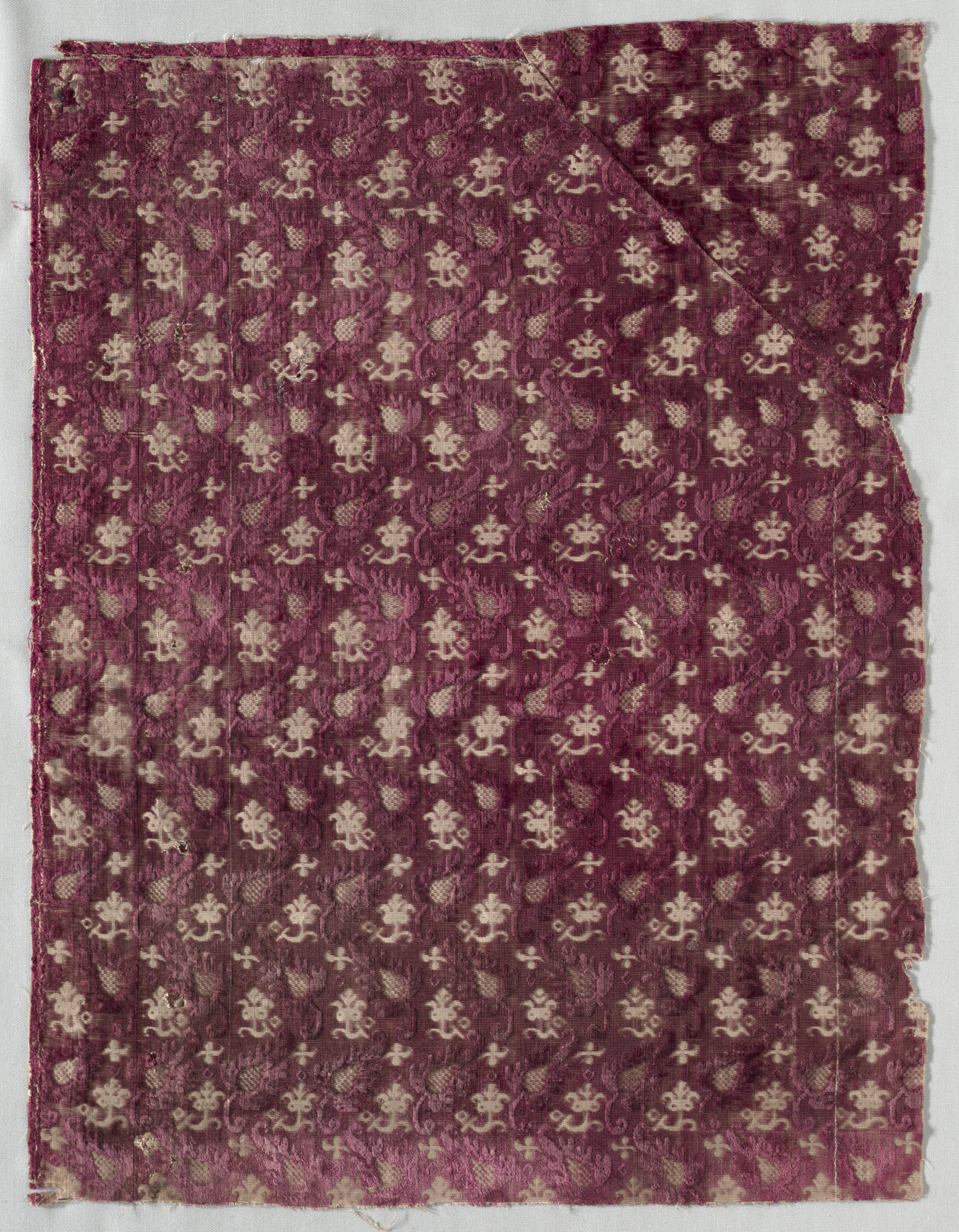
Technical Analysis: Velvet Fragment, Italy, 17th Century
The provided velvet fragment represents a pinnacle of European textile craftsmanship from the Baroque period. Originating in 17th-century Italy, the fabric is a compound weave, specifically a pile weave, constructed on a drawloom. This technology allowed for the creation of intricate, large-scale patterns, a hallmark of luxury during this era. The technical specification of "cut and uncut" velvet is critical. This technique, known as ciselé, involves weaving the pile threads to create a design where some areas are sheared (cut) to a uniform height, resulting in a plush, light-absorbing surface, while adjacent areas are left uncut, forming loops. This creates a play of texture and light—the cut velvet appears deep and luminous, the uncut velvet more subdued and resilient—within a single, unified pattern. The ground fabric is likely silk, with silk pile threads, though a possibility of a silk-velvet pile on a linen ground exists for certain applications. The fragment's durability suggests a high thread count and expert finishing.
Deconstructionist Interpretation: The "New DNA Strand" Reference
The directive to reference a "New DNA Strand" is a powerful conceptual lens. In our deconstruction, we do not view this fragment as a static artifact, but as a living code—a genetic blueprint of luxury, labor, and aesthetic ambition. Its "DNA" is composed of several intertwined strands:
The Strand of Opulence: The very structure of velvet, requiring exponentially more material and time than a flat weave, encodes extravagance. Its historical context—worn by the aristocracy and clergy—speaks of power, wealth, and divine association. The Italian origin ties it to merchant republics like Genoa and Venice, hubs of global trade and Renaissance innovation.
The Strand of Duality: The cut-and-uncut technique is a binary code woven into fabric. It is a physical manifestation of contrast: light/shadow, soft/structured, luxury/restraint. This inherent duality is the fragment's most potent genetic trait for modern application.
The Strand of Time & Decay: As a fragment, it carries the genetic memory of its own disintegration. The frayed edges, potential fading, and separation from its original whole are not flaws but data points. They tell a story of use, of the passage of centuries, of survival against odds. This strand encodes authenticity and narrative, a stark contrast to the sterile perfection of modern, mass-produced textiles.
Reconstruction & Avant-Garde Application: Zoey Fashion Lab Protocol
Moving from historical analysis to avant-garde creation requires a process of genetic splicing and recombinant expression. We do not replicate; we re-sequence. The goal is to express the core DNA of the fragment through a contemporary biological and technological lexicon.
Concept 1: "Digital Mycelium Velvet"
This approach reinterprets the pile structure through biomimicry and bio-fabrication. The cut/uncut duality is translated into a living textile grown from fungal mycelium.
Process: A substrate is inoculated with mycelium cultures. Through controlled environmental triggers (light, humidity, nutrient injection), we direct the growth to create dense, plush (cut) areas and open, networked (uncut) areas within the same sheet. The pattern is not woven but grown, following algorithmic patterns derived from the original 17th-century motif. The final material is stabilized, creating a leather-like, biodegradable velvet. The color is not dyed but derived from natural pigments or introduced during growth. The "fragment" state is inherent—each piece is a unique harvest from a larger "grow."
Concept 2: "Optical Loom: Memory-Woven Silicone"
This approach deconstructs the texture and light interplay into a purely synthetic, yet deeply tactile, form. The reference to a new DNA strand becomes literal in the form of synthetic polymer chains.
Process: We use advanced 3D weaving with monofilament silicone threads and optical fibers. The "cut pile" is represented by clusters of laser-cut silicone microfibrils, engineered to catch light. The "uncut pile" is simulated by continuous, clear silicone loops woven with embedded, dimmable micro-LED optical fibers. The original Baroque pattern is translated into a circuit diagram. The garment becomes an interactive display: pressure, sound, or biometric data from the wearer can alter the light emission from the "uncut" zones, creating a dynamic, living pattern that pulses and flows. The fabric is a fragment of data made physical.
Concept 3: "The Archeological Distortion Garment"
This is the most direct deconstruction, focusing on the fragment's state of decay and its narrative power. It treats the historical "DNA" as a document to be corrupted, magnified, and reconstructed.
Process: A high-resolution, 3D topographic scan of the original fragment is taken, capturing every fray, tear, and thread displacement. This digital point cloud is manipulated—stretched, mirrored, and multiplied—to create distorted, gargantuan versions of the original pattern. This new pattern is then executed in a technical mélange: using the exact cut/uncut velvet technique, but with materials like recycled nylon velvet (cut) and iridescent looped technical tape (uncut). The garment is constructed with the "frayed" edges of the digital scan becoming intentional, laser-cut raw edges on the garment's seams and hem. It is a wearable, walking fragment, explicitly acknowledging its derivative and deconstructed nature.
Conclusion: The Recombinant Future
The 17th-century Italian velvet fragment is not merely a material sample; it is a donor organism. Its genetic code—composed of historical context, technical brilliance, and embodied duality—provides the base pairs for our avant-garde creations. At Zoey Fashion Lab, our deconstructionism is a form of creative genetics. By splicing the opulence strand with bio-tech, the duality strand with interactive systems, and the decay strand with digital archaeology, we express entirely new "organisms" in the fashion ecosystem.
The "New DNA Strand" is the hybrid that results: part historical memory, part speculative future. It ensures that the profound artistry of the past does not sit inert in an archive but evolves, mutates, and finds urgent, relevant, and breathtaking expression in the avant-garde landscape of tomorrow. The loom is no longer just wooden; it is biological, digital, and conceptual. Our fabric is no longer just woven; it is grown, coded, and excavated.