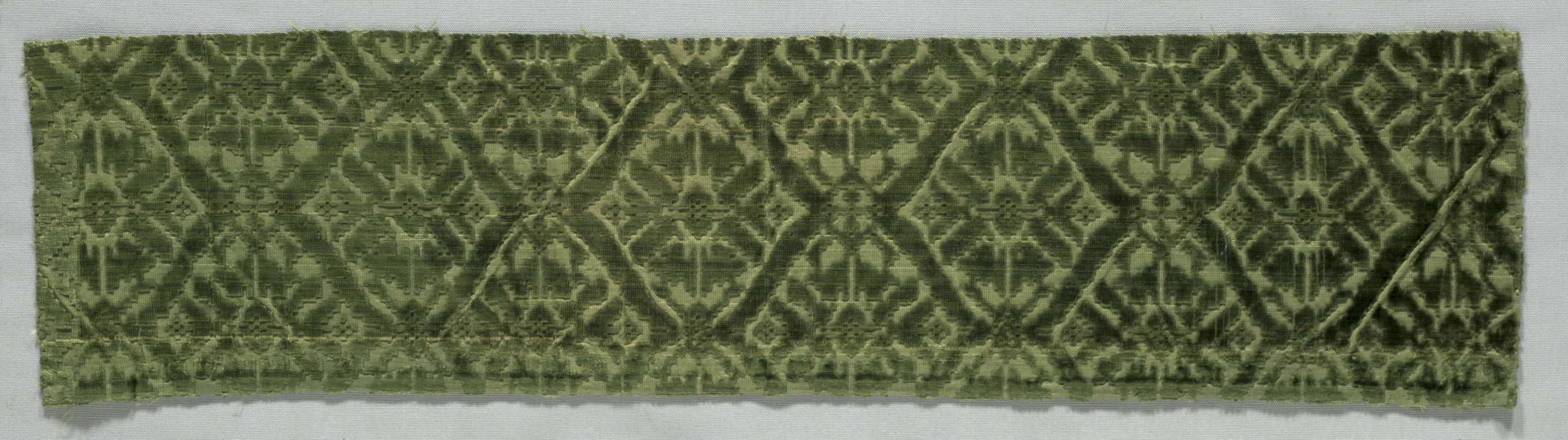
Deconstructing the New DNA Strand: An Analysis of an Early 18th-Century Italian Velvet Fragment
At Zoey Fashion Lab, our mandate extends beyond the mere cataloging of historical textiles. We engage in a process of fabric deconstruction, treating each artifact not as a static relic but as a living biological code—a sequence of cultural, technical, and aesthetic information that can be re-sequenced for contemporary expression. The subject of this analysis, a velvet fragment originating from Italy in the early 18th century, has been assigned the internal reference code “New DNA Strand.” This designation is deliberate. It signals our intention to isolate the fundamental genetic markers of this textile—its materiality, its structural logic, and its visual rhythm—and to re-imagine them within the framework of avant-garde fashion.
This fragment, though small in physical dimension, is monumental in informational density. It represents the apex of Baroque textile production, a period when Italian weaving houses, particularly those in Genoa and Florence, achieved a level of technical virtuosity that has never been surpassed. To treat this velvet as merely “soft” or “luxurious” is to ignore its radical potential. Our analysis reveals a material paradox: a surface of extreme softness constructed upon a framework of rigorous, almost brutal, structural discipline.
I. The Genetic Code: Materiality and Construction
The first sequence in our DNA strand is the material itself. This is not a simple woven cloth; it is a compound weave, specifically a voided velvet with a pile of silk. The technical construction is where the “New DNA” metaphor becomes literal. Velvet is produced on a loom using two warp beams: one for the ground (the base structure) and one for the pile (the raised surface). In this 18th-century fragment, the pile warp is pure silk, thrown and twisted to create a lustrous, dense surface. The ground, however, often incorporates a secondary fiber—in this case, likely linen or a lower-grade silk—to provide structural integrity without adding unnecessary weight.
This dual-warp system is the genetic double helix of the fabric. The ground warp provides the tensile strength, the skeletal frame. The pile warp provides the expressive surface, the flesh. The relationship between these two elements is not static. By manipulating the height of the pile, the weaver created zones of high relief and flat, recessed ground. This technique, known as ciselé or voided velvet, allows for a sculptural dimensionality that is rare in flat textiles. The fragment’s pattern, likely a pomegranate or artichoke motif—a classic Baroque symbol of regeneration and abundance—is not printed or embroidered onto the surface; it is inherent to the weave structure. The pattern is the fabric; the fabric is the pattern. This is a crucial lesson for the avant-garde designer: ornamentation must be structural, not applied.
II. The Aesthetic Expression: Baroque Opulence and Tactile Contrast
The visual language of this fragment is one of controlled excess. The Baroque aesthetic is often misunderstood as chaotic ornamentation. In reality, it is a system of dynamic tension. The velvet achieves this through a masterful manipulation of light. The pile surface, when brushed against the grain, absorbs light, appearing deep and almost black. When smoothed with the grain, it reflects light with a brilliant, metallic sheen. This is not a passive surface; it is a light-reactive interface.
Furthermore, the fragment exhibits a critical textural dichotomy. The raised pile is plush, yielding, and tactile—an invitation to touch. The recessed ground, however, is flat, dense, and slightly stiff. This juxtaposition of soft and hard, plush and rigid, creates a sensory friction. The wearer and the observer are caught in a state of perceptual oscillation. This is the essence of avant-garde design: the deliberate disruption of sensory expectation. The velvet is not merely comfortable; it is provocative. It challenges the binary of soft/hard, suggesting a material that can be both protective armor and sensual skin.
III. Re-sequencing the Strand: Implications for Avant-Garde Fashion
For Zoey Fashion Lab, the value of this fragment lies not in its historical authenticity, but in its extractable principles. We have identified three key genetic markers that can be re-sequenced for contemporary avant-garde silhouettes.
Marker 1: The Structural Ornament. In contemporary fashion, ornament is often a secondary layer—embroidery, beading, or printing applied to a base fabric. This velvet demands a different approach. The avant-garde designer must create three-dimensional forms through weave manipulation. This could involve developing new jacquard looms capable of producing variable-height piles that create architectural pleats, undulating surfaces, or even structural pockets without the need for cutting or sewing. The garment becomes a single, continuous woven form, where the pattern dictates the silhouette.
Marker 2: The Tactile Friction. The contrast between pile and ground offers a blueprint for mixed-media construction. An avant-garde coat, for example, could feature a plush velvet torso that transitions abruptly into a rigid, flat-woven panel at the shoulder or hip. This is not a decorative trim; it is a functional and conceptual joint, articulating the body in new ways. The friction between textures creates a visual and haptic tension that is far more compelling than a uniform surface. It speaks to the fragmentation of modern identity—the simultaneous desire for comfort and structure, for softness and strength.
Marker 3: The Light-Responsive Surface. The 18th-century weaver used pile direction to control light. The avant-garde designer can amplify this principle using modern technology. By integrating metallic threads into the pile or by using laser-cut pile techniques, we can create garments that change their visual density and color saturation as the wearer moves. A dress could appear solid and opaque from one angle, and then shimmer with a metallic, almost liquid quality from another. This is not about adding LEDs or digital screens; it is about using the fabric’s inherent physical properties to create a dynamic, performative surface.
IV. Conclusion: The Fragment as a Living System
The “New DNA Strand” is more than a historical curiosity; it is a design manifesto woven in silk. It demonstrates that true innovation in fashion is not the invention of new shapes, but the rediscovery of fundamental material logic. The early 18th-century Italian weavers were not merely craftsmen; they were early systems thinkers, understanding that beauty emerges from the rigorous interaction of structure, material, and light.
For Zoey Fashion Lab, this fragment serves as a catalyst. It challenges our design team to move beyond surface-level aesthetics and to engage with the deep engineering of textiles. The future of avant-garde fashion lies not in rejecting our heritage, but in re-sequencing its most sophisticated genetic codes. By isolating the principles of structural ornament, tactile friction, and light-responsive surfaces, we can create garments that are not just worn, but experienced—garments that possess the same paradoxical quality as this fragment: a radical softness built upon an unyielding, intelligent frame. This is the new strand. This is the future of fashion.