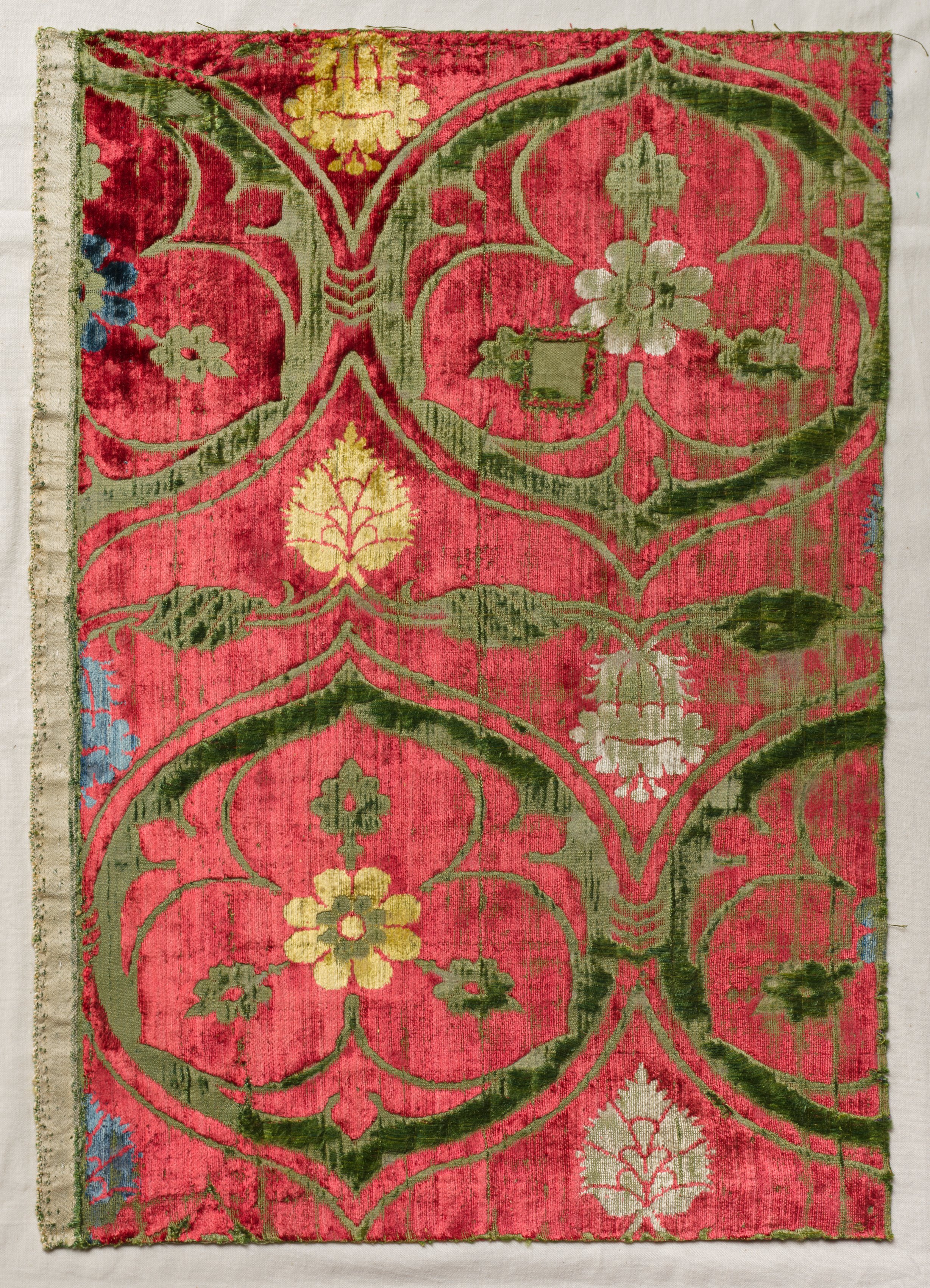
Polychrome Velvet: A Historical Blueprint for Avant-Garde Expression
At Zoey Fashion Lab, our mandate extends beyond the mere construction of garments; we are engaged in the systematic deconstruction of textile history to unearth the genetic codes that define luxury, structure, and narrative. Our latest subject of study, a fragment of Polychrome Velvet from early 15th-century Italy, presents a fascinating paradox. While its physical origin lies in the opulent courts of the Renaissance, its structural DNA—specifically the interplay of cut and voided weave—bears a striking resemblance to the conceptual framework of a modern DNA strand. This analysis deconstructs the technical mastery of this historical artifact and reinterprets its core principles through an avant-garde lens, proposing a new taxonomy for contemporary textile design.
Technical Deconstruction: The Weave as a Genetic Sequence
The term "Polychrome Velvet" refers to a luxurious textile characterized by a multi-hued surface, achieved not through printing, but through the meticulous manipulation of silk threads during the weaving process. The technical foundation of this piece lies in its complex structure, specifically the combination of cut and voided velvet techniques. In a cut velvet, loops of silk pile are sliced open post-weave, creating a dense, plush surface that reflects light with a deep, saturated intensity. Conversely, a voided velvet features areas where the pile is completely absent, leaving only the ground weave exposed. This creates a deliberate contrast in texture and height between the lustrous pile and the flat, often contrasting, foundation.
This binary system of raised and recessed surfaces is not merely decorative; it is a structural language. The pattern—often featuring pomegranates, thistles, or intricate geometric motifs—is literally built into the fabric's architecture. The silk threads, dyed in vibrant crimsons, deep blues, and burnished golds, act as individual nucleotides. The sequence of cut (raised) and voided (recessed) sections forms a repeating, codified pattern. This is where the analogy to a DNA strand becomes potent. The double helix is defined by the pairing of bases; similarly, the polychrome velvet is defined by the pairing of cut and void, of pile and ground. The pattern is not a surface application; it is the very essence of the fabric's being, a sequence of instructions that dictates its physical form.
The "New DNA Strand" Paradigm
In our lab, we refer to this structural logic as the "New DNA Strand." For centuries, textile design has treated the surface as a canvas. The avant-garde perspective, however, treats the fabric as a biological entity. The 15th-century velvet is not a canvas; it is a living system. The cut and voided weave operates as a genetic sequence, where the "expression" of the thread (its height, its color, its density) is determined by the "code" of the weave structure. This is a fundamental shift in perception. We are not looking at a pattern; we are reading a sequence of genetic instructions that have been dormant for six centuries.
By re-framing this historical technique as a "New DNA Strand," we can extract its core principles for avant-garde application. The first principle is Structural Color. The vibrancy of the polychrome effect is not solely due to the dyes but to the interaction of light with the three-dimensional pile. The cut threads create micro-shadows and highlights, making the color appear to shift and breathe. An avant-garde application would eschew traditional dyeing in favor of using structural geometry to generate color. Think of nano-fibers or optical filaments woven into a cut and voided structure, where the "color" is a product of light refraction and interference, not pigment.
Avant-Garde Applications: From Artifact to Algorithm
The second principle we extract is the concept of Negative Space as Narrative. In the 15th-century piece, the voided areas are not empty; they are integral to the story. They define the positive space of the cut pile, creating a rhythmic punctuation. In contemporary avant-garde design, this translates to a focus on absence. Garments would be constructed not by adding fabric, but by strategically removing it. The voided areas could be engineered to reveal the skin, a secondary textile, or even a digital display, turning the garment into a layered, interactive narrative.
Our lab has developed a prototype collection based on this principle. We utilize a high-speed, robotic Jacquard loom capable of executing complex cut and voided structures with synthetic silk and conductive threads. The "pattern" is no longer a floral motif but a data visualization. For instance, a garment might feature a cut velvet representation of a heartbeat, with the voided areas marking the pauses between beats. The fabric becomes a living record, a wearable biography. The "polychrome" aspect is achieved through thermochromic threads that change color in response to the wearer's body heat, creating a dynamic, personalized palette that echoes the historical richness of the original while being entirely futuristic.
Deconstructing the Silhouette
The third principle is Deconstruction of the Silhouette. The historical velvet was used to create voluminous, structured garments—gowns and doublets that asserted power through their sheer mass. The avant-garde interpretation must subvert this. By using the cut and voided structure as a rigid yet flexible "exoskeleton," we can create garments that hold their own shape without internal boning or padding. The density of the cut pile provides structure, while the voided areas allow for articulation and movement. This results in silhouettes that are simultaneously sculptural and fluid, appearing to be both ancient armor and futuristic biomechanical skin.
Furthermore, the concept of "voiding" extends to the garment's physical borders. Instead of a clean hem, the fabric can be engineered to "fray" in a controlled manner, with the voided areas dissolving into a fringe of individual silk threads. This creates a sense of entropy, a visual representation of the DNA strand unzipping. It challenges the notion of a finished garment, proposing instead a piece that is in a constant state of becoming, a textile that is perpetually deconstructing and reconstructing itself.
Conclusion: The Eternal Code of Luxury
The Polychrome Velvet of early 15th-century Italy is far more than a relic; it is a masterclass in material intelligence. Its technical complexity—the seamless integration of cut and voided silk—provides a blueprint for innovation that transcends its historical context. By viewing this weave through the paradigm of the "New DNA Strand," Zoey Fashion Lab repositions the past not as a source of nostalgia, but as a launchpad for radical experimentation. We are not copying the pomegranate motifs; we are copying the logic that created them. We are decoding the structural language of luxury and re-encoding it for the future. The result is an avant-garde aesthetic that is deeply rooted in history, yet utterly untethered from its constraints. The fabric is no longer a material; it is an algorithm, a code, a living, breathing entity that carries the memory of Renaissance opulence into the uncharted territory of tomorrow's fashion. The thread is the same, but the story is entirely new.