Deconstructing the Halberd: A Materialist Reading for Avant-Garde Application
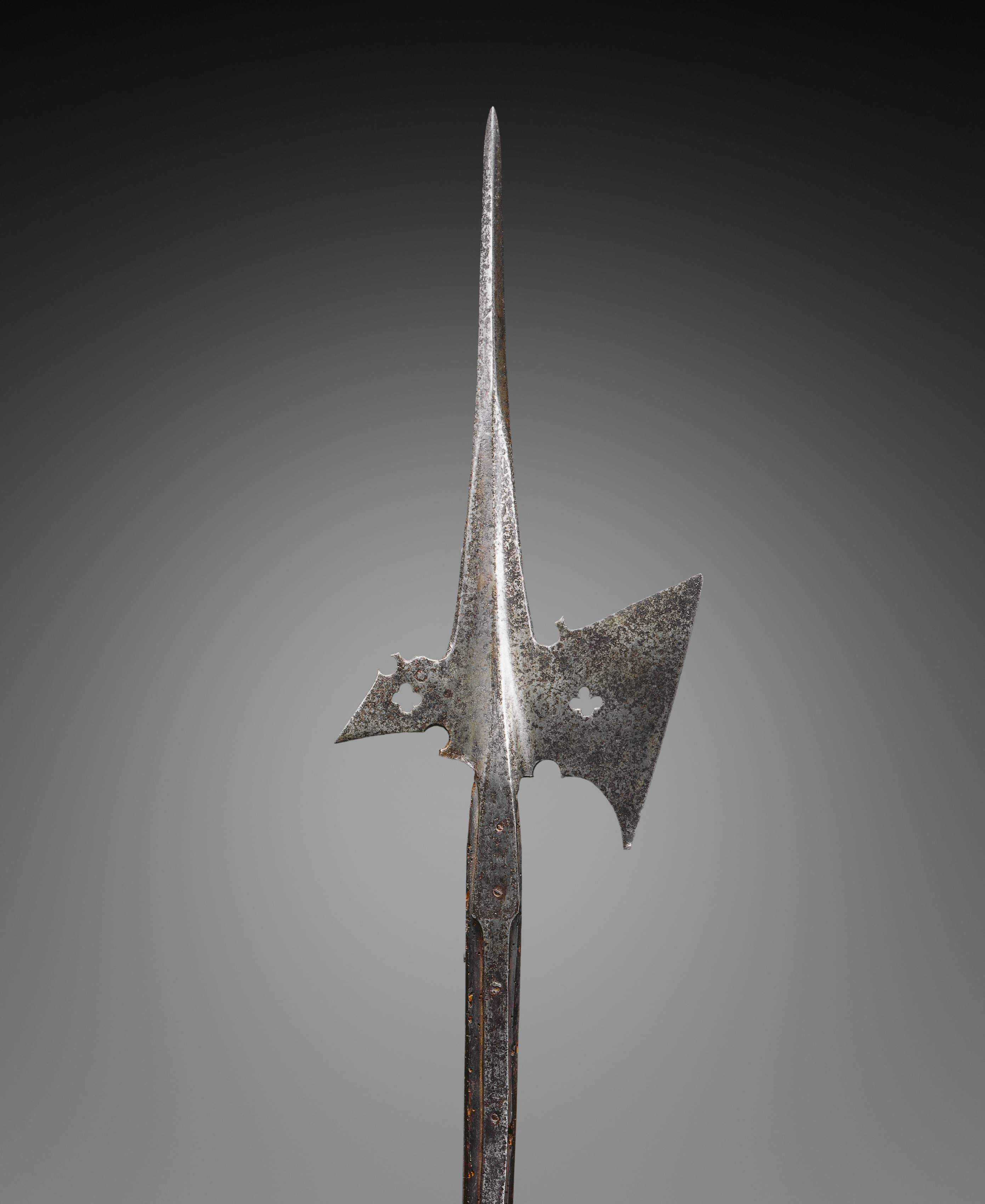
At Zoey Fashion Lab, we do not merely observe historical artifacts; we interrogate their material logic, extracting structural principles that can be re-sequenced into contemporary textile and garment systems. The halberd, a weapon of medieval infantry, presents a uniquely rich case study. Its presumed German origin, its hybrid construction of pierced steel and a rectangular, corner-planed wooden haft, and its aggressive silhouette offer a compelling blueprint for an avant-garde collection that challenges conventional notions of drape, armor, and wearability. This analysis will dissect the halberd not as a tool of war, but as a proto-fashion object—a complex assembly of tension, negative space, and geometric restraint.
I. Metallurgical Grammar: The Quatrefoil as Structural Void
The halberd’s head is its most articulate component. The steel blade, with its characteristic spike and broad axe edge, is immediately legible as a statement of force. However, the true interest for the fabric deconstructionist lies in the quatrefoil piercing. This is not mere decoration; it is a deliberate act of removing mass to create a structural signature. In fashion terms, this translates directly to the concept of negative space tailoring. We can reimagine this piercing as a laser-cut motif on rigid technical fabrics—think high-density neoprene or bonded leather—where the four-lobed aperture becomes a repeated pattern that allows for ventilation, visual lightness, and a rhythmic interruption of the garment’s surface.
Furthermore, the quatrefoil’s geometry is inherently architectural. It suggests a gothic window, a sacred geometry that contrasts sharply with the weapon’s brutal purpose. This dichotomy—the sacred and the martial—is a powerful avant-garde trope. In our collection, we will translate this by juxtaposing the piercing with asymmetrical closures and sharp, angular shoulder pads that mimic the halberd’s blade profile. The steel’s cold, reflective quality will be echoed in the use of metallic-coated yarns, liquid satins, or even micro-sequined panels that catch light and fragment the silhouette, creating a sense of living metal.
The materiality of the steel itself—its weight, its resistance, its unforgiving nature—is another critical point. In fabric, we must simulate this with dense, structured weaves. A double-faced wool or a heavy jacquard with a metallic weft can provide the necessary body. The key is to avoid softness. Every seam must be crisp, every edge raw or heat-sealed to prevent fraying, echoing the forged, unyielding nature of the original blade. The garment should feel like a second skin of armor, but one that is paradoxically flexible enough for movement.
II. The Haft’s Logic: Rectangularity and Planed Corners
Moving down from the head, we encounter the haft. The specification of a rectangular section with planed corners is a crucial detail. This is not a simple cylindrical pole. The rectangular form provides a grip that is directional—it tells the hand exactly how to hold it, preventing rotation. The planed corners soften the sharp edges, making the grip less punishing over time. This is a masterclass in ergonomic geometry, a principle often ignored in avant-garde fashion, which tends to prioritize silhouette over function.
In our deconstruction, this translates to a new pattern-cutting methodology. Instead of curved, flowing panels, we will employ angular, faceted cuts. Think of sleeves that are not set in a traditional armhole but are constructed as a series of rectangular panels that fold around the arm, creating a faceted, almost origami-like structure. The planed corners become mitred seams or beveled edges within the garment. This can be achieved through complex interfacing and internal boning that maintains the rectangular cross-section at the shoulder or hip, while the interior remains comfortable.
The wood’s grain is also a source of inspiration. Wood is a natural, organic material, in stark opposition to the forged steel. This duality—organic rigidity versus metallic aggression—will be expressed through fabric choice. We will pair a smooth, polished technical fabric (representing the steel) with a ribbed, corded, or even woven raffia texture (representing the wood). The haft’s length suggests a vertical, elongating line. In garment construction, this will manifest as elongated tunics, columnar dresses, and high-waisted, straight-leg trousers that create a continuous, unbroken vertical axis from shoulder to floor, mimicking the weapon’s imposing height.
III. The “New DNA Strand” Reference: A Genetic Mutation of Form
The reference to a “New DNA Strand” is not a biological metaphor; it is a systemic design principle. A DNA strand is a double helix—two interlocking, repeating sequences that twist around a central axis. For the halberd, we can identify two primary sequences: the piercing motif (the quatrefoil) and the angular profile (the blade and haft). The “new DNA” is created when these two sequences are forced to interlock and repeat in unexpected ways.
Concretely, this means developing a signature print and a signature texture that are derived from the halberd’s geometry but are not literal representations. A print could feature a distorted, elongated quatrefoil that spirals around the body, echoing the helical twist of DNA. Simultaneously, a structural element—a zipper, a seam, a pleat—would follow a similar spiral path, creating a three-dimensional helix in the garment’s construction. This is a mutation of the original halberd’s static form into a dynamic, kinetic one.
This DNA reference also suggests modularity. A strand is composed of individual nucleotides. We can apply this by designing a capsule collection of modular components—detachable collars, cuffs, and panels—that can be recombined in multiple ways. Each component would feature either the piercing motif or the angular profile, allowing the wearer to “re-sequence” their garment, much like editing genetic code. This creates a wardrobe that is not fixed but evolutionary.
IV. Avant-Garde Synthesis: From Weapon to Wearable
The final synthesis is not about creating a costume. It is about translating the gestalt of the halberd—its aggression, its geometry, its material tension—into a wearable proposition that challenges the wearer and the observer. The avant-garde aspect lies in the refusal to compromise. We will not soften the lines. We will not add excessive comfort padding. The garments will be demanding, requiring a certain posture and attitude, just as the halberd required a trained soldier.
The color palette will be austere: gunmetal grey, oiled black, raw umber, and bone white. These are the colors of steel, aged wood, and worn leather. There will be no prints that are pictorial; all surface interest will come from texture, weave, and the interplay of light on faceted surfaces. The overall effect is one of disciplined power—a fashion that is both a shield and a statement. For Zoey Fashion Lab, this halberd analysis is not an exercise in historical recreation but a foundational text for a new collection that proposes that true innovation in fashion comes from a deep, material understanding of objects outside its own domain. The halberd, a relic of violence, becomes a blueprint for a new form of sartorial strength.