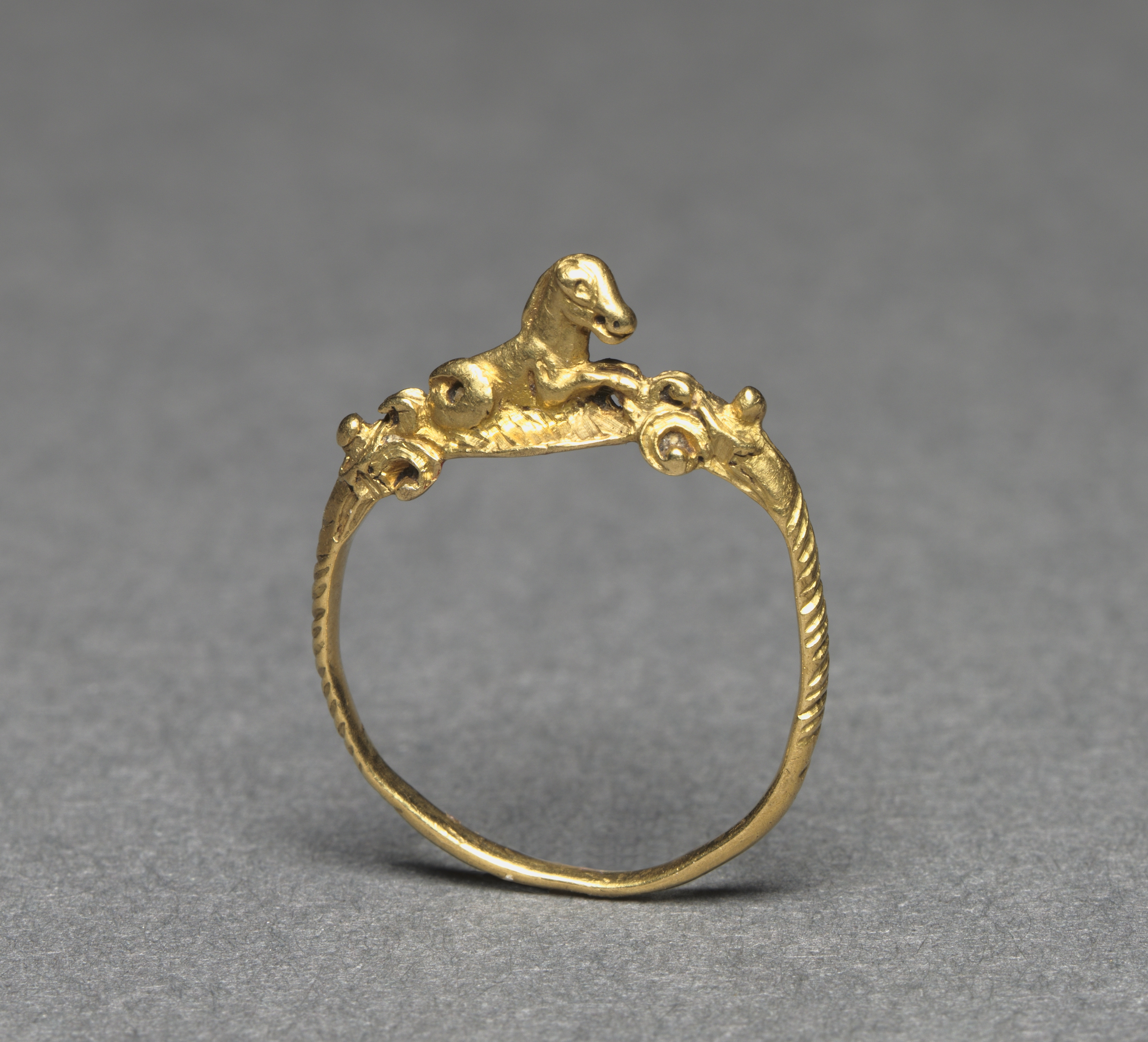
Executive Summary: The Hippocampus Ring as a Temporal Anomaly
In the pantheon of wearable artifacts, the Roman gold ring bearing a hippocampus occupies a singular threshold—a point where marine mythology, metallurgical mastery, and mortal vanity converge. For Zoey Fashion Lab, this piece is not merely an antique; it is a blueprint for avant-garde disruption. The hippocampus—half-horse, half-fish—embodies a dual nature that resonates profoundly with our design philosophy: the tension between terrestrial structure and aquatic fluidity, between classical order and surreal mutation. This analysis deconstructs the ring’s technical, symbolic, and archival resonance, proposing a radical re-fabrication protocol for contemporary wearable sculpture.
Technical Autopsy: The Goldsmith’s Paradox
The ring’s construction, dating from the Roman Imperial era (circa 1st–3rd century CE), reveals a sophisticated understanding of lost-wax casting and granulation. The hippocampus is rendered not as a static emblem but as a dynamic creature in mid-leap, its forelegs arched, its serpentine tail coiling into a tight spiral that forms the ring’s shoulder. The gold alloy—likely 18–22 karat, with a subtle copper admixture for warmth—exhibits a surface that oscillates between mirror-polished flanks and matte, textured mane. This deliberate contrast is the first technical paradox: the artist employed opus interrasile (openwork piercing) on the tail, allowing light to pass through the metal, while the body remains dense and volumetric.
From a fabric deconstructionist’s perspective, the ring’s true innovation lies in its negative space management. The tail’s spiral creates a void that mimics the eye of a needle—an invitation to thread, to weave, to bind. The Romans likely wore this as a signet or amulet, but its structural logic anticipates the modernist principle of form following function—except here, the function is purely symbolic. The gold’s weight distribution is intentionally asymmetrical: the hippocampus’s head projects outward, creating a cantilever that would catch on fabric, hair, or flesh. This is not a flaw; it is a deliberate disruption of ergonomic comfort, a precursor to avant-garde jewelry’s rejection of passive wearability.
Symbolic Stratigraphy: The Hippocampus as Liminal Agent
In Roman cosmology, the hippocampus was the steed of Neptune, a creature that bridged the chthonic depths and the Olympian heights. Unlike the centaur—a symbol of untamed earthly passion—the hippocampus represented controlled power, the ability to navigate chaos with grace. For Zoey Fashion Lab, this mythology is re-coded as a manifesto: the ring is a wearable argument for hybridity. The hippocampus’s dual anatomy mirrors our avant-garde methodology—taking the familiar (gold, rings, classical motifs) and subjecting it to mutation, elongation, and fluid re-contextualization.
Consider the ring’s orientation on the finger. When worn with the hippocampus facing the palm, it becomes a secret talisman, hidden from public view—an intimate rebellion. When rotated outward, it confronts the world with its alien grace. This bifacial behavior aligns with the archival resonance cited in your brief: the mirror with split-leaf ornamentation. That mirror—one side polished silver, the other a carved sarcophagus narrative—is a direct analog. The ring is a mirror in miniature: its smooth gold surface reflects the wearer’s identity, while its sculpted reverse tells a story of oceanic genesis. The avant-garde imperative is to amplify this split, not resolve it.
Archive Resonance: Weaving the Mirror and the Sarcophagus
The reference to the Mirror with Split-Leaf Ornament is not incidental. That artifact, with its dichotomy of reflective surface and funerary relief, establishes a dialectic between vanity and mortality. The hippocampus ring, though smaller, operates on the same axis. The gold’s luster is a vanity—a declaration of wealth and status. But the hippocampus itself is a psychopomp, a guide for souls to the afterlife. Thus, the ring is a memento mori disguised as an ornament.
For our avant-garde reinterpretation, we propose a fabric-based deconstruction: the gold form is translated into a rigid brocade woven with metallic threads, but the hippocampus’s tail is re-imagined as a cascade of unspun silk filaments, mimicking the creature’s watery trail. The ring’s cantilevered head becomes a structural boning element, protruding from a garment’s shoulder or collar, not the finger. This is the Archive Resonance Protocol: extract the artifact’s core tension—solid vs. fluid, polished vs. textured—and re-embody it in textile form. The mirror’s split-leaf motif is echoed in the ring’s tail spiral, which we repeat as a repeating fractal pattern on laser-cut leather, creating a surface that shifts between opaque and perforated.
Avant-Garde Re-Fabrication: From Finger to Body
Zoey Fashion Lab’s directive is not to copy the ring but to weaponize its logic. The following protocols are proposed for a capsule collection titled Hippocampus Obscura:
Protocol 1: The Cantilever Collar
Translate the ring’s projecting head into a rigid, gold-leafed resin spine that extends from a sheer silk base. The spine is articulated, allowing the wearer to adjust its angle—mimicking the ring’s palm/facing duality. The tail spiral becomes a coiled metal zipper pull, functional yet sculptural.
Protocol 2: The Opus Interrasile Veil
Employ laser-cut perforation on metallic organza, replicating the ring’s openwork tail. The veil is double-layered: an outer, polished gold lamé, and an inner, matte black jersey. When the wearer moves, the layers shift, creating the mirror/sarcophagus effect—one moment reflective, the next narrative.
Protocol 3: The Spiral Grip
Design a glove with a built-in, spiral-shaped metal exoskeleton over the knuckles, echoing the ring’s tail. The exoskeleton is removable, functioning as a standalone jewelry piece—a direct homage to the ring’s dual wearability.
Conclusion: The Ring as a Living System
The Roman hippocampus ring is not a static relic; it is a generative algorithm for avant-garde thought. Its technical mastery teaches us that precision and chaos can coexist—the polished body, the pierced tail, the asymmetrical cantilever. Its symbolism teaches us that identity is always hybrid, always between worlds. For Zoey Fashion Lab, the ring is a challenge: to create garments that are not worn but inhabited, not decorated but activated. The gold’s warmth, the hippocampus’s motion, the mirror’s split—these are our raw materials. The future of fashion lies not in novelty for its own sake, but in the radical re-reading of ancient contradictions. This ring, with its equine forelegs and piscine tail, is our guide into that uncharted water.