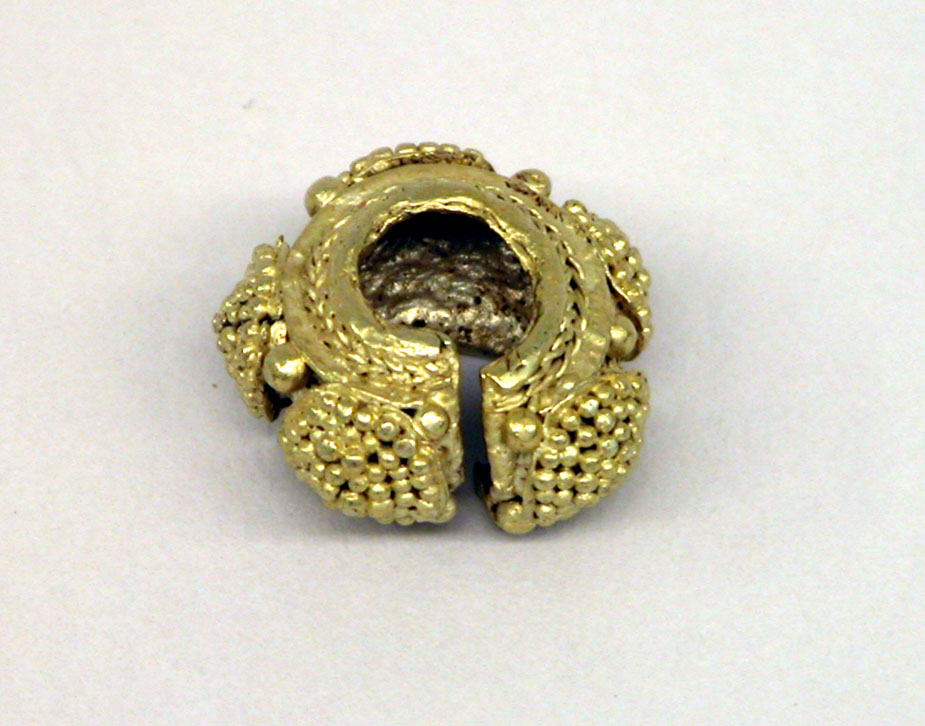
The Auricular Architecture: Recontextualizing the Javanese Gold Ear Ornament as a Blueprint for SS26
The contemporary fashion landscape is perpetually oscillating between the archaeological and the prophetic. In the hallowed archives of Zoey Fashion Laboratory, we do not merely study artifacts; we dissect their latent futurity. The subject of this definitive analysis—a Javanese gold ear ornament from the Indonesian archipelago—is not a relic of stasis but a manifesto of kinetic potential. When juxtaposed against our archive node, the *Mirror with Split-Leaf Palm*, a profound dialectic emerges: one surface reflects the ornate, gilded chaos of nature; the other, the stark, carved narrative of mortality on a cold stone sarcophagus. This ear ornament, suspended between these two existential poles, offers a radical blueprint for SS26, one that redefines the silhouette of the head and the very concept of wearable architecture.
Deconstructing the Golden Relic: Beyond Adornment
At first glance, the Javanese ear ornament is a testament to classical opulence—a heavy, intricate mass of gold designed to drape, pull, and elongate the earlobe. In traditional context, it signifies status, spiritual protection, and a connection to the divine. However, for the avant-garde eye, this object is a structural problem waiting to be solved. We must strip it of its anthropological sentimentality and view it purely as a load-bearing element for the human form. The ornament’s weight is not a liability; it is a deliberate gravitational anchor. It forces the wearer into a specific posture, a tilt of the head that becomes a silent language.
This is the genesis of our SS26 proposition: the ear as a foundation, not a periphery. For too long, fashion has treated the ear as a mere canvas for studs and drops. The Javanese piece, with its substantial presence and intricate filigree, suggests a more aggressive occupation of space. It transforms the side of the face into a topographical map of ridges and valleys. The gold, in its malleable yet rigid finality, becomes a form of exoskeletal jewelry—a metallic extension of the cartilage itself.
The Split-Leaf Dialectic: Light, Shadow, and the Narrative of Decay
The correlation with the *Mirror with Split-Leaf Palm* is not accidental; it is essential. The mirror’s surface is a pristine, polished plane—a symbol of immediate, superficial reflection. The gold leaf overlay is a frantic, organic scrawl of palm fronds, suggesting growth, fertility, and the uncontrollable sprawl of life. Conversely, the sarcophagus relief is a controlled, deliberate carving—a story of death, legacy, and permanence etched into stone.
Our SS26 ear ornament collection, titled “Auricular Decay,” synthesizes these opposing forces. We are not crafting jewelry; we are forging wearable reliquaries that house the tension between the fleeting and the eternal. The gold is manipulated to mimic the split-leaf palm—sharp, jagged, and asymmetrical—yet it is mounted on a base that evokes the cold, geometric precision of the sarcophagus lid. The result is a silhouette that appears to be simultaneously growing and fossilizing. The ear is no longer a passive receiver of sound; it becomes a narrative device, broadcasting a story of geological time and botanical urgency.
Structural Innovation: The Cartilage Cage and the Floating Filigree
The technical execution of this vision requires a departure from conventional jewelry engineering. We propose two distinct, yet interrelated, structural innovations for SS26.
Innovation One: The Cartilage Cage
Traditional earrings rely on the piercing as the sole point of suspension. This limits scale and encourages a downward, pendulous motion. For SS26, we introduce the Cartilage Cage—a rigid, gold framework that extends from the lobe, wrapping around the helix and concha. This is not a clamp; it is an architectural exoskeleton. It distributes the weight across the entire auricular structure, allowing for larger, more sculptural forms without the physiological strain of elongation. The cage is designed to be visible from the front, creating a striking profile that frames the cheekbone and jawline. This is the futuristic silhouette: the head becomes a sculpture plinth, with the ear as its central, defiant column.
Innovation Two: The Floating Filigree
Drawing from the mirror's split-leaf motif, we employ a technique we call Floating Filigree. This involves crafting the gold into ultra-thin, laser-cut panels of palm fronds that are then suspended via micro-articulated joints from the Cartilage Cage. These panels are not static; they possess a micro-movement that responds to the wearer’s breath and gait. This creates a dynamic interplay of light and shadow—the "mirror" effect—where the gold flashes and recedes against the skin. Yet, the articulation is dampened, weighted to evoke the solemn, deliberate motion of a sarcophagus relief. The jewelry does not jingle; it *sways* with a heavy, intentional grace. This is the synthesis of the archive node: the frantic energy of the palm, calcified into a slow, inevitable dance.
Silhouette and the Re-Definition of Space
The impact of these innovations on the SS26 silhouette is profound. We are moving away from the minimalist, skin-baring aesthetics of recent seasons and towards a maximalist, architectural occupation of negative space. The ear ornament is no longer an accessory; it is the primary garment of the head. It dictates the hairline, influences the neckline, and commands the viewer’s gaze to the lateral plane of the face.
Imagine a high-collared, stark white technical jersey gown, devoid of any other ornamentation. The entire narrative is carried by the Javanese-inspired gold cage that engulfs the ear and sweeps back towards the occipital bone. The silhouette is severe, almost alien, yet inherently regal. The wearer is transformed into a contemporary deity, a figure from a future archeological dig, adorned with the sacred metal of a forgotten civilization. The gold is not shiny; it is brushed, oxidized, and treated to have a matte, ancient finish—a nod to the sarcophagus. It absorbs light rather than reflecting it, creating a matte void against the skin.
Conclusion: The Ear as the Final Frontier
In conclusion, the Javanese gold ear ornament, when viewed through the deconstructive lens of Zoey Fashion Laboratory, is not an artifact of the past but a prototype for the future. It is a testament to the fact that true innovation lies in the radical reinterpretation of historical form. For SS26, we are not merely designing jewelry; we are engineering new anatomies. We are proposing that the ear, long ignored as a structural element, is the final frontier of couture expression.
The collection “Auricular Decay” is a bold statement against the ephemeral. It is a commitment to permanence, weight, and narrative. It challenges the wearer to embody the dialectic of the mirror and the sarcophagus—to be both the vibrant, sprawling palm and the stoic, carved stone. The gold is our medium, but the message is one of structural revolution. We are not decorating the body; we are rebuilding it, one ear at a time, forging a silhouette that is as intellectually rigorous as it is visually stunning. This is not the end of jewelry; it is the beginning of auricular architecture.