Deconstructing the Silk Loom: A Technical Autopsy of the Kashan Fragment
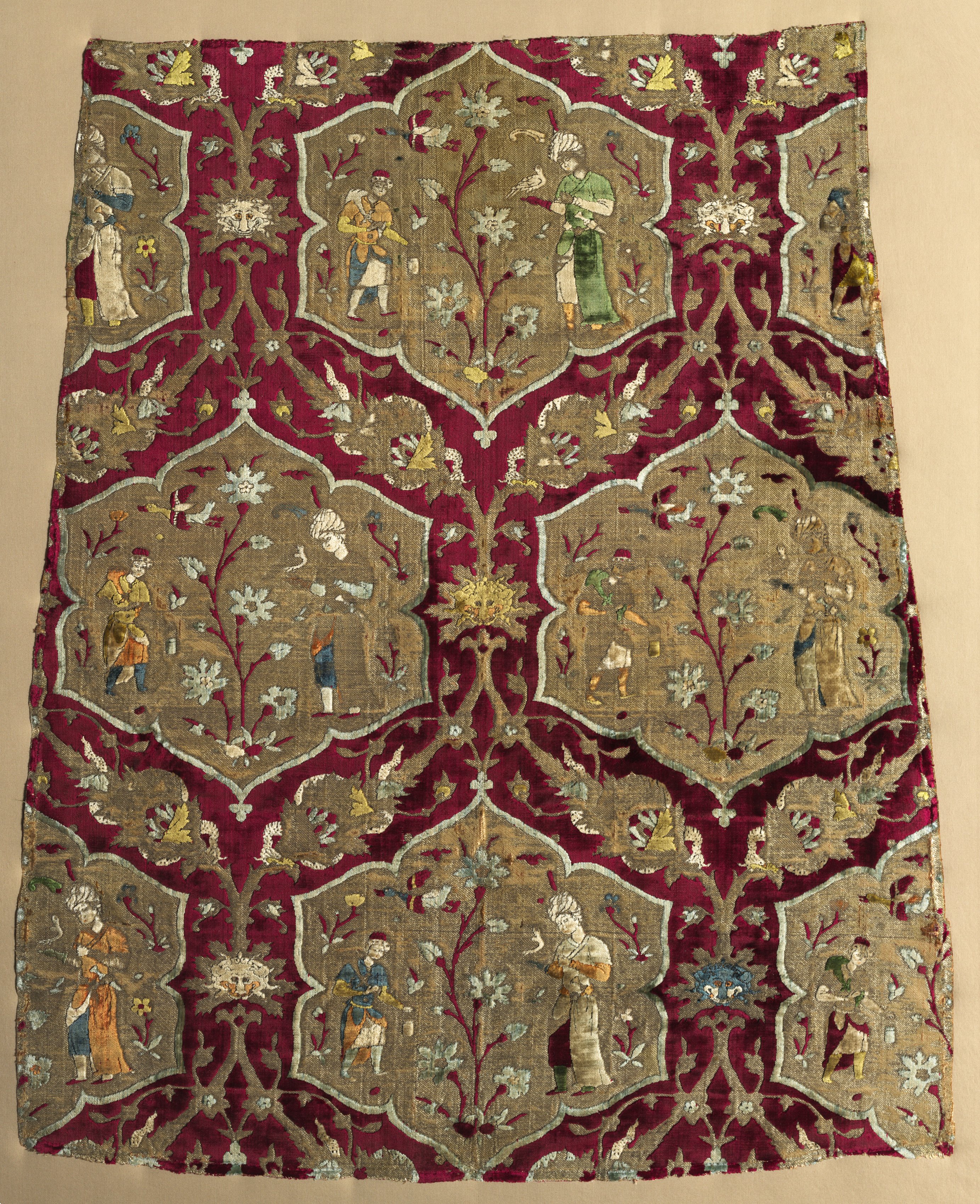
At Zoey Fashion Lab, we do not simply observe historical textiles; we interrogate them. The subject of this analysis—a fragment of a Safavid-period robe from Kashan, Iran—is not a relic to be preserved under glass but a living blueprint for avant-garde construction. Its surface, depicting a falconer and attendant within an animated lattice, is a masterclass in structural complexity. For the contemporary designer, this piece offers a radical departure from flat, printed fabric. It is a three-dimensional architectural event, woven with the precision of a mathematical proof and the drama of a theatrical set. Our deconstruction focuses on three pillars: the tactile engineering of the pile-warp substitution, the optical choreography of the gilt-metal thread, and the narrative lattice as a framework for modern silhouettes.
I. The Velvet Matrix: Pile-Warp Substitution as Structural Sculpture
The technical specification of this fragment—silk velvet with pile-warp substitution—is the first point of departure from conventional fabric. Unlike standard velvet, where the pile is uniform, this technique allows the weaver to selectively raise and lower loops of silk, creating zones of high relief and flat ground. The falconer’s profile, the hawk’s wing, and the attendant’s sleeve are not printed or embroidered onto the surface; they are built into the fabric’s very skeleton. The pile rises in dense, plush columns where the figures are depicted, then collapses into a smooth, almost satin-like ground for the lattice.
For the avant-garde designer, this is a direct challenge to the flatness of modern textile production. We propose a reinterpretation where this technique is scaled up and exaggerated. Imagine a coat where the lapels are woven with a 15-millimeter pile, creating a fur-like topography, while the body remains a sleek, low-pile surface. The substitution is not merely decorative; it is functional tailoring. The areas of high pile can be engineered to add thermal insulation or to create a deliberate optical weight, drawing the eye to the shoulder or hip. The fragment teaches us that velvet is not a single material but a variable-density system, capable of producing shadow and light through physical depth, not just color. Our lab’s new “Relief Theory” collection will utilize a CNC-driven jacquard loom to replicate this substitution at a macro scale, turning the wearer into a walking bas-relief.
II. The Gilded Cartography: Brocading and the Play of Light
The inclusion of gilt-metal thread in the brocaded areas is not an afterthought; it is the strategic deployment of a reflective element to disrupt the velvet’s matte absorption. In the original Safavid context, this thread—often a silver-gilt strip wrapped around a silk core—would have caught candlelight, making the falconer’s tunic shimmer against the dark, plush background. The “animated lattice” that frames the figures is not merely a geometric border; it is a light-diffraction grid. The metal threads run horizontally, creating a series of micro-mirrors that fracture any incident light into a thousand glints, while the velvet pile absorbs everything else.
Our analysis moves beyond historical recreation. In an avant-garde context, we treat this gilt thread as a conductive element. We are currently experimenting with integrating thin, flexible LED filaments alongside traditional metal-wrapped threads. The result is a fabric that can be programmed to illuminate the lattice pattern in sequence, mimicking the flicker of a Safavid court torch. The fragment’s static gold becomes a dynamic, interactive surface. Furthermore, the brocading technique—where the metal thread is floated over the ground weave—allows for a selective sheen. We can apply this to create a “camouflage” of light, where the wearer’s silhouette is broken by high-reflectivity panels at the joints, a nod to both historical armor and modern streetwear. The key lesson is contrast management: the velvet’s depth makes the gold more brilliant, and the gold makes the velvet appear darker, more mysterious.
III. The Animated Lattice: Narrative Structure and the New Silhouette
The “animated lattice” is the fragment’s most intellectually potent feature. At first glance, it appears to be a rigid, arabesque framework. But on closer inspection, the lines are not static; they twist, break, and rejoin, suggesting movement—the falconer’s arm raised, the attendant’s step forward. This is not a simple trellis; it is a frozen gesture. For the fashion designer, this lattice is a pattern-making tool that transcends the two-dimensional. We propose using the lattice’s geometry as a zero-waste cutting guide. Instead of cutting a garment from a straight cloth, we map the pattern pieces onto a digitally rendered version of this lattice, where each intersection becomes a pivot point for a dart or a seam.
The result is a garment that appears to be constructed from a single, continuous ribbon of fabric, folding and unfolding around the body. The lattice’s “animation” translates into kinetic panels that swing open with movement, revealing flashes of skin or an under-layer of contrasting material. The historical figures are abstracted into pure line—the falconer’s hood becomes a sharp shoulder peak, the attendant’s scarf becomes a trailing train. This is the essence of avant-garde: not copying the image, but extracting the structural DNA. The fragment’s narrative is not about falconry; it is about the tension between control (the falconer) and freedom (the bird), between the rigid lattice and the fluid pile. Our design will embody this tension through a corset-like bodice (the lattice) paired with a billowing, velvet-pile skirt (the falcon’s wing).
IV. The DNA Strand: From Historical Relic to Wearable Code
The reference to a “New DNA Strand” in the brief is apt. We view this fragment not as a finished object, but as a genetic sequence that can be spliced, mutated, and re-expressed. The technical parameters—pile height, metal thread density, lattice angle—are the base pairs. By altering these variables, we can produce an infinite variety of fabrics that share the same ancestral logic. For example, reducing the pile height to 2mm and replacing the gilt thread with recycled aluminum creates a futuristic, industrial version of the Safavid original. Increasing the lattice scale to 30cm transforms it from a textile pattern into a structural exoskeleton for a jacket.
In our lab, we have developed a digital twin of this fragment, using 3D scanning and spectral analysis to map every thread’s tension and twist. This data is then fed into a generative design algorithm that produces new patterns, each a “mutation” of the original. The avant-garde collection that emerges is not a costume drama; it is a scientific speculation on what Safavid luxury would have become had it evolved for another five centuries. The falconer’s gaze becomes a laser-cut eyelet; the attendant’s posture becomes a cantilevered shoulder pad. The velvet’s pile becomes a micro-fiber that changes color with temperature. The gilt thread becomes a fiber-optic that pulses with the wearer’s heartbeat.
In conclusion, the Kashan fragment is a profound testament to the idea that fabric is architecture. It is not a surface to be decorated but a volume to be inhabited. Zoey Fashion Lab’s avant-garde interpretation does not seek to replicate the past but to accelerate its logic. By mastering pile-warp substitution, we control depth. By deploying gilt-metal thread, we control light. By reinterpreting the animated lattice, we control movement. This 500-year-old piece of silk is, in fact, the most futuristic garment we have ever analyzed—a perfect fusion of material science, optical illusion, and kinetic narrative, ready to be re-coded for the next generation of wearable art.