Deconstructing the Palimpsest: The Black and White Elbow Gauntlet as Proto-Avant-Garde DNA
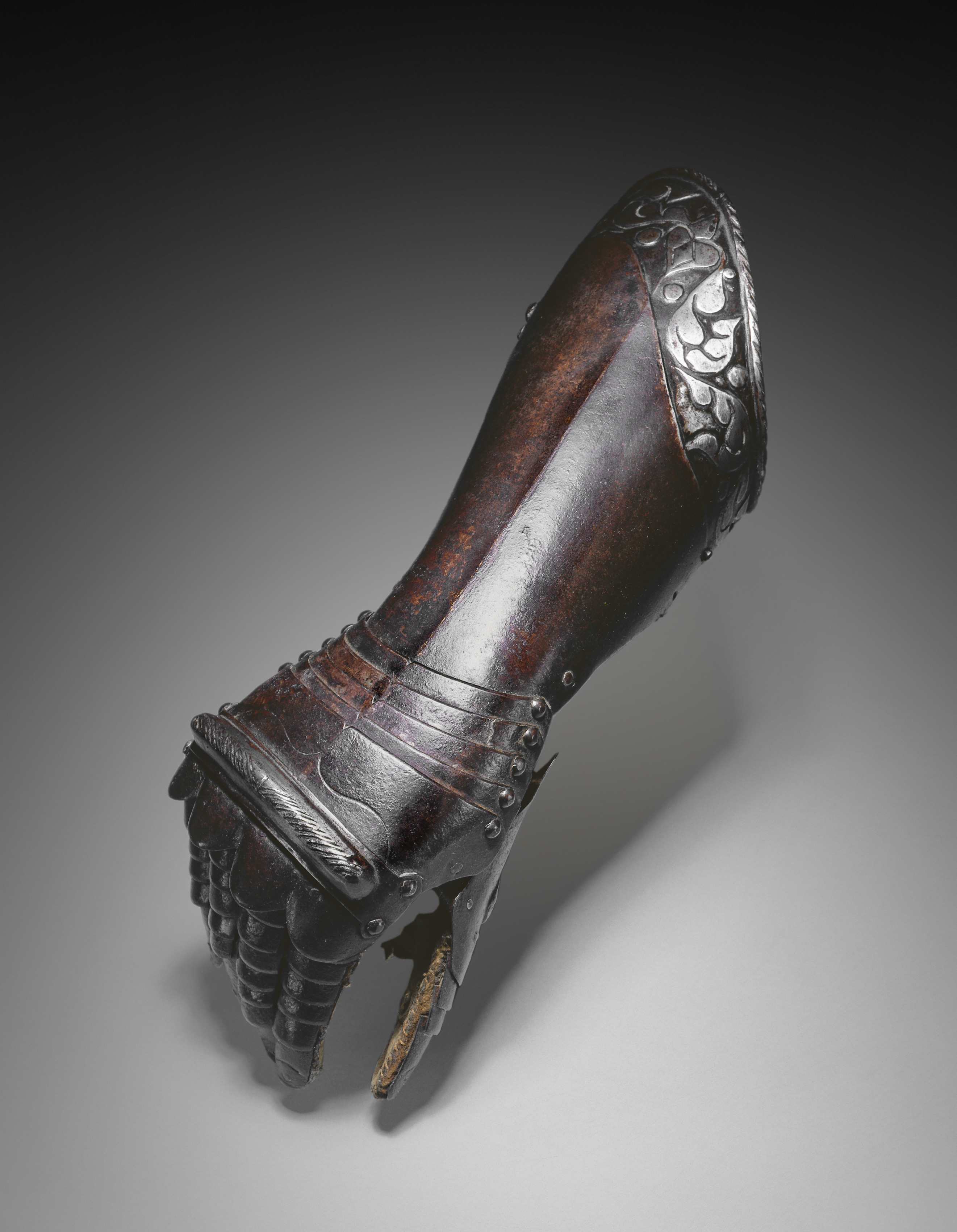
At Zoey Fashion Lab, our mandate is not merely to preserve historical artifacts but to extract their latent design DNA and re-sequence it for contemporary expression. The subject of this analysis—a right-hand elbow gauntlet from 16th-century North Germany, forged in blackened steel and lined with leather—presents a singular opportunity. On the surface, it is a piece of functional armor. Beneath that, it is a complex text of material, silhouette, and cultural memory. When we isolate its "New DNA Strand," we discover a blueprint that resonates profoundly with the principles of avant-garde fashion: asymmetry, brutalist materiality, and the deliberate subversion of the human form. This analysis will deconstruct the gauntlet’s physical and conceptual architecture, proposing a translation from historical martial necessity to contemporary sartorial provocation.
I. Material Dialectics: The Blackened Steel and the Supple Leather
The primary technical dialogue within this artifact is between its two core components: the ferrous shell and the organic interior. The blackened steel is not a passive surface; it is a deliberate act of aesthetic and functional aggression. The blackening process—likely achieved through heat treatment, oil quenching, or a chemical application—served dual purposes. Practically, it inhibited rust and reduced glare on the battlefield. Conceptually, it created a matte, light-absorbing plane that denied the reflective vanity of polished armor. This is a pre-modern gesture of anti-ornamentation, a rejection of chivalric glitter in favor of a grim, utilitarian opacity.
In stark contrast, the leather lining introduces a principle of intimacy. This is the point of contact between the cold metal and the warm, vulnerable flesh of the wearer. The leather absorbs sweat, conforms to the musculature of the forearm, and over decades of use, develops a patina of wear that is unique to its owner. This is a profound sartorial concept: the hard exterior is always contingent upon the soft, unseen interior. For the avant-garde designer, this dialectic is gold. It suggests a garment that is not merely worn but inhabited. The design DNA here is one of dualistic tension—hard/soft, public/private, protective/vulnerable. A contemporary translation might involve a structured, carbon-fiber exoskeleton fused with a bio-molded, recycled silk interior, where the internal layer is deliberately exposed at the seams, creating a visual and tactile rupture.
II. Silhouette and Asymmetry: The Ergonomic Provocation
The gauntlet’s form is dictated by the anatomy of the sword arm, yet its visual outcome is strikingly abstract. The elbow cop—the pronounced, dome-like articulation—is the focal point. It extends laterally, creating a sharp, geometric protrusion that fundamentally alters the wearer’s profile. This is not a passive covering; it is an architectural extension of the body. The piece is also strictly unilateral. It is designed for the right hand only, leaving the left arm unarmored. This asymmetry is not a flaw but a strategic and stylistic declaration. It creates a visual imbalance that draws the eye, suggesting a body that is perpetually in motion, mid-lunge, or prepared for a strike.
From a Zoey Fashion Lab perspective, this is the genesis of the "power asymmetry" trend. The gauntlet’s DNA is not about symmetry or balance; it is about directed force and narrative imbalance. The lines are not soft or flowing; they are hard, angular, and segmented. The overlapping lames (the articulated metal strips) that protect the elbow’s flexion create a rhythmic, ribbed texture that speaks of mechanical precision. This is a precursor to the robotic exoskeletons of sci-fi and the structured shoulders of 1980s power dressing. The avant-garde translation would be a single-sleeve jacket, where one arm is encased in a sculptural, rigid polymer that mimics the elbow cop’s extension, while the other arm is left bare or draped in fluid jersey. The result is a garment that forces the wearer to adopt a new posture, a new attitude—one of latent, kinetic energy.
III. The New DNA Strand: Black and White as Conceptual Spectrum
Our reference to the "New DNA Strand" is a call to extract the core genetic markers of this artifact. The most potent marker is the color palette: black and white. Yet, this is not a simple binary. The black is not a flat black; it is a spectrum of char, soot, and graphite, reflecting light in unpredictable ways. The white is not present in the metal but exists as the conceptual opposite—the glint of a polished edge, the pale flesh of the hand that emerges from the cuff, or the stark white of the leather’s interior stitching. This is a monochromatic system based on light absorption and reflection, not on pigment.
This black-and-white dialectic is a foundational principle of avant-garde fashion, from the stark geometries of Bauhaus to the deconstructed layering of Japanese designers. The gauntlet proves that this aesthetic is not a modern invention but a timeless language of power and control. The DNA strand we extract is composed of three key sequences:
Sequence 1: The Articulated Joint
The overlapping lames are a study in modular construction. They allow for movement while maintaining a continuous surface. This is a lesson in kinetic tailoring. The modern equivalent would be a gown with laser-cut, interlocking panels that expand and contract with the body’s motion, creating a living, breathing sculpture. The blackened finish would be translated into a high-tech, matte technical fabric with a water-repellent, non-reflective coating.
Sequence 2: The Protective Shell
The gauntlet’s primary function is to shield. This protective impulse is translated into a design philosophy of emotional armor. The garment becomes a psychological barrier, a way of presenting an impermeable front to the world. The avant-garde designer can use this by creating pieces that are physically heavy, substantially constructed, and visually imposing. The garment is not just clothing; it is a statement of self-defense against the chaos of the modern world.
Sequence 3: The Unilateral Statement
Finally, the right-hand specificity is the most radical element. It challenges the very notion of a "set." In a world of matching suits and paired gloves, this gauntlet stands alone. This is a call for deliberate incompleteness. The design DNA suggests that a garment need not be a full ensemble to make a complete statement. A single, powerful accessory—a sculptural cuff, a harness, a single exaggerated sleeve—can be more potent than a full look. It is the art of the interruption, the deliberate flaw that makes the entire composition memorable.
IV. Synthesis: From Armor to Avant-Garde
In conclusion, the 16th-century North German elbow gauntlet is not a relic; it is a prophecy. It contains within its blackened steel and worn leather the fundamental tensions that define avant-garde fashion: the conflict between protection and exposure, the power of asymmetry, and the profound depth of a monochromatic palette. At Zoey Fashion Lab, we do not copy this artifact. We re-sequence its DNA. We take the articulation, the brutal materiality, and the unilateral power and inject them into new silhouettes, new textiles, and new contexts.
The result is a garment that is not for the battlefield, but for the modern urban arena—a space that is equally demanding, equally aggressive, and equally in need of a striking, protective, and provocative form of dress. The gauntlet is the original statement piece, and its legacy is the future of fashion.