The Luminal Construct: Deconstructing the Wall Light as Wearable Architecture
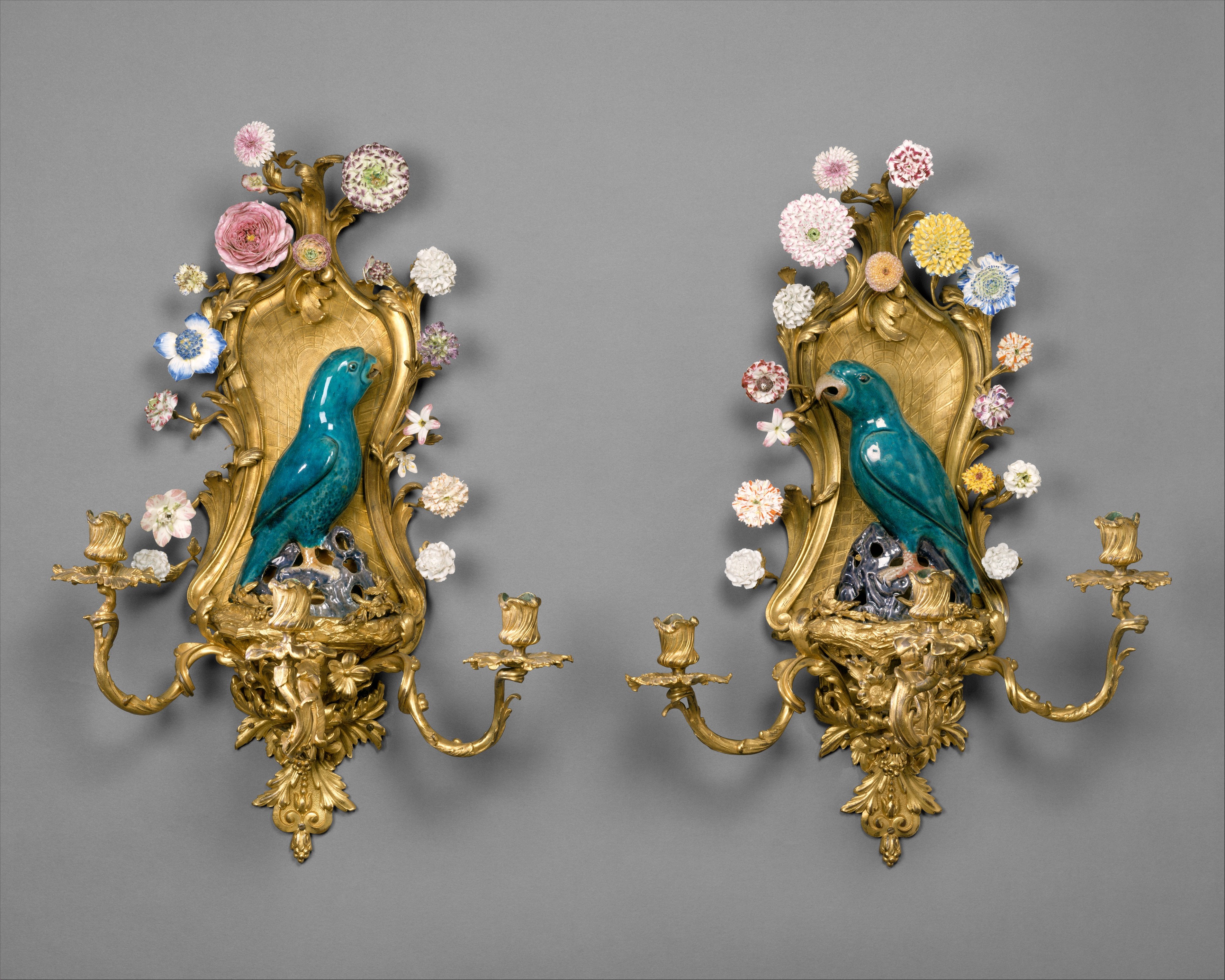
In the rarefied atmosphere of Zoey Fashion Laboratory, we do not observe objects; we interrogate them. The subject of today’s dissection—a singular wall light, one of a pair, hailing from the Global Frontier—is not a mere artifact of decorative arts. It is a proto-garment, a frozen moment of structural rebellion that predates the very concept of deconstruction by three centuries. This piece, a cacophony of glazed biscuit Chinese porcelain parrots from the K’ang Hsi period, soft-paste Vincennes porcelain flowers, 19th-century hard-paste blooms, and gilt-bronze, is a masterclass in temporal collision. For SS26, we are not inspired by this object; we are extracting its latent energy to forge a new silhouette—one that defies gravity, chronology, and the passive relationship between body and environment.
I. The Anatomy of Temporal Dissonance
The wall light’s power lies in its deliberate anachronism. The K’ang Hsi parrots, with their austere, glazed biscuit finish, speak of imperial rigidity and precise ceramic control. They are the structural bones—the stiff, unyielding corsetry of the 17th century. Yet, they are violently juxtaposed with the frivolous, almost saccharine soft-paste Vincennes roses, whose creamy, unglazed surfaces suggest a fragile, ephemeral softness. Then, the 19th-century hard-paste flowers arrive, sharper, more defined, a Victorian interpolation of nature’s chaos. This is not a harmonious composition; it is a curated argument.
For the Zoey Fashion Laboratory SS26 collection, this translates directly into our “Chrono-Suture” technique. We are abandoning seamless garment construction. Instead, we are grafting disparate textile epochs onto a single chassis. Imagine a razor-sharp, architectural shoulder pad constructed from a technical, bio-ceramic mesh—our modern equivalent of the porcelain—sliced open to reveal a cascading interior of recycled silk organza petals, mimicking the soft-paste’s fragility. The garment’s seams are not hidden; they are exposed, gilt-bronze zippers running along the spine like the metalwork of the light’s armature. The silhouette is a hybrid: a rigid, almost armor-like carapace on the left side, dissolving into a fluid, petal-soft drape on the right. This is not a dress; it is a wearable debate between control and abandon.
II. The Gilt-Bronze Skeleton: Exoskeletal Innovation
The gilt-bronze component is the unsung hero of this artifact. It is the connective tissue, the nervous system that allows the porcelain and the flowers to coexist. It is also the key to our “Exo-Frame” silhouette. In traditional couture, structure is hidden within the lining. Here, we invert this logic. The bronze becomes a literal exoskeleton, a visible, load-bearing frame that dictates the wearer’s posture and movement.
For SS26, we are crafting external, articulated joints from brushed aluminum and recycled brass, echoing the gilded scrolls. These are not decorative; they are functional hinges. A jacket sleeve is not sewn to the body; it is attached via a mechanical pivot at the shoulder, allowing for a range of motion that mimics the swiveling arm of the wall light. The result is a futuristic silhouette that is simultaneously robotic and organic. The wearer does not merely put on a garment; they are mounted onto it. The torso is elongated, the neck is freed, and the arms are presented as independent sculptural appendages. This is the “Luminal Limb”—a direct response to the light’s own protruding arm, which thrusts the floral arrangement into space, demanding attention.
III. Chromatic Austerity and the Glazed Surface
Color is not a decorative afterthought; it is a structural material. The K’ang Hsi palette—deep cobalt, celadon green, and stark white—is one of restraint and imperial power. The Vincennes flowers introduce a blush of pink and a buttery yellow, while the gilt-bronze adds a flash of metallic avarice. Our SS26 palette is a study in this “Glazed Contrast”.
We are utilizing a new generation of lacquer-bonded fabrics that mimic the high-shine, vitreous quality of biscuit porcelain. A vinyl-coated cotton twill will be used for tailored trousers, offering a hard, reflective surface that catches light like a ceramic glaze. This will be juxtaposed against matte, unglazed silk crepe—our soft-paste equivalent—which absorbs light and creates a tactile, almost powdery texture. The color blocking will be severe: a full skirt in cobalt blue lacquer, a bodice in raw, undyed silk, and a single, sweeping panel of gold lamé that acts as the gilt-bronze highlight, tracing the body’s diagonal from hip to shoulder. There is no subtlety here; each color is a distinct material stratum, refusing to blend, just as the porcelain refuses to yield to the flower.
IV. The Standalone Study: From Object to Avatar
The context of this analysis is a standalone avant-garde study, which is crucial. We are not designing a collection that merely references a historical style. We are using this wall light as a generative algorithm. The object’s function—to illuminate a room—is sublimated. Its new function is to illuminate the body’s potential as a kinetic sculpture.
Our final proposal is the “Parrot’s Perch” gown. The silhouette is asymmetric: a high, rigid collar that flares outwards like the parrot’s tail, constructed from laser-cut, porcelain-white thermoplastic. The bodice is a complex matrix of exposed seams and bronze-ringed grommets, allowing for ventilation and visual fragmentation. The skirt is a cascade of 3D-printed, petal-like discs, each one hinged to the next, creating a sound like rustling ceramic when the wearer moves. It is heavy, deliberate, and utterly mesmerizing. The wearer becomes a living installation, a human wall light, broadcasting a silent, fierce radiance.
This is the future of couture: not the pursuit of comfort, but the pursuit of architectural truth. By deconstructing the wall light, we have constructed a new paradigm. The body is no longer a passive mannequin; it is the armature. The garment is no longer a covering; it is a light source, projecting the wearer’s identity into the room with the unapologetic force of a gilded bronze sconce. This is not fashion. This is applied philosophy, draped in porcelain, and wired for the future.