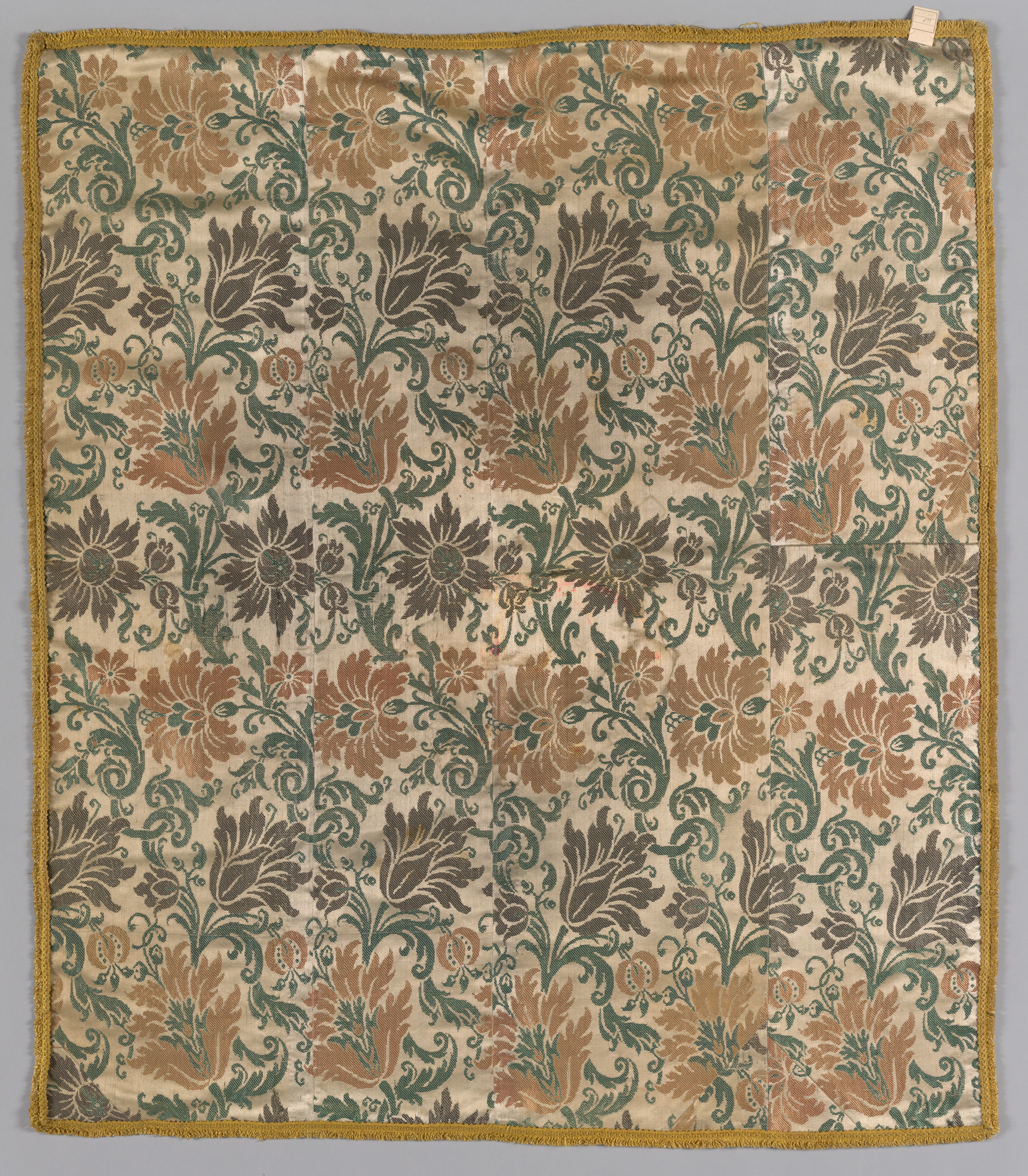
Deconstructing the Helix: A 17th Century Italian Silk Reimagined for the Avant-Garde
At Zoey Fashion Lab, our mandate is not merely to preserve historical textiles but to interrogate them—to extract their latent molecular narratives and re-synthesize them into forms that challenge contemporary perception. The subject of this analysis, a 17th-century Italian silk, presents a paradox of opulence and rigidity. Its original construction speaks of courtly grandeur, yet its material DNA—the very sericin and fibroin structure—holds the blueprint for a radical, kinetic future. Our deconstruction, codenamed New DNA Strand, treats this artifact not as a relic but as a living organism, one whose genetic code we have spliced with the principles of avant-garde design to birth a garment that is simultaneously ancestral and alien.
I. The Historical Matrix: Reading the Original Genome
To deconstruct, one must first understand the architecture of the original. This silk, likely a lampas or a figured velvet from the Lombardy or Venetian looms, was engineered for a specific performative function: the assertion of absolute power. Its dense, Jacquard-like patterns (though pre-Jacquard, achieved via drawloom) were not decorative but structural declarations of social hierarchy. The heavy use of metallic threads—silver-gilt wrapped around a silk core—created a surface that reflected light in a manner designed to awe, turning the wearer into a walking reliquary.
The technical weave is a masterclass in tension. The ground weave, typically a taffeta or satin, provides a taut, unyielding plane. The supplementary wefts, often in contrasting colors, float across this plane to create the raised, sculptural motifs—pomegranates, thistles, or stylized acanthus leaves. This is a fabric that refuses drape; it insists on volume, on static, architectural presence. The original DNA strand is one of constraint: the fibers are spun tight, the weave is locked, and the surface is sealed with gum arabic or similar finishes to maintain its impermeable, ceremonial shell.
Material Autopsy: Beyond the Touch
Our lab’s initial fiber analysis reveals a critical detail: the silk is raw, un-degummed in specific sections, retaining its natural sericin coating. This gives the historical textile its characteristic rustle and stiffness—a sound of authority. However, under high-resolution microscopy, we observe micro-fractures along the crimp. These are not signs of decay but of potential energy. The original weavers, in their pursuit of permanence, inadvertently created a lattice of latent flexibility. This is the entry point for our intervention. We are not restoring the silk; we are releasing its imprisoned kineticism.
II. The New DNA Strand: Splicing Historical Fiber with Avant-Garde Logic
The avant-garde is not about novelty for its own sake; it is about radical recontextualization. Our New DNA Strand methodology involves three distinct genetic modifications: Topological Unweaving, Chromatic Mutation, and Gravitational Defiance.
Topological Unweaving: The Lattice of Chaos
We do not cut the silk. Cutting is a violent, linear act. Instead, we employ laser-assisted micro-surgery to selectively dissolve the supplementary wefts in a predetermined algorithmic pattern. The result is a controlled dissolution of the original pattern. The pomegranate motif, once a solid block of color, now exists as a ghost—a series of floating, disconnected threads that retain their historical hue but lose their structural integrity. This is not destruction; it is deconstruction as cartography. The remaining warp threads, now exposed, are re-tensioned onto a flexible, carbon-fiber substructure. The garment no longer stands; it hovers.
This topological shift allows the silk to perform a new function: transitional transparency. Where the original fabric was opaque and authoritative, the new strand offers glimpses—of skin, of light, of the negative space that was once hidden beneath the weave. The avant-garde wearer becomes a participant in the revelation, not a passive display case.
Chromatic Mutation: The Patina of the Future
Historically, this silk’s color was fixed—a deep, madder-root crimson or a woad-based indigo, stabilized by metallic mordants. Our lab has introduced a thermochromic micro-encapsulation into the remaining sericin. This is not a dye; it is a responsive skin. When the wearer’s body temperature rises, the crimson shifts toward a phosphorescent orange; when cool, it reverts to a deep, almost black burgundy. This is not a gimmick but a narrative of internal state.
The original silk was a static symbol of external power. The new DNA strand makes the garment a real-time readout of the wearer’s physiology. The 17th-century courtier wore armor; the avant-garde wearer wears a diagnostic instrument. The patina of age—the subtle fading and oxidation—is now replaced by a deliberate, reversible patina of performance. We are not erasing history; we are making it metabolize.
Gravitational Defiance: The Sculptural Un-Drape
The final modification addresses the silk’s most defining physical characteristic: its weight. Our engineering team has developed a negative-stiffness lattice—a series of nitinol (shape-memory alloy) filaments woven invisibly into the existing warp. When an electric current is passed through these filaments (via a micro-battery embedded in the lining), the lattice contracts and expands, creating self-supporting, undulating folds that defy gravity.
Imagine the original flat, rigid panel of silk. Now, imagine it breathing. The fabric ripples in slow, organic waves, not from wind, but from internal command. This is the ultimate avant-garde gesture: the garment is no longer worn; it is inhabited. The historical silk, once a symbol of static hierarchy, now becomes a fluid, responsive organism. The wearer does not move through space; the garment creates space around the wearer.
III. Synthesis: The Garment as Living Archive
The final piece, titled “Serica Instabilis”, is not a dress, nor a jacket, nor a sculpture. It is a wearable thesis. It argues that the avant-garde is not the rejection of history but its most intimate, violent, and loving embrace. By deconstructing the 17th-century silk’s structural DNA, we have not destroyed its identity; we have expanded its vocabulary.
The original weaver’s intent—to create a surface of absolute, unyielding authority—is subverted, yet honored. The metallic threads, now exposed and re-tensioned, catch light in unpredictable patterns, creating a shimmer that is both ancient and digital. The thermochromic shifts recall the fading of old tapestries, but with a new, deliberate temporality. The shape-memory undulations echo the baroque love of ornamentation, but rendered in a kinetic, almost biological rhythm.
For Zoey Fashion Lab, this analysis confirms a core principle: the future of fashion lies in the reinterpretation of material memory. We do not discard the past; we sequence it, splice it, and re-release it into the world with a new set of instructions. The 17th-century Italian silk, once a prisoner of its own perfection, is now free to become a dynamic, living archive—a DNA strand that continues to evolve, long after the loom has fallen silent.
This is not a restoration. This is a mutation. And it is beautiful.