Deconstructing the Powder Flask: An Avant-Garde Re-Evaluation of Form and Function
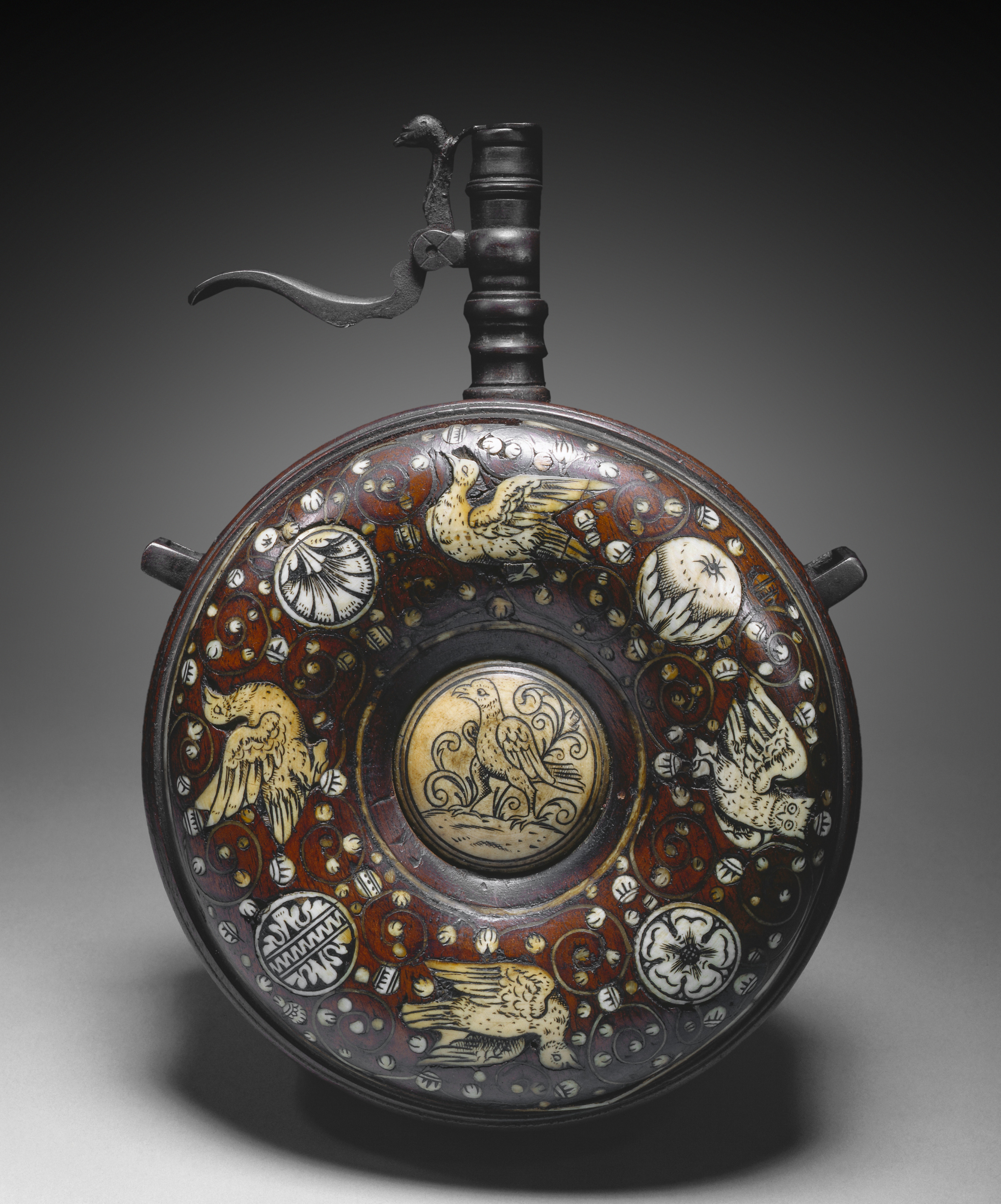
At Zoey Fashion Lab, our mandate extends beyond the mere cataloging of garments and accessories. We engage in a dialectical process with objects, stripping them of their historical context to reveal the raw, structural DNA that can inform future design languages. Today, we turn our analytical lens to a seemingly anachronistic artifact: the German powder flask. Crafted from walnut, inlaid with intricate ivory, and fitted with a turned steel funnel and spring cap, this object—circa the 17th or 18th century—appears to belong to the dusty annals of hunting lore. Yet, upon rigorous deconstruction, we uncover a blueprint for a distinctly avant-garde aesthetic, one that challenges the binary of utility and ornament, and proposes a new paradigm for tactile and visual experience.
I. Material Dialectics: The Organic Versus the Mechanical
The powder flask presents a compelling thesis on material hierarchy. The primary body—a rich, dark walnut—is not merely a container but a sculptural volume. Its organic curves, worn smooth by centuries of handling, speak to a humanistic, almost fleshy tactility. This is the primordial womb of the object, holding the volatile potential of gunpowder. In contrast, the steel funnel and spring cap are the rational, mechanical appendages—precise, cold, and unyielding. For the avant-garde designer, this is not a conflict but a synthesis. The design directive here is to juxtapose biological warmth with industrial precision. We translate this into fabric by pairing heavy, boiled wool or sculpted neoprene (the walnut) with exposed, gunmetal-toned zippers, rigid metallic grommets, and laser-cut acrylic clasps (the steel). The garment becomes a living organism with a mechanical exoskeleton, a nod to cybernetic futurism grounded in historical materiality.
Furthermore, the ivory inlay introduces a third term: the ornamental as structural signifier. The inlay is not applied superficially; it is embedded within the wood, creating a flush, seamless plane. This technique suggests that decoration can be integral to the object’s integrity, not a superficial afterthought. In our collections, we interpret this through intarsia knitting and jacquard weaving, where complex patterns are woven into the fabric’s structure rather than printed on its surface. The design language becomes one of embedded narrative—patterns that emerge from the cloth’s very core, akin to the ivory’s emergence from the walnut. This rejects the flatness of digital printing in favor of a dimensional, haptic ornamentation.
II. Functional Choreography: The Spring Cap and the Ritual of Release
The technical mechanism—the turned steel funnel with its spring cap—is the most avant-garde element of the entire artifact. This is not a passive opening; it is a choreographed interface between user and object. The spring cap requires a deliberate, two-stage action: a downward press and a lateral twist to release the charge. This mechanical ritual transforms a simple act of pouring into a performance. For Zoey Fashion Lab, this informs our approach to adaptive and transformable design. We envision garments with similar “spring-loaded” closures—not merely zippers or buttons, but concealed magnetic toggles that require a specific gesture to activate. A cape that unfurls with a twist of the shoulder clasp; a collar that rises with a press of a hidden lever. The wearer becomes an active participant in the garment’s morphology, and the act of dressing becomes a sequence of deliberate, almost ceremonial movements.
This focus on the mechanism as aesthetic also challenges the contemporary obsession with invisibility in fastenings. The steel funnel is proudly displayed, its turned ridges catching the light. In our avant-garde pieces, we expose the hardware—the ratchets, the pulleys, the articulated joints—as decorative elements. A jacket’s cuff might feature a visible, functional turnbuckle; a skirt’s waistband might use a climbing-carabiner closure. This is a design philosophy of honest engineering, where the means of assembly are celebrated as part of the visual language. It is a direct rebuke to the seamless, minimalist aesthetic that dominates current luxury markets.
III. The “New DNA Strand”: Re-Splicing Historical Codes
The reference to a “New DNA Strand” is critical here. We do not seek to replicate the powder flask; we seek to extract its genetic code—its material logic, its functional choreography, its structural ornament—and re-splice it into a contemporary fashion genome. The flask’s silhouette, a flattened oval, is a study in ergonomic efficiency. It conforms to the palm, suggesting a design ethos of body-centric architecture. Our garments adopt this principle through asymmetrical draping and modular panels that contour to the body’s natural pivots and flexes, rather than imposing a rigid, two-dimensional shape.
The ivory inlay’s patterns, often floral or geometric, are deconstructed into abstract, pixelated motifs. We translate these into high-relief embroidery using metallic threads and recycled glass beads, creating a surface that mimics the tactile contrast between smooth wood and raised ivory. The color palette is drawn directly from the object’s patina: deep espresso browns, bone whites, tarnished silver, and the faint amber of aged resin. This is not a nostalgic palette; it is a muted, futurist palette that grounds the avant-garde in a sense of archaeological weight.
IV. Conclusion: Toward a Tactile Futurism
The German powder flask, viewed through the Zoey Fashion Lab lens, is not a relic but a prophecy. It prophesies a fashion that is simultaneously robust and delicate, mechanical and organic, functional and ornamental. It demands a return to craft-based innovation, where the maker’s hand and the engineer’s precision are not oppositional forces but collaborative partners. The avant-garde, in our interpretation, is not about shock for its own sake, but about the radical recontextualization of the familiar. By deconstructing this historical object, we have unearthed a design DNA that prioritizes haptic experience, kinetic interaction, and structural honesty. This is the future we are building: a wardrobe of sculptural, interactive pieces that honor the past not through imitation, but through a profound, material re-imagining. The powder flask has been emptied of its gunpowder; we now refill it with the volatile energy of new form.