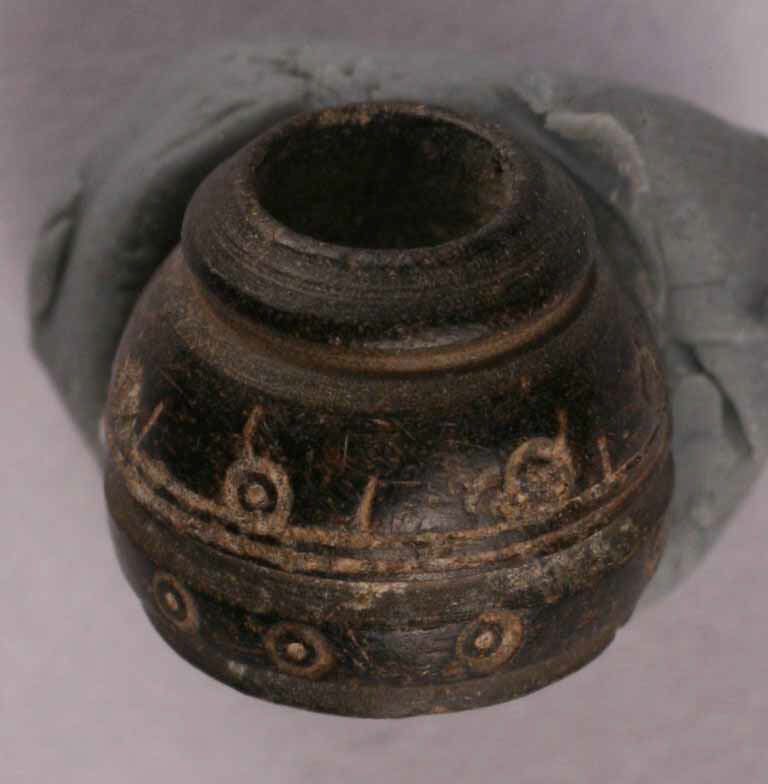
Deconstructing the Primordial Code: Spindle Whorl as Avant-Garde Genesis
The artifact designated Spindle Whorl—a stone disc, carved and incised, retrieved from the conceptual Global Frontier—is not merely an inspiration. It is a primordial algorithm. For Zoey Fashion Laboratory’s SS26, it serves as the core data-set from which we derive a new language of form. This analysis posits the whorl not as a relic of textile production, but as the archetypal symbol of rotational energy, encoded memory, and centrifugal force. Our couture interrogation extracts its embedded principles: axial rotation, stratified density, and ritual incision, transmuting them into a manifesto on structural innovation and the future silhouette.
Axial Architecture: The Silhouette in Torque
The primary function of the spindle whorl is to sustain and regulate spin. SS26 translates this kinetic principle into “torque-based silhouettes.” Garments are engineered to appear as if captured in a moment of dynamic rotation around the body’s axis. This is achieved through asymmetric spiraling cuts that originate at a single, off-center point—often the clavicle, hip, or scapula—and unravel around the form. Imagine a tailored wool jacket whose single lapel extends, twisting into a coiled skirt structure, or a dress whose seam lines are not vertical but helical, creating a visual vortex that draws the eye in a continuous, gravitational orbit around the wearer.
This challenges the static frontality of traditional couture. The silhouette is no longer a mere profile; it is a four-dimensional proposition, suggesting movement even in stillness. Fabrics are key collaborators. We employ memory-tech felts that hold engineered curves, laminated silks with variable rigidity, and spiral-cut jerseys that bias and twist according to the body’s own topography. The body becomes the spindle, the garment the whorl-induced spin, a literal embodiment of potential energy.
Stratified Density & Lithic Layering
Stone, as material origin, dictates a philosophy of mass and void, weight and erosion. The whorl’s carved nature suggests subtraction, a reduction to essential form. SS26 explores this through lithic layering—a technique where garments are constructed from superimposed, irregular planes resembling geological strata. A coat is not a unified shell but an assemblage of stone-wool panels, sliced and stacked with deliberate, raw-edged offsets, creating deep, shadow-harboring fissures across the torso.
This approach redefines volume. It is not inflated or padded, but built through accumulation and erosion. We create “negative peplums”—where material is carved away from the hip to reveal a structured underlayer—and “sedimentary skirts” with laser-sintered polymer "fossils" embedded between sheer and opaque textile layers. The color palette emerges directly from this mineral logic: basalt black, chalk white, ochre, and striated grey, punctuated by the sudden crystalline flash of quartz-like beading or mica-infused coatings. The wearer becomes a walking geology, a testament to time and pressure.
The Incised Narrative: Data-Scarification and Linear Code
The incised patterns on the whorl are its most potent cipher. These are not decorative motifs but functional grooves for thread tension, a proto-binary code for binding. In our SS26 lexicon, incision becomes “data-scarification.” Seams are exaggerated into deep, topographic trenches, often left raw or bound with contrasting, high-tensile technical cords. Laser-cut perforations trace algorithmic paths across leather and neoprene, mapping not floral patterns but schematics for imaginary circuitry or sound waves from forgotten chants.
This narrative of incision extends to construction itself. We pioneer a technique of “structural scarification,” where garments are partially deconstructed to reveal their functional armature. Boning is exposed not as failure but as exoskeletal tribute, etched with coordinates from the Global Frontier. Seam allowances, typically hidden, are turned outward and meticulously finished, becoming a raised, linear landscape on the garment’s surface. It is a celebration of the blueprint, making the process of creation the primary ornament.
Conclusion: The Autonomous Garment-Object
The Spindle Whorl Collection for SS26 culminates in the concept of the autonomous garment-object. These are not clothes designed solely for the human form; they are architectural propositions that engage the body as a symbiotic partner. A jacket can stand away from the shoulders via internal armatures of carbon fiber, creating a dynamic, personal space. A skirt’s hemline is dictated by the mathematical progression of the golden ratio, not by knee or calf.
This is standalone avant-garde study in its purest form. By deconstructing the whorl’s ancient logic—its spin, its stone, its scars—Zoey Fashion Laboratory engineers a future where couture is a medium for philosophical and spatial inquiry. The collection does not reference the past; it recompiles its embedded data for a future syntax. The result is a powerful, silent dialogue between primordial tool and futuristic silhouette, where every seam, plane, and incision is a deliberate step in the continuous, spinning evolution of form.