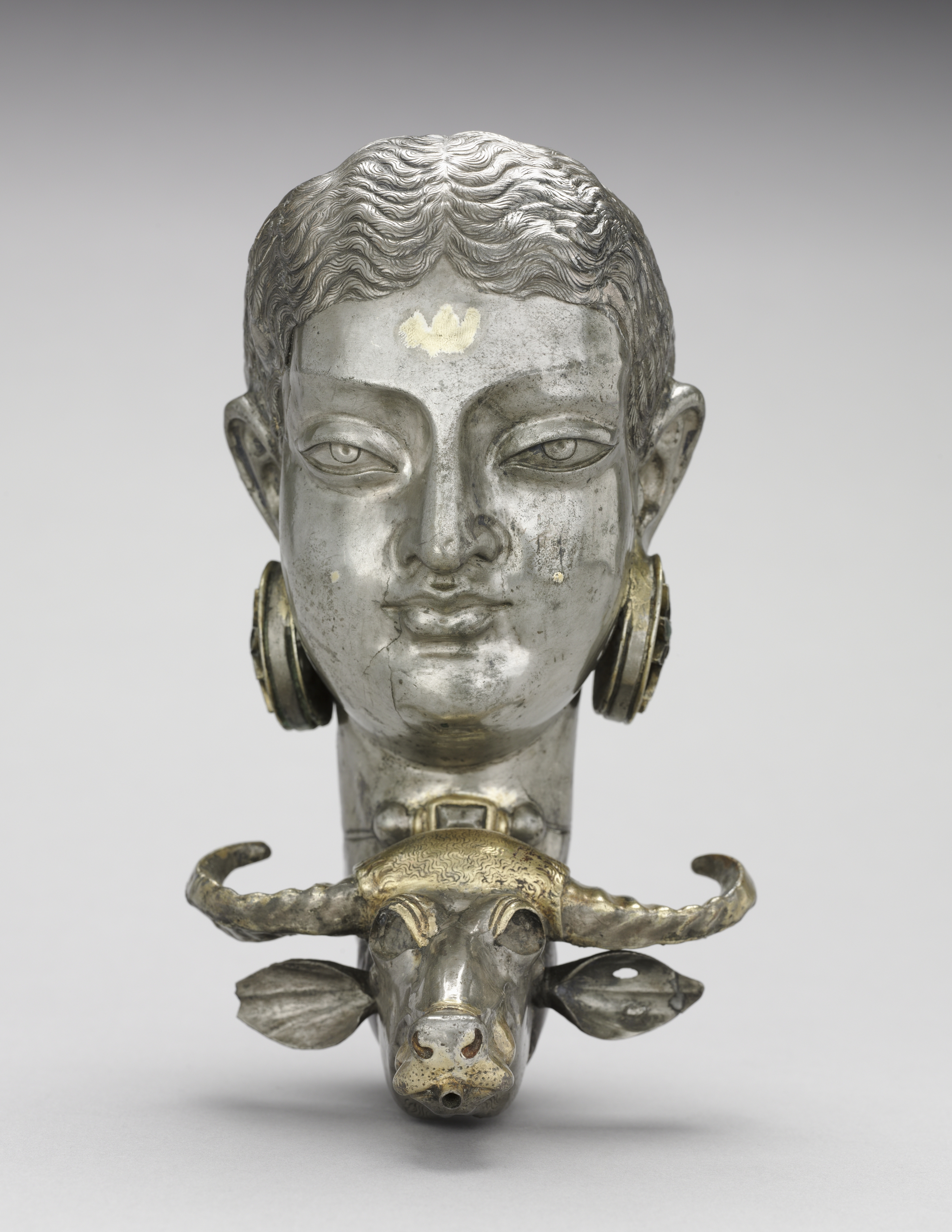
Deconstructing the Rhyton: A Study in Material Duality and Temporal Collision
At Zoey Fashion Lab, we do not merely observe artifacts; we interrogate them. We strip them of their museum placards and their climate-controlled reverence to expose the raw, often contradictory, dialogues embedded within their very molecules. The Woman and Water Buffalo Rhyton, a silver-gilt vessel from the Sasanian or Turk Shahi dynasties, is not a relic of a bygone era. It is a blueprint for a new aesthetic—a manifesto of Avant-garde design that thrives on the tension between polished surface and brutal form, between golden opulence and earthy mortality.
Our analysis begins not with the object’s function, but with its fundamental schizophrenia. The provided reference—a mirror with split-leaf palmette scrolls on one side and a funerary relief on the other—serves as the perfect conceptual key. The Rhyton is this mirror, forged in three dimensions. It is a vessel that holds liquid, yet its form is a narrative of confrontation. This is the essence of our deconstruction: the Rhyton is not a singular object but a collision of two opposing visual philosophies.
The Polished Facade: Gilded Opulence as a Mask
Let us first dissect the surface. The silver body, treated with mercury gilding, presents a facade of blinding radiance. The gilding is not a mere coating; it is a deliberate act of alchemy, transforming a cool, lunar metal into a solar, imperial statement. In the Sasanian court, such gilding was a signifier of royal power, a way to capture light and project authority. The glass inlays—likely set into the eyes of the woman or the buffalo’s harness—would have caught the flickering torchlight of a palace hall, creating points of intense, jewel-like focus.
This is the “Mirror” aspect of the object: a pristine, reflective surface designed to dazzle and distract. The intricate patterns—perhaps the split-leaf palmette motifs hinted at in the reference—would have been chased into the metal with painstaking precision. This is the language of control, of courtly refinement, of a civilization that mastered the art of the beautiful lie. In an Avant-garde context, we recognize this as the “Brand Surface”—the curated Instagram feed, the flawless runway look, the seductive veneer of luxury that conceals the messy, chaotic process of creation.
Yet, for the Avant-garde, the surface is never the truth. It is the starting point for subversion. The gilding is not seamless perfection; it is a skin stretched taut over a more primitive, more violent core. The very technique of mercury gilding—a process involving toxic fumes and intense heat—speaks to a violent transformation. The beauty is born of danger. This is our first deconstructive thread: the luxurious surface is a fragile membrane, and the Rhyton’s true power lies in what it threatens to reveal beneath.
The Brutal Form: Earthly Narrative and Structural Tension
Now, we turn to the form itself. The Rhyton is not a delicate vase or a symmetrical amphora. It is a composite beast—a woman fused with a water buffalo. This is the “Stone Slab” narrative, the funerary relief that speaks of life, death, and the raw forces of nature. The woman is not a passive ornament; she is in a dynamic, almost agonistic, relationship with the animal. Is she controlling it? Is she merging with it? Or is she being consumed by it?
The water buffalo is a potent symbol of the ancient world. It represents the untamed, the chthonic, the life-giving yet destructive power of water and mud. It is the beast of burden that sustains agriculture, yet it is also the creature that can gore and trample. The woman, rendered in silver, is the human intellect, the civilizing force, attempting to harness this power. The Rhyton’s structure—with the woman’s torso forming the upper vessel and the buffalo’s body forming the spout—creates a literal flow from the human to the animal. The liquid poured from the vessel passes through the woman and exits the buffalo’s mouth. It is a symbolic transfusion: the civilized pouring itself into the primal.
This is where the Avant-garde finds its most potent material. The Rhyton is not a harmonious composition; it is a study in awkwardness. The join between the human and animal bodies is not seamless; it is a point of anatomical distortion, a surrealist junction. The proportions are deliberately off. The woman’s head may be too large for the buffalo’s body, or the buffalo’s legs are too short, creating a sense of unease and instability. This is not a failure of artistry; it is a deliberate aesthetic choice. It is the “Anti-Vitruvian” ideal—a rejection of classical proportion in favor of expressive distortion.
Cultural Hybridity and the Avant-Garde Aesthetic
The Rhyton’s contested origin—Sasanian Iran or Turk Shahi Kabul—is not a historical inconvenience; it is its greatest asset. This ambiguity is the very definition of the Avant-garde. It refuses to be categorized. It is neither purely Persian nor purely Central Asian. It is a hybrid, a product of the Silk Road’s cultural cross-pollination. The Sasanian love for silver and gilding meets the nomadic, steppe-derived energy of the Turk Shahi.
This cultural fluidity translates directly into a design language. The Rhyton is a “Global Object” in the most radical sense. It is not a tourist souvenir; it is a statement of identity that is fluid, negotiated, and complex. For the modern fashion house, this is a critical lesson. We cannot afford to be defined by a single national aesthetic. We must be fluent in multiple visual dialects, synthesizing them into something that is entirely new and unsettling. The Rhyton is a masterclass in this synthesis. It takes the zoomorphic forms of steppe art, the courtly refinement of Sasanian metalwork, and the symbolic weight of Near Eastern mythology, and fuses them into a single, coherent, and deeply strange object.
Conclusion: The Rhyton as a Wearable Concept
For Zoey Fashion Lab, the Woman and Water Buffalo Rhyton is more than an artifact; it is a design thesis. It teaches us that true luxury is not about comfort or ease. It is about tension. It is about the friction between the polished and the raw, the civilized and the primal.
Our next collection will not feature a literal reproduction of the Rhyton. Instead, we will translate its core principles. We will use high-shine, liquid-metal fabrics that mimic the gilded silver, but we will cut them in asymmetric, distorted silhouettes that echo the Rhyton’s anatomical unease. We will incorporate structural elements that resemble the join between woman and beast—heavy, sculptural shoulder pieces that seem to grow organically from the body. We will use color palettes of oxidized silver, deep bronze, and the dark, wet earth of the riverbank. The glass inlays will become our crystal embellishments, but they will be set in raw, unpolished settings, like shards of glass pressed into metal.
The Rhyton is a call to arms against the tyranny of the beautiful. It is a reminder that the most compelling art is born from conflict, not harmony. It is the “Mirror with Split-Leaf” held up to the fashion industry, showing us that our reflection must be fractured, complex, and utterly fearless. We will not pour wine from it; we will pour ideas. And they will be sharp, dangerous, and unforgettable.