Deconstructing the Imperial Canopy: The Royal Round Tent as Proto-Existentialist Architecture
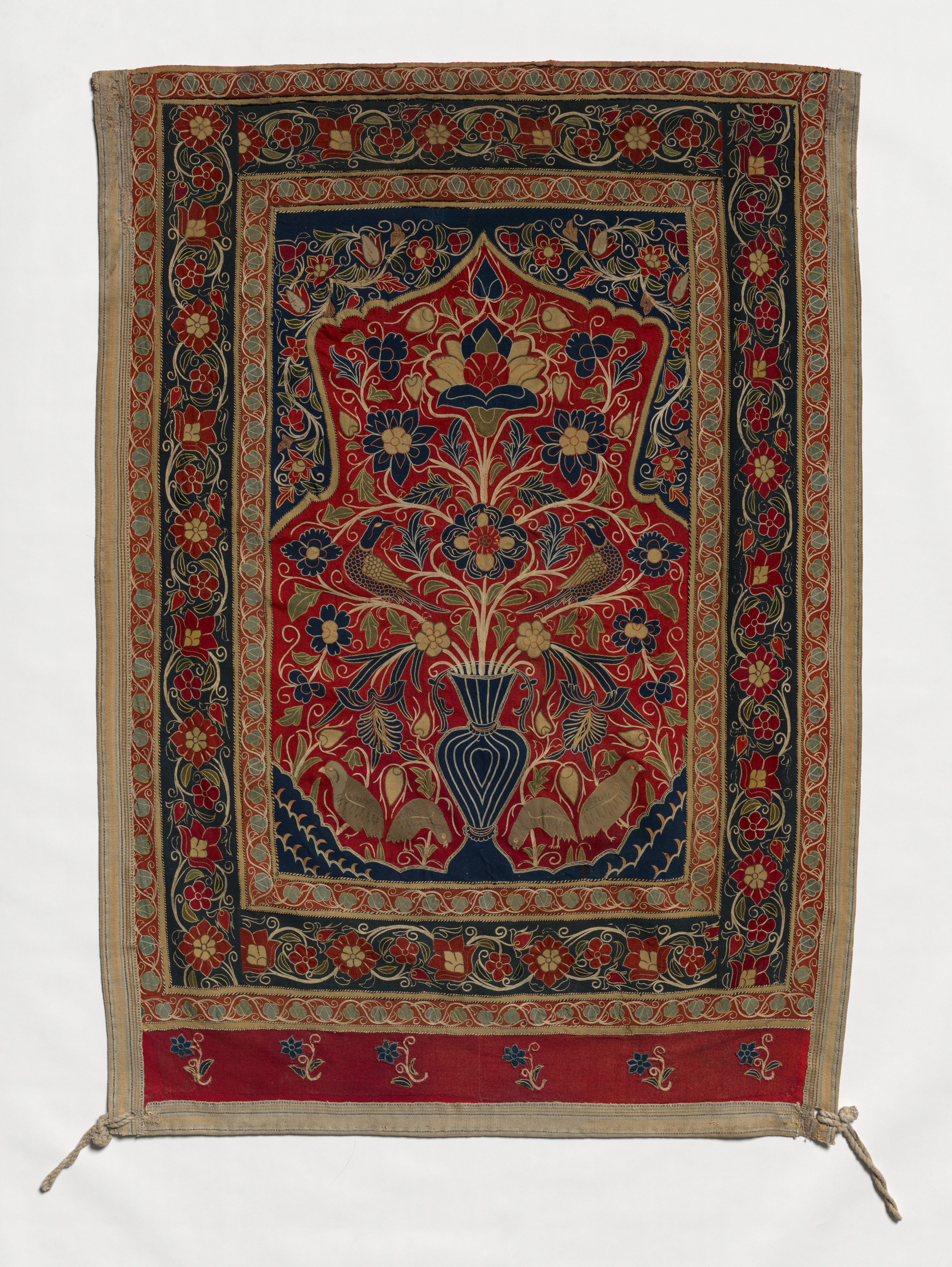
In the annals of textile history, the Royal Round Tent made for Muhammad Shah, hailing from Rasht during Iran’s Qajar period (1779-1925), is typically relegated to the category of "decorative arts." Zoey Fashion Lab rejects this taxonomy. We perceive this object not as a mere shelter or an artifact of courtly opulence, but as a proto-existentialist architecture—a mobile, wearable universe that prefigures the avant-garde’s obsession with the dissolution of boundaries between body, space, and identity. This wall panel, a single design unit from a larger ceremonial structure, is a radical manifesto woven in wool and silk, a testament to the Qajar court’s sophisticated understanding of power as a function of spatial manipulation.
Material Dialectics: The Grammar of Nomadic Sovereignty
The technical specification of this tent reveals a deliberate clash of material grammars. The interior, a sanctuary of wool plain weave with intricate inlaid work, speaks to a tactile, haptic intimacy. This is the language of the nomadic tent, the yurt, the portable palace of the steppe. Yet, superimposed upon this rugged foundation is an explosion of silk embroidery in chain stitch—a technique that is inherently fluid, sinuous, and almost calligraphic. The chain stitch is not a static application; it is a kinetic line, a drawn thread that mimics the movement of a pen across a manuscript. This juxtaposition is not accidental. It is a dialectical synthesis: the earthy, grounded wool (the terrestrial) is subjugated and elevated by the luminous, aristocratic silk (the celestial).
Furthermore, the inclusion of tape and leather as structural elements, alongside the exterior’s robust cotton-wool plain weave, reinforced by rope and an iron ring, introduces a brutalist, utilitarian counterpoint. The iron ring is the architectural keystone, the point of convergence that bears the tensile load. In our avant-garde reading, this ring is not merely a hardware fitting; it is the symbolic omphalos, the navel of the world, around which the entire political and cosmic order revolves. The tent, therefore, is not a passive enclosure. It is a tensile structure—a system of forces held in dynamic equilibrium, mirroring the delicate balance of power in the Qajar court.
Avant-Garde Resonance: The Tent as a Wearable Performance
For Zoey Fashion Lab, the most provocative aspect of this artifact is its function as a pre-cinematic, immersive environment. The wall panel presented to us is not the whole tent, but a "design unit"—a fragment, a synecdoche. This fragmentation is profoundly modern. It aligns with the avant-garde’s fascination with the détournement, the act of isolating a signifier from its original context to create new meaning. By isolating this single panel, we are invited to deconstruct the entire architectural proposition. We see the tent as a garment for a collective body, a membrane that defines the court’s social skin. The emperor, seated at the center, is not merely inside the tent; he is the heart of the textile organism. The walls are his epidermis, the embroidered patterns his circulatory system, the iron ring his crown.
This concept pre-empts the radical experiments of 1960s and 70s fashion, such as the work of Pierre Cardin or Walter Van Beirendonck, who treated clothing as miniature architecture. However, the Qajar tent operates on a more monumental scale. It is architecture as couture. The chain-stitched silk patterns, likely depicting floral motifs or hunting scenes, are not merely decorative. They are narrative projections that transform the interior into a storyboard. The ruler is not just sitting in a room; he is sitting inside a myth, surrounded by the visual rhetoric of his own legitimacy. The tent is a totalizing environment, a precursor to the Gesamtkunstwerk (total work of art) that Wagner would champion in the West a century later.
Chromatic Absence and the Politics of Light
While we lack specific color analysis, the mention of "inlaid work" suggests a complex interplay of negative and positive space. In the avant-garde context, we interpret this as a study in chromatic absence. The wool's natural, undyed tones perhaps provided a muted, earthen ground, against which the silk embroidery would have exploded with jewel-toned intensity—lapis blues, emerald greens, and madder reds. This contrast is a chiaroscuro of texture and hue. The interior would have been a dark, womb-like space, lit by oil lamps or filtered sunlight. The light would catch the raised chain stitches, making them shimmer and dance, creating a living, breathing mural. This is not passive decoration; it is kinetic light art, an early form of projection mapping using thread as the pixel.
The exterior, conversely, with its robust cotton and wool, would have been a more austere, monochromatic mass—a fortress of fabric against the elements. This duality—the opulent, colorful interior versus the stark, functional exterior—is a profound metaphor for the Qajar political psyche. It is a theater of public restraint and private excess. The tent is a machine for producing the emperor's aura. From the outside, it is a mountain. From the inside, it is a universe. This dichotomy is the essence of avant-garde design: the deliberate manipulation of perception to create a psychological effect.
Conclusion: The Tent as a Temporal Anomaly
In conclusion, the Royal Round Tent of Muhammad Shah is not a relic of a bygone era. It is a temporal anomaly, a blueprint for immersive, experiential design that resonates with contemporary practice. The "Archive Resonance" referenced in the provenance—a term suggesting a vibration or echo across time—is precisely what we must harness. This object challenges the contemporary fashion designer to think beyond the garment. It demands we consider the environmental, political, and psychological impact of our creations.
Zoey Fashion Lab proposes a radical reinterpretation: to view this tent as a wearable architecture for the psyche. The iron ring is the collar; the walls are the train of a ceremonial gown; the embroidery is the digital print of a future collection. By deconstructing this Qajar masterpiece, we do not seek to replicate its form, but to extract its algorithmic principles: the tension between material and ornament, the interplay of public and private, and the use of textile as a tool for political and metaphysical storytelling. This tent is not a wall panel; it is a portal. And we intend to walk through it.