The Fragment as Future: Deconstructing the Imperial Headdress for SS26
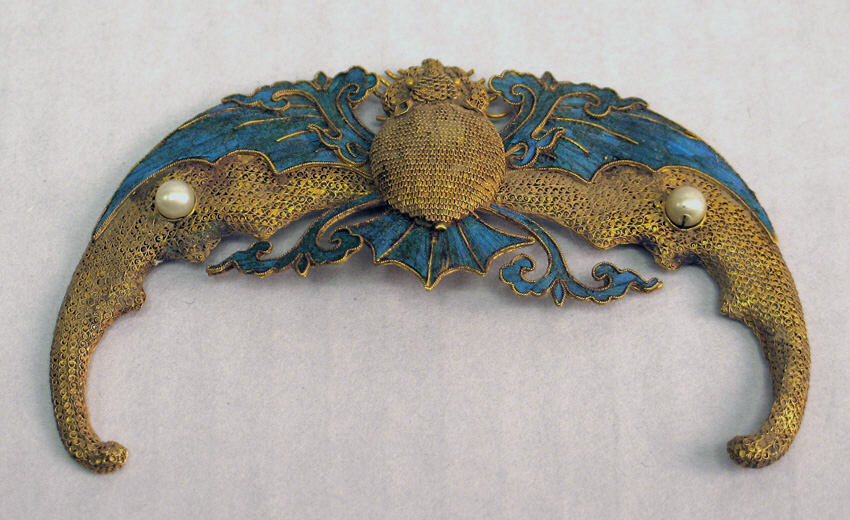
The avant-garde imperative is not to create new objects, but to extract new realities from extant ones. Within the hallowed confines of Zoey Fashion Laboratory, we do not merely observe artifacts; we interrogate them, dismantle their historical gravity, and reassemble their atomic truths into prophecies of silhouette. The subject of this definitive study—a Fragment of Headdress, hailing from the opulent dynasties of China, composed of gold, feathers, and pearls—presents a paradox of material permanence and structural ephemerality. For Spring/Summer 2026, this relic is not a nostalgic nod to imperial grandeur. It is a blueprint for a post-humanist architecture of adornment, a testament to how a severed piece of ceremonial weight can birth a new language of weightlessness and kinetic futurism.
I. Deconstructive Archaeology: Reading the Fragment's Intrinsic Geometry
To approach this fragment is to abandon the holistic gaze. We do not see a crown, a phoenix cap, or a ceremonial tiara. We see a catastrophic interruption of symmetry—a jagged edge where gold filigree once met its counterpart, a plume of feathers arrested in mid-flight, a constellation of pearls whose linear trajectory is violently truncated. This is the essence of deconstructive aesthetics: the fragment is not a ruin but a state of becoming. The gold base, likely hammered to a paper-thin resilience, offers a rigid yet yielding substructure. Its color is not merely yellow; it is a spectral luminance, a solar energy that the SS26 palette must absorb and refract. The feathers, perhaps kingfisher or egret, introduce a chaotic, organic vector, while the pearls—spheres of calcified time—provide points of tactile punctuation. In the Laboratory, we identify this as a tri-material tensile system: metallic compression, organic expansion, and mineral density. The future of couture lies not in singular fabrics but in the orchestrated friction between such disparate physical states.
The Silhouette of the Severed Crown
From this analysis, we derive the Asymmetric Cranial Scaffold. The SS26 silhouette will not rest upon the head; it will orbit it. Imagine a carbon-fiber exoskeleton that mimics the fragment's broken base, cantilevered to project forward, creating a deep shadow over the brow. This is not a hat. It is a piece of wearable architecture that defines negative space as aggressively as positive form. The gold is reimagined as a liquid-metal alloy, sprayed onto the scaffold in irregular, molten drips, freezing the moment of fracture. This silhouette rejects the perfect oval of the skull, instead proposing a dynamically unbalanced profile—a visual torque that suggests the head is perpetually turning away from tradition. The pearls are not strung; they are individually suspended on micro-filaments, vibrating with every gesture, creating a sonic and visual aura of instability. This is the future of headwear: not a statement of status, but a statement of dislocation.
II. Structural Innovation: From Static Ornament to Kinetic Interface
The historical headdress was a symbol of static authority—a frozen tableau of wealth. Our SS26 iteration, the Feather-Filament Kinetic System, is the antithesis. The original feathers' natural curvature is exaggerated and synthesized into a high-tensile, bio-mimetic polymer. These are not attached; they are programmed to respond to air currents and the wearer's pulse via micro-haptic sensors. The silhouette becomes a living organism, breathing and ruffling in real-time. This is the avant-garde leap: the fragment's original passive beauty is upgraded to an interactive performance interface. The gold, traditionally a signifier of immutability, is now a conductive thread woven through the polymer, transmitting data to the pearl nodes, which light up in low-frequency rhythms. The couture garment becomes a wearable instrument, a soloist in the symphony of the city. The structural innovation is not in the material itself, but in the relationship between materials—a cybernetic choreography where the feather's flutter is the input, and the pearl's glow is the output.
Recontextualizing the Pearl: The Modular Orbital Node
In our Laboratory, the pearl ceases to be a sphere of lustrous value. It becomes a modular connector. We have deconstructed the pearl's stringing logic—the linear thread—and replaced it with a magnetic, ball-and-socket joint. The pearls now function as universal joints, allowing for the reconfiguration of the entire headpiece. The wearer can, in a gesture of radical agency, detach the pearl nodes and reattach them to a collar, a cuff, or a hip-extension. This is the Deconstructive Modularity Principle: a single artifact that can be dismantled into a system of garments. The fragment is thus not a singular object but a generative seed. For SS26, the headdress becomes a transformable exoskeleton that can be worn as a full helmet, a gorget, or a shoulder pauldron. This fluidity of function is the ultimate luxury—not the possession of a thing, but the command of a system. The gold, in this context, is the rigid skeleton; the pearls are the joints; the feathers are the muscles. Together, they form a new anatomy of dress, one that is perpetually in a state of re-assembly.
III. Futuristic Silhouettes: The Post-Imperial Body
This fragment compels us to design not for the body we have, but for the body we are becoming. The SS26 collection, titled Severed Dynasty, will feature garments that extend the headdress's logic downward. A gown of liquid gold lamé will have a trailing, asymmetrical train that mimics the broken base of the fragment, ending in a frayed, laser-cut edge that suggests a violent removal. The sleeves will be constructed from overlapping feather-like panels, articulated on hidden hinges, allowing the arms to move with a mechanical, avian grace. The pearls will be embroidered in erratic, non-repeating clusters, creating a topographical map of chaos on an otherwise pristine surface. The overall silhouette is one of controlled instability—a body that is elegant yet poised for flight, a fusion of imperial memory and speculative biology. The waist is cinched not with a corset, but with a rigid, gold-plated pelvic cradle, echoing the headdress's scaffolding. This is the new elegance: not the suppression of the body, but its augmentation through architectural exoskeletons that reference the fragment's original, severed power.
The Color of Absence
The palette of SS26 is a direct response to the fragment's materials. We reject the obvious gold. Instead, we propose oxidized bronze, tarnished silver, and iridescent white—the colors of decay and memory. The gold is present only as a spectral highlight, a flash of light on a sharp edge. The feathers are dyed in deep, desaturated indigos and greys, suggesting the shadow of the original's brilliance. The pearls are matte, not lustrous, with a surface that mimics the patina of age. This is a futuristic palette of archaeological futurism, where the future is not bright and sterile but layered with the residue of the past. The garments will look as if they have been excavated from a future archaeological site, where the imperial headdress was shattered and its fragments were repurposed into new, unknown ceremonial forms. The color is not a decoration; it is a narrative of time, a testament to the material's journey from dynastic power to avant-garde provocation.
Conclusion: The Fragment as a Manifesto
The Fragment of Headdress is not a historical curiosity. It is a manifesto for SS26. It teaches us that true innovation is born from rupture. By severing the headdress from its original context, we have liberated its structural DNA. The gold, the feathers, and the pearls are no longer signifiers of a lost empire; they are raw data for a new aesthetic order. The future of couture lies in this act of deconstructive re-imagination—taking the broken, the partial, and the overlooked, and elevating it to a new, provocative, and deeply intelligent form. In the Zoey Fashion Laboratory, we do not restore. We re-originate. And from this single, severed fragment, we have engineered an entire future of silhouette, structure, and subversive beauty. The headdress is dead. Long live the fragment.