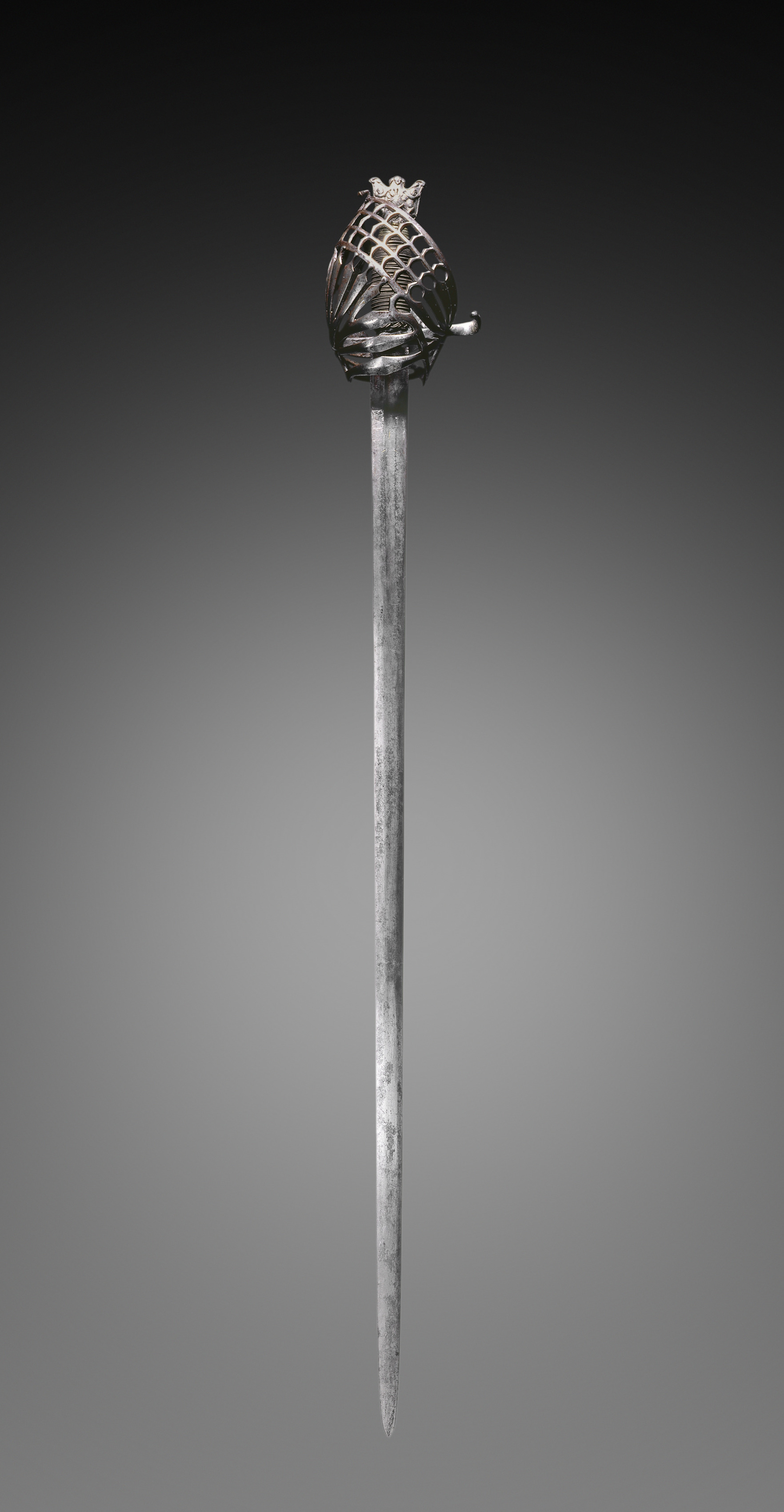
Deconstructing the Blade: The Schiavona Broadsword as Avant-Garde Muse
At Zoey Fashion Lab, our mandate transcends mere garment construction. We excavate historical artifacts, not for their nostalgic value, but for their latent structural DNA—the tension, rhythm, and metallurgical logic that can be translated into wearable sculpture. This season, our focus turns to the Schiavona Broadsword, a 16th-century Venetian cavalry weapon. On the surface, it is a brutal instrument of war. Yet, beneath its formidable silhouette lies a complex lattice of interlaced steel, organic silver wire, and a counterbalanced pommel that prefigures contemporary modular design. This analysis deconstructs the Schiavona’s technical anatomy to propose a new avant-garde fashion language, one that we term “The New DNA Strand.”
I. The Basket Hilt: A Lattice of Structural Negation
The most iconic element of the Schiavona is its distinctive basket hilt—a series of curved, flattened steel bars that envelop the hand in a protective cage. Unlike the solid guards of other broadswords, the Schiavona’s basket is porous, rhythmic, and architectural. It does not conceal the hand; it frames it, creating a negative space that is as deliberate as the metal itself. For the fabric deconstructionist, this translates directly into a study of openwork textiles and skeletal draping.
Consider the application of laser-cut leather or heat-bonded technical mesh that mimics the hilt’s overlapping, yet non-touching, steel ribbons. The garment must not rely on a continuous surface. Instead, it must be built from interlocking panels with intentional gaps, allowing the skin or an under-layer to become the “hand” within the cage. The visual effect is one of controlled vulnerability—a structure that protects while simultaneously exposing the kinetic movement beneath. We propose a series of bolero jackets and bodices where the seams are externalized, and the fabric is cut into curved, blade-like strips that weave over and under one another, secured not by stitching but by magnetic or snap-fit fasteners that echo the hilt’s riveted joints.
Translating the Grip: Silver Wire and Tactile Tension
The Schiavona’s grip is a masterclass in ergonomic tension. It is traditionally wrapped in silver wire, wound tightly over a wooden core. This is not merely decorative; it provides a non-slip surface and dissipates the shock of impact. In fashion terms, this demands a re-evaluation of surface texture and tactile hierarchy. The “grip” of a garment is often overlooked, yet it defines how the wearer interacts with the piece.
We propose a new technique: “Wire-Wrapped Couture.” This involves using metallic-coated elastic or actual fine silver-plated chain to wrap, coil, and bind sections of a garment—around the waist, the forearms, or the throat. This is not a necklace or a belt; it is an integral part of the garment’s construction. The wire acts as a tensioning cable, pulling fabric into sculptural folds or creating a corseted effect that is both functional and visually aggressive. The tactile sensation is paramount: the cool, hard metal against the softness of wool or silk creates a binary opposition—the same shock-and-absorb logic of the original sword grip. This technique turns the wearer’s body into the “core” around which the metallic strand is wound, making every movement a visible act of dynamic balance.
II. The Silver Pommel: Counterbalance as Design Principle
The Schiavona’s silver pommel is not an afterthought. It is a critical counterweight, shifting the sword’s center of gravity to allow for swift, precise movements. In our avant-garde lexicon, the pommel represents the principle of asymmetric counterbalance in garment design. We reject the static symmetry of traditional tailoring. Instead, we introduce deliberate, weighted elements that alter the silhouette’s equilibrium.
Imagine a floor-length coat where one shoulder is heavily embellished with a solid, polished silver or chrome-plated resin “pommel”—a smooth, spherical mass that visually anchors the garment. The opposite side is left fluid and unadorned, creating a dynamic diagonal line. This is not mere decoration; it changes how the fabric falls, how the wearer moves, and how the piece is perceived in three-dimensional space. The pommel also informs our approach to hardware and closures. Instead of discreet buttons, we use large, polished silver spheres as functional toggles, or as finials at the end of long, trailing ties. Each closure becomes a point of gravitational interest, forcing the eye to travel down the body’s length, replicating the visual journey from blade tip to pommel.
The New DNA Strand: Interlacing History and Future
The reference to a “New DNA Strand” is central to our thesis. The Schiavona’s construction is not a linear progression from blade to pommel; it is a helical structure of interwoven elements. The steel basket loops around the grip, which is bound by wire, which connects to the pommel, which balances the blade. This is a closed-loop system of interdependent stresses.
Our fashion application, therefore, cannot be a simple motif or print. It must be a structural helix. We propose a series of garments constructed from continuous, spiral-cut fabric strips. A single length of technical jersey, for example, is cut in a continuous spiral, then twisted and layered to form a dress or a top. The “strands” of the garment mimic the sword’s basket, creating a self-supporting structure that requires minimal internal seams. The color palette is equally binary: the cold, oxidized grey of battle steel, the bright flash of polished silver, and the deep, dark void of the leather grip—near-black, matte, and absorbent.
This DNA strand also manifests in our print and texture development. We are creating a jacquard weave that reproduces, at a macro scale, the cross-hatched pattern of the wire grip. The fabric will have a three-dimensional ribbed texture that catches light differently depending on the angle, mimicking the way light skitters across a wound wire surface. This is not a literal reproduction but a sublimated abstraction—a genetic code extracted from the object and re-expressed in a new material language.
III. Avant-Garde Application: From Battlefield to Body
The avant-garde nature of this project lies in its rejection of the sword’s lethality in favor of its kinetic and structural poetry. We are not creating armor; we are creating exoskeletal fashion that celebrates the body’s capacity for movement and balance. The Schiavona’s DNA informs a collection of sharp-shouldered, asymmetrical tailoring, where sleeves are constructed to mimic the basket’s curve, and hemlines are cut on the bias to suggest the blade’s taper.
We see this manifesting in a signature piece: a “Basket-Hilt Corset” made of rigid, molded black leather, with silver-plated brass bars curved across the torso. These bars are not fixed; they are articulated with small hinges, allowing the wearer to bend and twist while the structure maintains its cage-like integrity. Beneath this, a fluid, bias-cut silver silk slip moves freely, representing the “blade” of the body. The contrast is stark: the rigid, historical structure against the fluid, modern movement.
Ultimately, the Schiavona Broadsword, through the lens of Zoey Fashion Lab, is not a weapon but a diagram of dynamic tension. It teaches us that true strength is not monolithic; it is found in the interplay of opposing forces—hard and soft, open and closed, static and kinetic. By deconstructing its silver wire, its steel basket, and its counterbalancing pommel, we construct a new sartorial genome, one that is both deeply historical and fiercely futuristic.