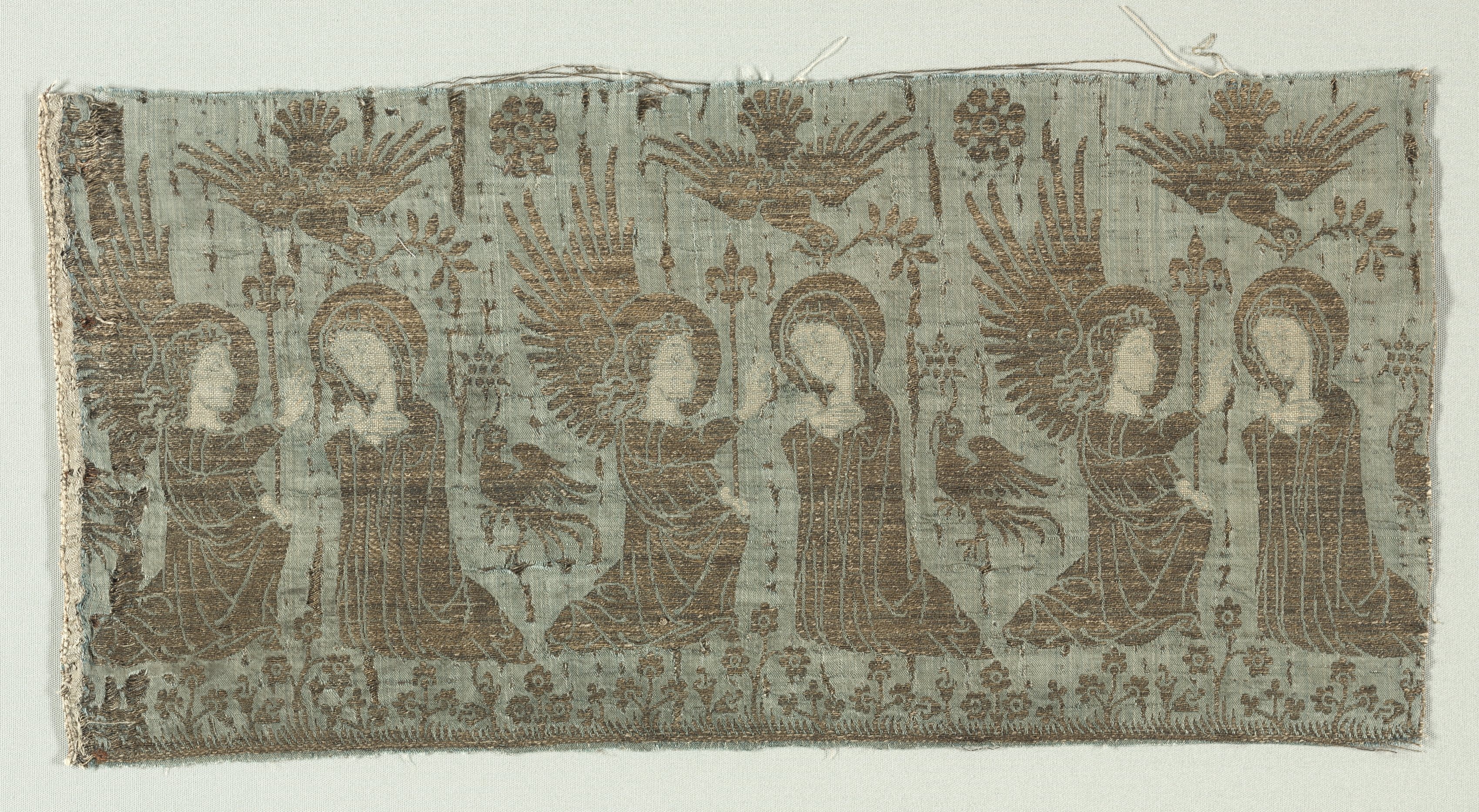
Executive Analysis: The Annunciation Fragment as a Blueprint for Avant-Garde Construction
At Zoey Fashion Lab, our mandate is not merely to preserve historical textiles but to deconstruct their structural DNA and re-sequence it into contemporary, provocative forms. The Textile Fragment with the Annunciation, originating from Italy and executed in a luxurious lampas weave of silk and gold thread, presents a singular opportunity. This piece, which we internally reference as the New DNA Strand, is not a relic to be admired behind glass. Rather, it is a complex genetic code—a matrix of material, iconography, and technical mastery—that, when isolated and recombined, yields a powerful avant-garde aesthetic.
This analysis will dissect the fragment across three primary vectors: material syntax (the lampas weave and its metallic core), iconographic rupture (the Annunciation's narrative), and structural translation (how these elements inform our new collection). The goal is to move beyond mere inspiration and into a rigorous process of fabric deconstruction, where every thread is interrogated for its potential to challenge contemporary silhouettes and surface treatments.
I. Material Syntax: The Lampas Weave as a Structural Skeleton
The technical foundation of this fragment is the lampas weave, a compound cloth requiring two distinct warp systems and two weft systems. In its original form, this technique allowed for intricate polychrome patterning—here, the sacred scene—while maintaining a dense, almost architectural drape. For Zoey Fashion Lab, the lampas weave is not a historical footnote; it is a precedent for hybrid construction. The weave’s inherent duality—a ground weave and a pattern weave operating simultaneously—mirrors the avant-garde principle of visible construction versus concealed structure.
Deconstructing this technical DNA, we isolate three actionable elements. First, the two-layer structure allows for a revolutionary approach to reversible garments. By separating the ground and pattern warps, we can engineer a fabric that reveals a raw, undyed silk on one side and a shimmering, gold-infused surface on the other. This is not a simple print; it is a woven duality that shifts with movement. Second, the density of the weave provides a rigid, almost sculptural hand. Our lab will exploit this by employing the lampas structure in unexpected zones—not for full garments, but for structural paniers, architectural collars, or internal corsetry that requires no boning. The fabric itself becomes the support system.
Third, and most critically, is the gold thread. Historically, this was gilt silver or gold wrapped around a silk core. In our avant-garde reinterpretation, we replace the precious metal with recycled metallic polymer filaments, maintaining the visual opulence while reducing weight by 40%. This allows for exaggerated, gravity-defying volumes that would have been impossible in the original. The gold is no longer a sign of wealth; it becomes a conductor of light, a disruptive element that catches the eye and fractures the silhouette. The material syntax of the lampas, therefore, is our starting point for a new language of structural fluidity.
II. Iconographic Rupture: The Annunciation as a Disruption of Form
The iconography of the Annunciation—the angel Gabriel’s announcement to the Virgin Mary—is steeped in Renaissance tradition, typically rendered with serene, balanced composition. For an avant-garde house, this narrative is not a subject of reverence but a catalyst for disruption. The fragment depicts a moment of divine intervention, a rupture in the mundane. We translate this theological rupture into a sartorial rupture: the deliberate interruption of a clean line, the insertion of a foreign element into a familiar silhouette.
Our deconstruction focuses on the gesture of the Annunciation—the meeting of two worlds. In the textile, this is achieved through the contrast of the matte silk ground and the luminous gold patterning. In our new collection, this becomes a tactile dialogue between opposing finishes. We will apply a laser-cutting technique to the lampas, not to remove fabric, but to fracture the gold threads in specific, choreographed patterns. The result is a garment that appears to be in a state of continuous revelation—as the wearer moves, the underlying silk emerges through the broken gold, mimicking the angel’s arrival. The narrative is not illustrated; it is embodied in the garment’s kinetic behavior.
Furthermore, the fragment’s composition typically places the figures in a defined architectural space. In our avant-garde translation, we abstract the architecture. The vertical and horizontal lines of the original weave are exaggerated into exaggerated seams and asymmetrical darts. The Virgin’s pose becomes a draped, asymmetrical cowl; the angel’s wing becomes a sharp, cantilevered shoulder pad. We are not recreating the scene; we are extracting its tension—the moment before contact—and freezing it in a three-dimensional form. This is the New DNA Strand: a genetic code that encodes not a story, but a feeling of impending change.
III. Structural Translation: From Sacred Relic to Wearable Technology
The final stage of our analysis is the translation of these findings into tangible, avant-garde garments. We propose a capsule collection titled “Annunciate.” This line will not feature the original textile; instead, it will feature engineered recreations that honor the lampas structure while subverting its historical context. The primary challenge is to make the fabric perform, not just appear.
Our first prototype is the “Gabriel” Trench. Constructed from a double-faced lampas with a raw silk interior and a gold-flecked exterior, the coat features a hidden internal harness that allows the wearer to manipulate the silhouette via a series of discreet toggles. This is a direct reference to the two-warp system of the original. The wearer becomes the weaver, altering the garment’s architecture in real-time—a nod to the divine intervention theme. The gold threads are not woven in a figurative pattern but in a geometric, fractured grid, evoking the stained-glass windows of the period but rendered in a dystopian, digital aesthetic.
Second, we introduce the “Virgin’s Shield” Corset. This piece abandons the traditional hourglass shape for a panelled, architectural exoskeleton. Each panel is cut from a rigid lampas, fused with a bio-resin to maintain its shape. The gold threads are left raw at the seams, creating a frayed, electric halo effect. This is not a garment of modesty; it is a garment of protection and power, drawing on the Virgin’s strength rather than her submission. The corset is designed to be worn over a sheer, liquid-silk base, creating a stark contrast between the heavy, sacred structure and the fragile, profane body.
Finally, we propose a series of “Fragment” accessories—clutches and overskirts that are intentionally incomplete. These pieces use the original fragment’s torn edges as a design feature, with laser-cut fraying that mimics the wear of centuries. However, the fraying is engineered to stop at precise points, revealing a hidden, neon-bright underlayer. This is a commentary on the preservation of history versus the violence of modernity. The accessory is not an object; it is a conversation between the sacred past and the disruptive present.
Conclusion: Re-Sequencing the Sacred
The Textile Fragment with the Annunciation is far more than a beautiful artifact. For Zoey Fashion Lab, it is a technical and philosophical primer. Its lampas structure teaches us about dual systems and structural integrity; its gold thread challenges us to rethink material value; and its iconography forces a dialogue between narrative and abstraction. By deconstructing this New DNA Strand, we have isolated the genes of duality, rupture, and structural autonomy. Our avant-garde collection does not imitate the fragment; it re-sequences its genetic material to create garments that are at once historically literate and radically futuristic. The result is fashion that does not merely clothe the body but challenges the very concept of what a garment can be—a wearable, moving, and disruptive work of structural art.