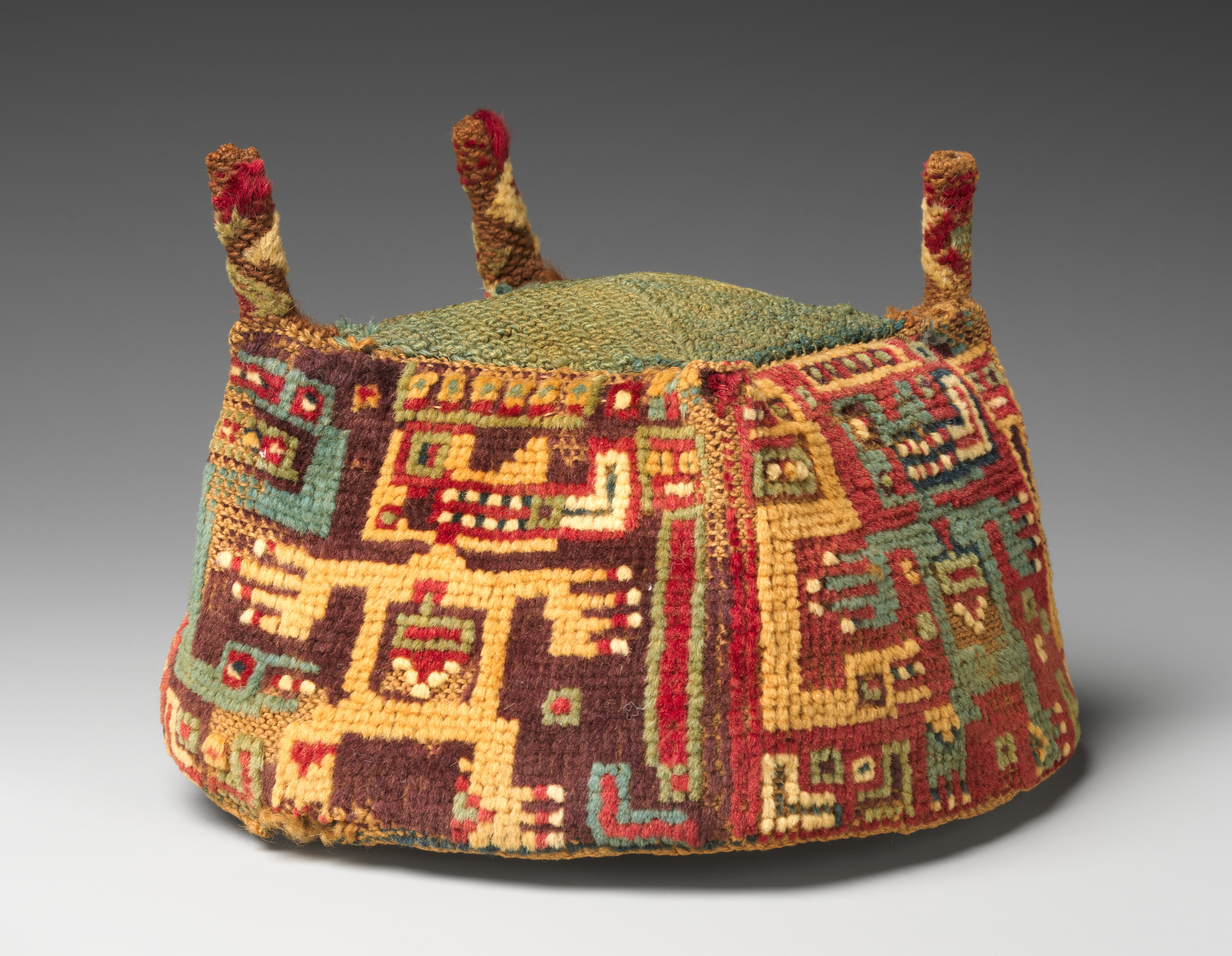
The Four-Cornered Hat: A Proto-Avant-Garde Blueprint for SS26
In the relentless pursuit of the next silhouette, the fashion laboratory often looks forward—to smart textiles, to bio-fabrication, to the algorithmic generation of form. Yet, as Zoey Fashion Laboratory’s lead curator, I posit that the most radical future is frequently buried in the archaeological past. The Wari Four-Cornered Hat, a pre-Columbian artifact woven from camelid hair, is not merely a relic; it is a masterclass in structural subversion, a proto-avant-garde manifesto that predates deconstruction by over a millennium. For Spring/Summer 2026, this object is not inspiration—it is a directive. It commands us to rethink the crown, the brim, and the very relationship between the head and the heavens.
Deconstructing the Cube: The Geometry of Dissent
The Wari hat’s defining feature is its radical departure from the spherical norm. It is a quadrilateral, a soft architectural cube that sits upon the cranium, creating a visual tension between the organic curve of the human skull and the rigid, intellectual assertion of the right angle. In contemporary practice, we often speak of "breaking the silhouette," but the Wari artisans achieved something more profound: they ignored the silhouette. They did not modify the circle; they replaced it with a square, thereby altering the wearer’s entire spatial presence. This is not a hat; it is a habitable sculpture.
For SS26, we must resurrect this principle of geometric defiance. The future of millinery lies not in softer, more fluid forms, but in the deliberate juxtaposition of hard, planar surfaces against the fluidity of the body. Imagine a hat constructed from rigid, bio-resin panels that mimic the Wari’s woven structure, yet are hinged with micro-silicone joints. The hat can fold flat for storage—a nod to nomadic practicality—but when deployed, it asserts a cubic dominance that challenges the wearer’s posture. The shoulders must roll back; the neck elongates. The garment dictates the anatomy, not the reverse. This is the futuristic silhouette of control, where the accessory becomes the primary architectural load-bearing element of the ensemble.
The Material Logic of Camelid Hair: From Fiber to Future
The Wari’s choice of camelid hair—likely alpaca or vicuña—is not incidental. This fiber is not merely soft; it is structurally intelligent. Unlike sheep’s wool, camelid hair possesses a hollow core, offering superior thermal regulation and a remarkable strength-to-weight ratio. The Wari exploited this to create a hat that was both dense and light, a paradox that modern textile engineering still struggles to replicate. The yarn was spun to a specific grist, then woven with a technique that created a felted, almost leather-like surface, allowing the four corners to hold their shape without internal wire.
For our SS26 laboratory, we are not replicating camelid hair; we are translating its logic. Consider a new generation of yarns derived from lab-grown keratin—the very protein of hair—spun into a filament with a continuous, hollow core. This "bio-camelid" fiber can be 3D-printed directly into a four-cornered form, eliminating seams entirely. The material will be self-supporting, yet breathable, and will react to body heat by subtly shifting its opacity. The hat becomes a living membrane, a second skin that is also a fortress. The material is not a passive covering; it is an active agent in the wearer’s thermal and visual ecosystem.
Structural Innovation: The Brim as a Cantilever
Traditional millinery treats the brim as a protective awning. The Wari hat, however, has no brim in the conventional sense. Instead, its four corners function as negative-space brims, casting shadows that are sharp and angular rather than soft and curved. This is a lesson in structural innovation: the most advanced form is not necessarily the most complex, but the most efficient in its use of material and shadow.
In our SS26 interpretation, we propose a hat where the four corners extend outward and upward, forming a cantilevered structure that hovers above the shoulders. This is achieved through a carbon-fiber lattice that is woven to mimic the Wari’s diagonal tension lines, then coated in a photovoltaic film that powers embedded micro-LEDs. The hat becomes a personal energy source, collecting solar power during the day and emitting a soft, programmable luminescence at dusk. The silhouette is no longer static; it is a dynamic light sculpture. The corners, far from being decorative, are now functional solar panels and display screens, communicating the wearer’s biometric data or simply their aesthetic mood. This is the hat as a wearable interface, a direct evolutionary leap from the Wari’s ceremonial headdress, which likely signified rank and cosmic connection.
The Post-Human Crown: Identity and the Void
The Wari hat was not merely decorative; it was a signifier of status, possibly worn by administrators or religious figures. It created a literal and metaphorical distance between the wearer and the common ground. In our SS26 context, this translates into a powerful commentary on the post-human condition. The four-cornered hat is the ultimate social distancing device—not in a medical sense, but in a psychological one. It announces that the wearer does not conform to the organic, the natural, the expected.
This hat is for the digital nomad of the future, the individual who operates in both physical and virtual realms. The square silhouette is a direct visual rebuke to the soft, organic curves of the "influencer" aesthetic. It is sharp, unapologetic, and intellectually demanding. It does not ask to be liked; it demands to be considered. When worn with an unstructured, flowing gown of recycled ocean plastic, the contrast is electric—the hard angular hat against the liquid drape. This is not a costume; it is a declaration of intent. It says: I am not here to blend; I am here to define the grid.
Conclusion: The Wari as a Time-Traveling Colleague
The Four-Cornered Hat of the Wari is not an artifact to be archived; it is a colleague to be consulted. Its principles—geometric defiance, material intelligence, and structural efficiency—are the very pillars upon which we must build the future of avant-garde couture. For SS26, we do not merely reference the past; we re-engineer its logic for a world that craves distinct, powerful, and intellectually resonant forms. The hat is ready to be reborn, not as a museum piece, but as a weapon of mass distinction. Let us cut the cloth, not in a circle, but in four decisive, unyielding corners.