Technical Deconstruction & Material Alchemy: The Lampas Grid
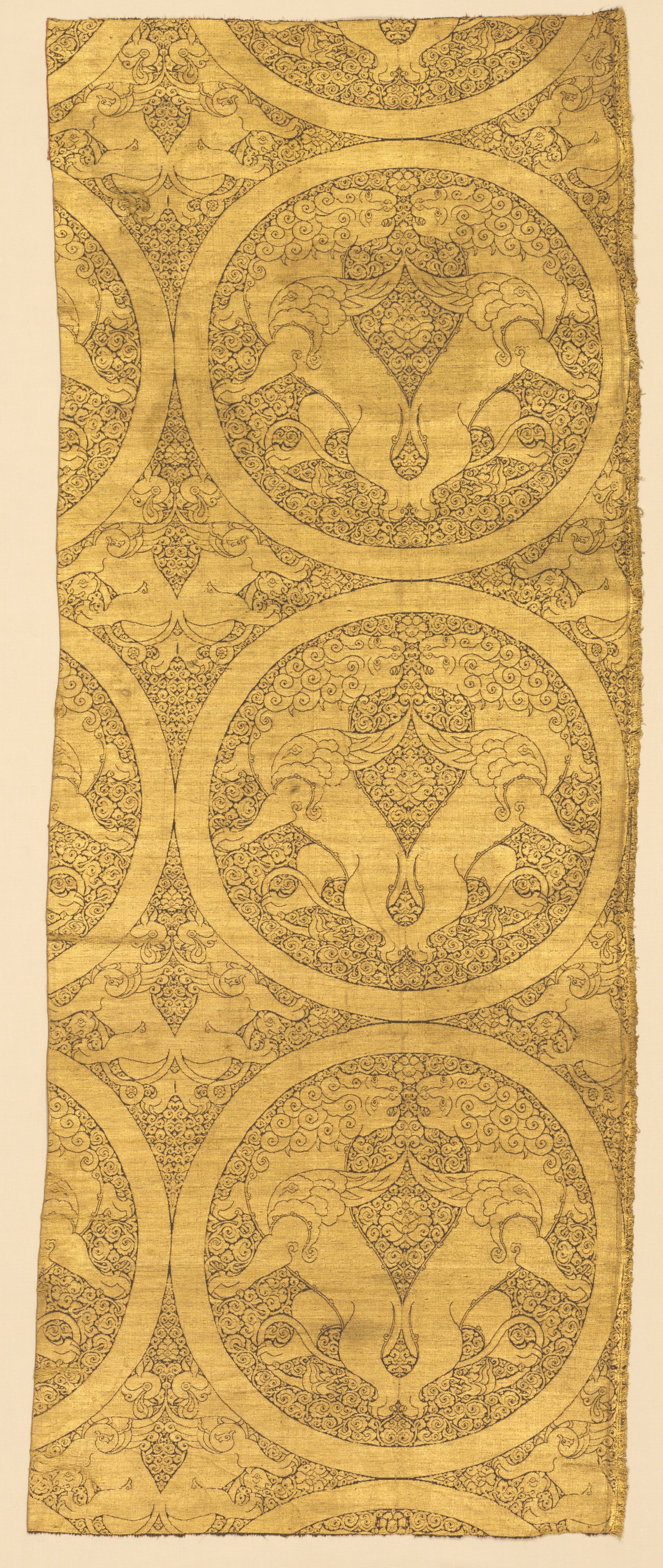
The artifact presents as a superlative example of lampas weave, a sophisticated textile structure that represents the apex of pre-industrial loom technology. This is not a simple embroidery but a structural integration of luxury. The foundation is a silk plain-weave ground, providing a resilient, subtly lustrous canvas. Upon this, a second set of warp threads (the pattern warp) is interwoven with supplementary weft threads—in this case, flat strips of gold wound around a silk core—to form the dense, raised metallic motifs. The technical virtuosity lies in the precise manipulation of these multiple warp and weft systems to create a coherent, large-scale pattern repeat. The result is a fabric of extreme duality: the silk grants fluidity and tensile strength, while the metal threads impart weight, a commanding visual presence, and a light-capturing quality that would have made the wearer a moving constellation of reflected flame and shadow.
Archive Resonance: The Silk Road as a Neural Network
在人类文明的长河中,器物与绘画不仅是时代技艺的结晶,更是文化碰撞与美学交融的无声见证。十六至十七世纪的中亚,正处于一个巨大的文化交互界面。 This textile is a data packet from that network. The winged lion (sphinx or simurgh) and the griffin are not merely decorative motifs; they are migratory symbols traversing Persian, Mesopotamian, Scythian, and possibly even Hellenistic visual lexicons. The lampas technique itself likely migrated along these same routes, from Byzantine and Islamic weaving centers into Central Asian workshops. The fabric is thus a palimpsest of transmission, where technique and iconography fuse. It speaks of a patronage that sought to articulate power and divinity through a cosmopolitan visual language, one understood by elites across desert and mountain. The metallic brilliance was not just opulence; it was a performative material, designed for courtly and ritual contexts where light equated to spiritual and temporal authority.
Avant-Garde Proposition: The Zoey Fashion Lab Intervention
For Zoey Fashion Lab, this cloth is not a relic but a proposition for radical contemporary form. Our deconstruction moves beyond aesthetic homage into the realm of conceptual and material re-engineering.
1. De-Hierarchizing the Motif: Fragmentation & Amplification
The original fabric asserts a rigid, repeating hierarchy. Our avant-garde approach will digitally fragment and isolate the winged lion and griffin. A single claw, a disembodied wing, the vortex of a griffin's eye—these elements will be extracted, scaled to monumental proportions, and laser-cut from modern technical materials: recycled metallic foils laminated onto biodegradable films, or thermo-molded polymers with refractive surfaces. The symbol is no longer a regal pattern but a deconstructed glyph, applied in asymmetric, overlapping collages across garments, challenging the original's formal order.
2. Material Transmutation: From Gold Thread to Data Thread
We transmute the alchemy of silk and gold into the alchemy of smart and sustainable materials. The gold thread's function was to capture and reflect light. We reinterpret this through:
• Photoluminescent yarns woven into the base cloth, charged by ambient light and emitting a soft glow that traces the ghost of the original patterns.
• Conductive metallic threads embroidered in paths that mirror the motif's outlines, integrated with minimalist LED circuits (for runway pieces) that pulse with data—perhaps translating real-time Silk Road wind patterns or stock market flows.
• The silk ground is reimagined as peace silk or lab-grown spider silk alternatives, but also as a base for 3D-printed bio-leather accents, creating a hybrid texture field that questions the very categories of "natural" and "manufactured."
3. Structural Dissonance: The Lampas Logic Re-coded
The lampas structure—a disciplined matrix—will be subverted. Imagine garments where one side obeys a tailored, woven logic (a nod to the original's craftsmanship), while the opposing side dissolves into fluid, draped assemblies of the fragmented motifs, held together by magnetic closures or adjustable tension cords. Seams are left raw, revealing the "warp and weft" of the construction process, making the architecture of the garment as explicit as the pattern. Volumes will be exaggerated—a sleeve becomes a wing, a trouser leg echoes a griffin's muscular hindquarter—creating a silhouette that is both bestial and architectonic.
Conclusion: The New Cosmopolitan Fabric
The Central Asian cloth of gold was a testament to a connected, pre-modern world. Zoey Fashion Lab's avant-garde deconstruction seeks to create its 21st-century counterpart: a fabric of conceptual and material hybridity. We replace the Silk Road with the digital cloud, the gold of kings with the glow of data, and the fixed iconography of power with a fluid, personal mythology. The resulting collection will not "use" the historical reference but will engage in a critical dialogue with it, producing garments that are resonant archives in their own right—speaking of contemporary collisions, technological embodiment, and a new, conscious luxury forged from the fragments of history. The winged lion does not rest on the cloth; it takes flight in a new form.