Deconstructing the Baroque Thread: The Velvet Fragment as Avant-Garde DNA
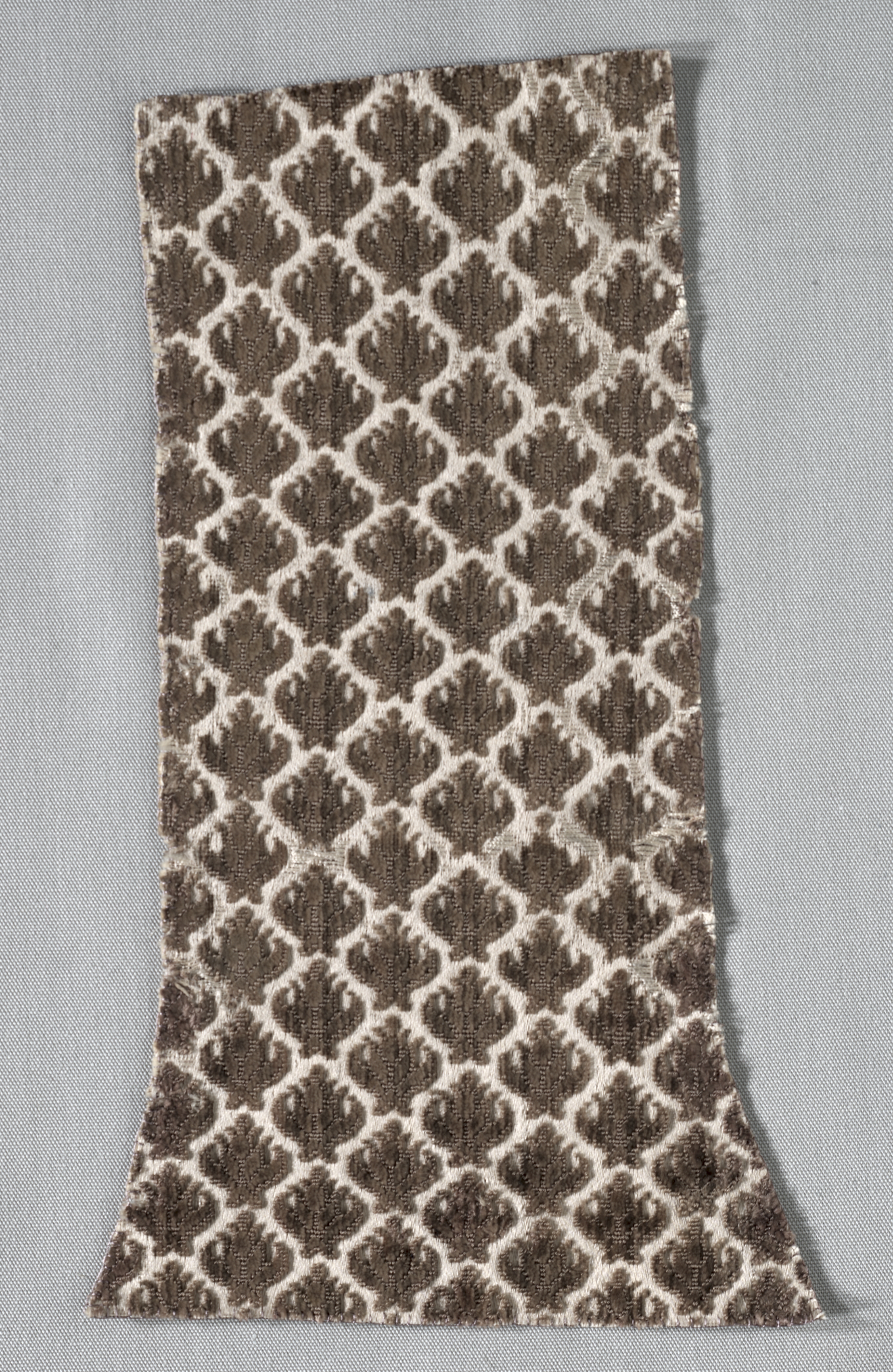
At Zoey Fashion Lab, we do not merely preserve historical textiles; we interrogate them. We treat each fragment not as a relic to be entombed in glass, but as a living genetic code—a strand of design DNA that can be re-sequenced, mutated, and expressed in contemporary form. Our latest subject, a fragment of Italian cut and uncut silk velvet dating from the late 16th to early 17th century, presents a paradox of profound significance. On the surface, it is the epitome of aristocratic opulence: a dense, plush, light-absorbing surface born from the looms of Florence or Venice. Yet, beneath its sumptuous exterior lies a structural logic that resonates with startling clarity with the principles of avant-garde fashion. This analysis will deconstruct the fragment’s technical, aesthetic, and conceptual architecture, revealing why this Baroque artifact is not an anachronism, but a precursor to radical design thinking.
I. Technical Autopsy: The Dichotomy of Cut and Uncut Velvet
The primary technical innovation of this fragment is the masterful juxtaposition of cut and uncut pile. In cut velvet, the loops of silk are sheared open, creating a dense, erect pile that feels like a soft, deep carpet. This surface absorbs light, creating rich, shadowy recesses. In contrast, uncut velvet—often called *ciselé*—leaves the loops intact, resulting in a more rigid, reflective surface that catches light and creates a subtle, glistening highlight. The fragment’s design alternates between these two states, creating a dynamic, tactile topography.
From a deconstructionist standpoint, this is not merely a decorative flourish. It is a deliberate manipulation of material memory. The uncut loops represent potential energy; they are the raw, unopened thread, a promise of depth not yet realized. The cut pile, conversely, is kinetic energy—an irreversible act of transformation that creates a permanent shadow. The avant-garde designer sees this as a blueprint for surface as narrative. We can translate this binary into modern fabrication: a garment might feature laser-cut perforations that mimic the cut pile’s light absorption, juxtaposed against bonded, unperforated panels that echo the uncut loop’s sheen. The result is a garment that changes its visual weight and texture across its surface, challenging the uniform flatness of mass-produced textiles.
II. Chromatic and Textural Dissonance
While the fragment’s original color may have faded, its structural intent remains vivid. The pattern, often a pomegranate or artichoke motif, was typically woven in a single, deep hue—crimson, black, or deep aubergine—relying entirely on the play of light across the cut and uncut surfaces for its visual impact. This is a critical lesson for the avant-garde: color is subordinate to texture. In a contemporary context, this translates to a monochromatic palette where variation is achieved through relief, not hue. Imagine a sculptural coat in a single shade of jet black, where the chest is composed of high-pile, felted wool (cut), and the sleeves are constructed from a rigid, technical mesh (uncut). The garment becomes a study in shadow and light, a wearable chiaroscuro.
Furthermore, the silk itself is a material of contradictions. It is simultaneously strong and delicate, lustrous and matte. The avant-garde interpretation seizes on this duality. We can deconstruct the silk’s molecular structure conceptually, pairing it with incompatible materials—industrial nylon, recycled rubber, or metallic organza—to create a hybrid fabric. The velvet fragment teaches us that luxury is not about uniformity but about the tension between opposing forces. The designer’s role is to orchestrate that tension, allowing the softness of silk to collide with the rigidity of a structural polymer, producing a garment that is both precious and aggressive.
III. The Fragment as a Symbol of Impermanence and Reassembly
Perhaps the most potent avant-garde lesson from this fragment is its very state of being: a fragment. It is incomplete, a remnant of a larger whole that is lost to time. This is the essence of the deconstructionist aesthetic—the celebration of the unfinished, the visible seam, the raw edge. The fragment does not hide its history; it displays its cuts, its wear, its faded glory. For Zoey Fashion Lab, this is a directive to design garments that are honest about their construction.
We propose a collection titled “New DNA Strand,” where each piece is assembled from modular components, echoing the fragment’s status as a discrete unit of a larger pattern. A gown might feature a bodice constructed from a single, continuous piece of uncut velvet, while the skirt is a patchwork of smaller, cut-velvet panels, each with visible, raw seams. The seams are not flaws; they are the genetic markers of the design’s lineage. They tell the story of the garment’s assembly, much as the fragment’s broken edges tell the story of its extraction from a larger textile.
IV. Translating Baroque Opulence into Radical Wearability
The challenge is to avoid costume. A direct copy of a 17th-century doublet is a museum piece, not fashion. The avant-garde translation requires abstraction. We extract the *principles*—the cut/uncut dichotomy, the monochromatic texture play, the modular construction—and re-express them in a contemporary silhouette. Consider a modern, oversized blazer. The lapels are made of a high-pile, cut-velvet that feels like a whisper against the neck. The body of the blazer is constructed from a flat, uncut, technical jersey with a subtle loop structure. The shoulder pads are asymmetrical, one sharp and structured, the other soft and draped, mimicking the fragment’s irregular edges.
The result is a garment that is at once historical and futuristic. It carries the weight of aristocratic tradition but speaks the language of contemporary rebellion. It is not a costume; it is a conceptual transplant. The wearer is not a Renaissance noble, but a modern individual who understands that true luxury lies in the intelligent manipulation of material and meaning.
V. Conclusion: The Fragment as a Living Code
In conclusion, the Italian velvet fragment is far more than a piece of old fabric. It is a technical treatise on surface, light, and material duality. It is a philosophical statement on impermanence and the beauty of the incomplete. And it is a design blueprint for a new form of avant-garde expression. At Zoey Fashion Lab, we view this fragment as a strand of DNA—a set of instructions that, when decoded and re-synthesized, can produce garments of radical originality. The cut and uncut loops become metaphors for potential and actualization. The fragmented edges become a celebration of process. The monochrome palette becomes a canvas for textural storytelling. By deconstructing the Baroque, we do not destroy it; we liberate its core principles, allowing them to mutate and evolve into a new, defiantly modern aesthetic. This is the true work of the Chief Fabric Deconstructionist: to see not a relic, but a revolution waiting to be re-threaded.