Deconstructing the Ephemeral: The Uchikake as a Blueprint for SS26 Structural Poetry
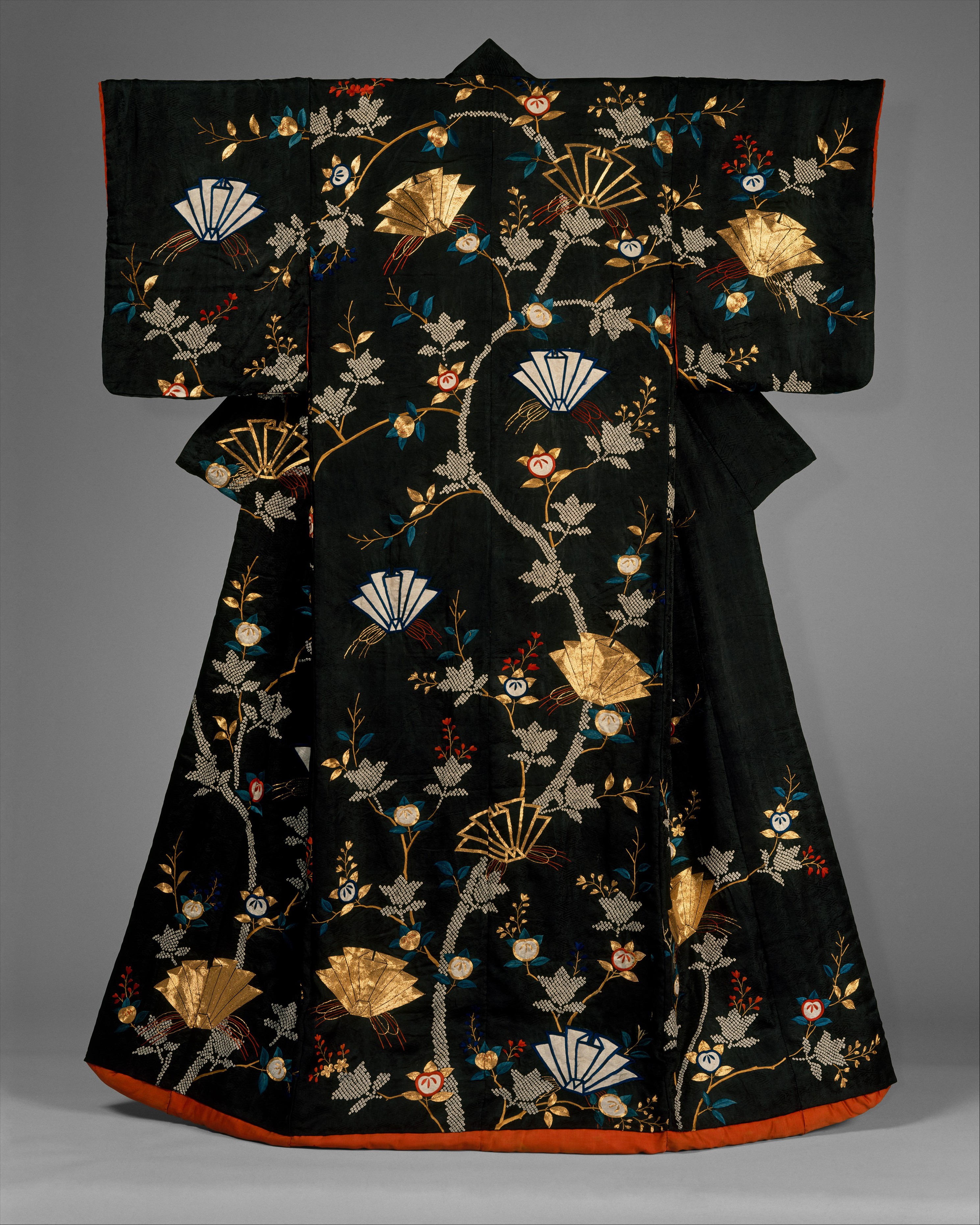
In the relentless pursuit of the new, the avant-garde often looks to the archaic, not for nostalgia, but for a radical re-sequencing of form. At Zoey Fashion Laboratory, our SS26 investigation begins not with a blank canvas, but with a singular artifact: a Japanese Uchikake, or outer robe, rendered in tie-dyed satin damask, its surface a topographical map of silk embroidery and couched gold thread. This is not a study in cultural appropriation, but a forensic dissection of structural logic. We are extracting the garment’s latent futurism—its architectural rigidity, its volumetric defiance of the body, and its narrative density—to forge a new lexicon for the coming season. The Uchikake is not a costume; it is a pre-fabricated manifesto on space, time, and ornamentation.
I. The Silhouette of Suspension: Beyond the Body's Perimeter
The traditional Uchikake is a study in negative space, a garment that creates a secondary environment around the wearer. Its defining feature—the trailing, heavily padded hem—is not merely decorative. It functions as a counter-gravitational anchor, transforming the wearer into a mobile architectural plinth. For SS26, we are deconstructing this ground-level gravity and re-projecting it upward. Our futuristic silhouette borrows the Uchikake’s rigid, box-like torso, but liberates the hem, allowing it to hover via internal, carbon-fiber boning that mimics the original’s dense cotton wadding.
The result is a levitating capsule, a garment that creates a clear, unbroken volume from shoulder to mid-thigh, before erupting into a controlled, asymmetrical flare. This is not the flowing drape of the past; it is a static dynamism, a frozen moment of expansion. The sleeves, traditionally long and pendulous, are re-engineered as detachable, inflatable modules—soft architecture that can be pressurized to alter the garment’s profile in real-time. The wearer becomes a living sculpture, their silhouette a variable parameter, echoing the Uchikake’s original function of transforming the human form into a ceremonial monument.
Structural Innovation: The Damask's Digital Re-Formation
The choice of tie-dyed satin damask is critical. The fabric’s inherent luster and its high-relief, woven patterns provide a rich, tactile surface that our laboratory processes as data. We are not replicating the tie-dye; we are algorithmically translating its chaotic gradients into a parametric pattern for laser-cut, recycled mylar panels. These panels are then heat-bonded to a base of bio-fabricated silk, creating a hybrid textile that possesses the Uchikake’s visual depth but with a fraction of the weight.
This new material allows for a radical reinterpretation of the garment’s internal structure. The original Uchikake relied on a heavy, structured lining to maintain its shape. Our SS26 version employs a latticework of shape-memory alloys, woven invisibly into the seams. This allows the robe to transition from a flat, two-dimensional state—perfect for transport—to a fully articulated, three-dimensional volume when triggered by body heat. This is programmable couture, where the garment’s architectural integrity is not sewn in, but embedded as a dynamic potential.
II. The Mandarin Oranges: Ornament as Kinetic Counterpoint
The embroidered Mandarin oranges, scattered across the damask, are not passive motifs. In their original context, they signify prosperity and good fortune. In our deconstructive analysis, they become spherical counterpoints to the garment’s planar severity. We are extracting these forms and re-presenting them as physical, kinetic appendages. Imagine small, polished, resin-cast spheres—each containing a micro-LED that pulses with a soft, organic light—attached to the garment’s exterior via magnetic, re-positionable nodes.
This is modular ornamentation for the digital age. The wearer can reconfigure the placement of these "oranges" to alter the garment’s optical balance, creating a new silhouette with each adjustment. They are no longer static symbols; they are interactive elements that allow for a continuous, real-time dialogue between the wearer, the garment, and the observer. This transforms the act of dressing from a singular event into an ongoing performance piece.
Folded-Paper Butterflies: The Architecture of Flight
The folded-paper butterflies—origami rendered in gold thread and silk—are the most potent source of structural innovation. Origami is, at its core, a discipline of transformational geometry. A single, flat plane is converted into a three-dimensional form through a series of precise, angular folds. For SS26, we are scaling up this principle. The butterflies are not merely embroidered; they are engineered as functional hinges.
We have developed a system of origami-inspired pleats that run the entire length of the robe’s back. When the wearer moves, these pleats unfold and refold, creating a dynamic, wing-like silhouette that expands and contracts with each step. The "butterflies" themselves are re-imagined as detachable, rigid panels—made from a composite of recycled aluminum and silk—that can be attached to the pleats to lock them into a specific, sculptural configuration. This is the ultimate expression of the avant-garde principle: form is not fixed, but a state of potential.
III. Synthesis: A New Ceremony for the Future
The Uchikake was designed for a single, monumental occasion: a wedding. Its purpose was to be seen, to be remembered, to mark a transition. Our SS26 deconstruction retains this ceremonial gravitas, but redirects it toward a new purpose: the ceremony of the self in flux. This is not a garment for a passive observer; it is a tool for active self-definition. The wearer is not merely clothed; they are an architect of their own presentation.
The fusion of the tie-dyed damask’s organic chaos with the rigid logic of the origami structure and the modular kineticism of the Mandarin oranges produces a garment that is simultaneously ancient and hyper-futuristic. It speaks to a future where clothing is not a static object, but a responsive, intelligent environment. The Uchikake’s heavy, opulent past is not discarded; it is distilled, digitized, and re-energized into a new form of wearable technology. This is not a revival; it is a resurrection. We are not looking back; we are using the past as a launchpad to propel the silhouette into a new dimension of structural and conceptual possibility. The result is a definitive statement for SS26: a garment that is less about covering the body and more about redefining the space the body occupies.