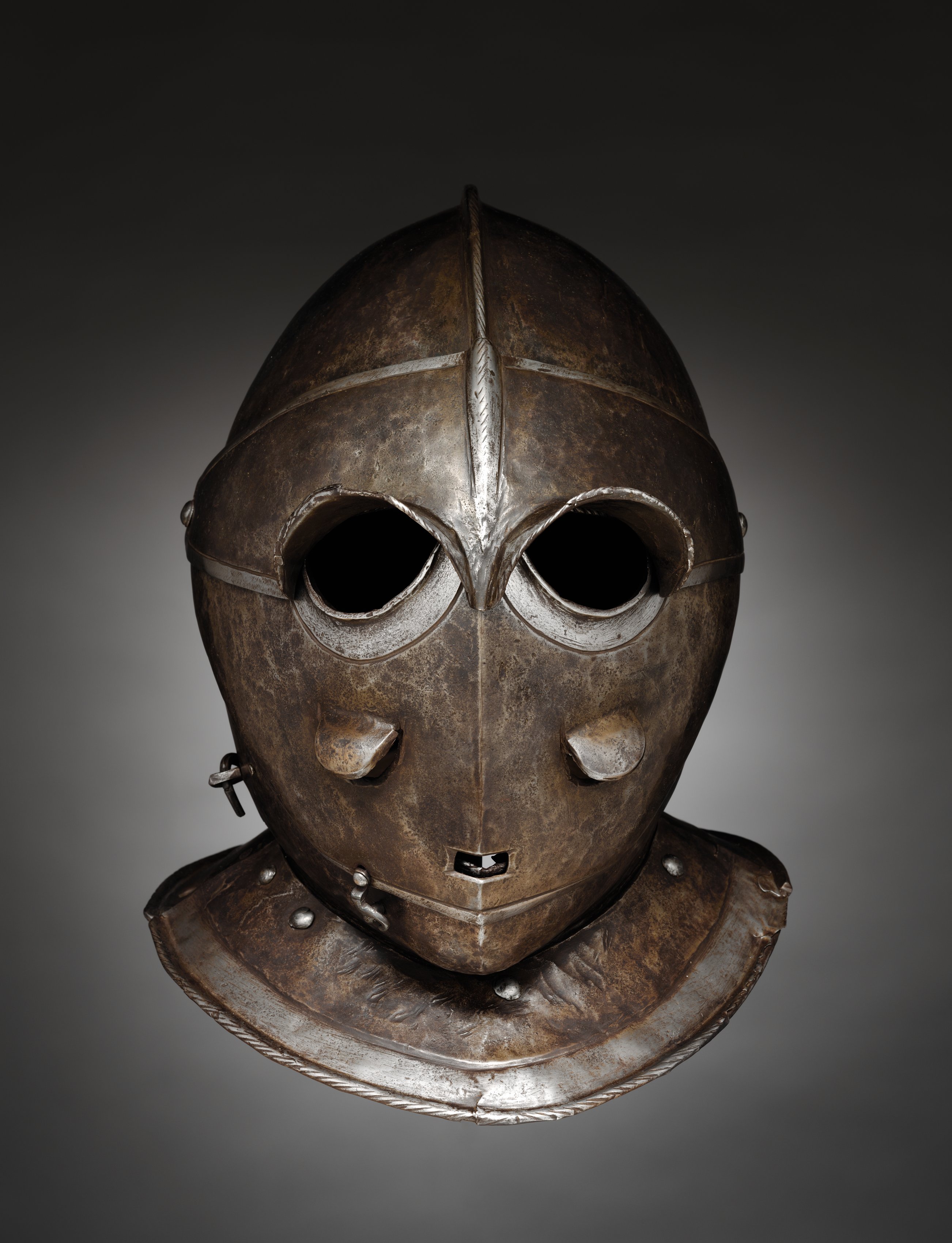
Deconstructing the Todenkopf: A Blackened Relic as an Avant-Garde Blueprint
At Zoey Fashion Lab, our mandate extends beyond the mere analysis of textiles; we engage in the archaeology of form, excavating historical artifacts to extract their latent, contemporary DNA. The subject of this deconstruction is the Savoyard Helmet, specifically the Todenkopf (death’s head) variant, originating from Italy or Germany in the early 17th century. Forged from blackened steel, this object is not simply a piece of armor; it is a frozen scream, a sculptural manifesto of mortality and defiance. In this analysis, we will dissect its materiality, silhouette, and psychological resonance, proposing a new DNA strand for avant-garde fashion that is both brutal and cerebral.
I. Materiality and the Alchemy of Blackening
The primary technical feature of the Todenkopf is its blackened steel surface. This is not a mere paint or coating; it is a controlled oxidation process—often achieved through heat and oil or acid—that transforms the metal’s lustrous silver into a matte, almost velvet-like abyss. In the context of early 17th-century warfare, this blackening served a dual purpose: it prevented rust and reduced glare, making the wearer less visible to enemies. For the avant-garde designer, this process is a masterclass in surface manipulation as narrative. The blackened finish rejects the ostentatious shine of ceremonial armor, instead embracing a utilitarian darkness that absorbs light. This is a direct challenge to contemporary fashion’s obsession with high-gloss finishes and digital sheen.
From a haptic perspective, the texture is paradoxical. It is cold to the touch, yet the process of blackening implies heat and transformation. The surface is smooth but not reflective; it feels like solidified shadow. In our new DNA strand, we propose a fabric analog: a double-faced technical jersey where the outer layer is treated with a matte, graphite-infused silicone coating, while the inner layer remains a raw, unbleached organic cotton. The silicone provides the visual and tactile weight of the blackened steel, while the cotton offers breathability and a ghostly, pale interior—a nod to the human flesh once protected by the helmet. This duality—external armor, internal vulnerability—is the core of our material innovation.
II. Silhouette: The Skull as Architectural Form
The Todenkopf’s silhouette is its most radical element. Unlike the rounded, smooth contours of typical burgonets or morions, the Savoyard helmet is hammered into the unmistakable shape of a human skull. The cranium is domed, the temples are subtly recessed, and the face opening is framed by a pronounced, flared brim that mimics the zygomatic arch. This is not a protective shell; it is a memento mori worn directly on the head. The avant-garde potential here lies in the subversion of the human form. The helmet does not simply cover the head; it replaces it with an idealized, skeletal geometry.
For our design translation, we deconstruct this silhouette into a modular garment system. Imagine a high-collar overcoat where the shoulder line is not a natural slope but a sharp, flared peak, echoing the helmet’s brim. The collar itself is constructed from multiple layers of rigid, steam-molded wool, shaped to hug the jawline and extend upward, creating a "neck-cranium" effect. The garment’s sleeves would be cut with a pronounced, almost orthopedic curve at the elbow, referencing the articulation of the skull’s sutures. We propose a "reverse tailoring" technique where seams are exposed and reinforced with blackened metal rivets, not for decoration, but to suggest the riveted construction of the original armor. The overall silhouette is one of aggressive geometry—sharp, asymmetrical, and unapologetically skeletal.
III. Psychological Resonance: The Visor as a Void
Perhaps the most compelling aspect of the Todenkopf is its face. The visor is not a series of slits for vision; it is often a solid plate with a single, narrow horizontal aperture or, in some variants, a grotesque, stylized face. This creates a profound psychological effect: the wearer becomes an anonymous, terrifying entity. The blackened steel absorbs facial features, reducing the human to a symbol of death. In an era of digital surveillance and curated online personas, this anonymity is both frightening and liberating. The avant-garde fashion statement here is not about hiding but about transcending the individual.
We translate this into a line of veiled headpieces and facial prosthetics. Instead of a traditional visor, we propose a sculptural face-shield made from laser-sintered nylon, blackened with a micro-etched texture that mimics the pitted surface of aged steel. This shield would be attached to a high-neck garment, completely obscuring the lower half of the face. The eyeholes, instead of being circular, would be long, horizontal slits that follow the angle of the cheekbones. This design forces the viewer to confront the wearer as a form, not a face. It challenges the fashion industry’s fixation on facial beauty and individuality, offering instead a collective, archetypal presence. The void where the face should be becomes the most powerful statement of the ensemble.
IV. The New DNA Strand: From Armor to Apparel
Synthesizing these elements, the new DNA strand for Zoey Fashion Lab is defined by three codons: Blackened Matter, Osseous Geometry, and Anonymity of Presence.
Blackened Matter dictates that all primary fabrics—whether technical knits, bonded leathers, or coated wools—must undergo a process of visual and tactile darkening. The finish should be matte, absorbent, and slightly granular, reminiscent of the helmet’s oxidized surface. This is not a trend; it is a permanent state of material being.
Osseous Geometry governs the cut and construction. Patterns must be drafted with a focus on skeletal landmarks: the clavicle, the scapula, the occipital bone. Garments will feature articulated panels, exposed joint mechanisms, and structural boning that is visible and celebrated. The goal is to make the wearer feel as though they are donning an exoskeleton, not clothing.
Finally, Anonymity of Presence is the philosophical core. Each piece, whether a coat, a headpiece, or a glove, must include an element that obscures or abstracts a part of the human form. This could be a high collar that swallows the chin, a sleeve that extends into a pointed, claw-like hand, or a hood that creates a deep, shadowy recess for the face. The wearer does not disappear; they become a monumental, anonymous figure—a modern-day Todenkopf striding through the city, a living memento mori for an age obsessed with permanence.
In conclusion, the Savoyard Helmet is not a historical dead end but a starting point. Its blackened steel, its skull-like form, and its terrifying anonymity offer a rich, provocative vocabulary for avant-garde fashion. By translating its material alchemy, architectural silhouette, and psychological depth, we forge a new path that is at once brutal, intellectual, and deeply contemporary. The death’s head is no longer a warning of mortality; it is a declaration of transformative power.