Deconstructing the Sacred Loom: Samite Fragments and the Avant-Garde Imperative
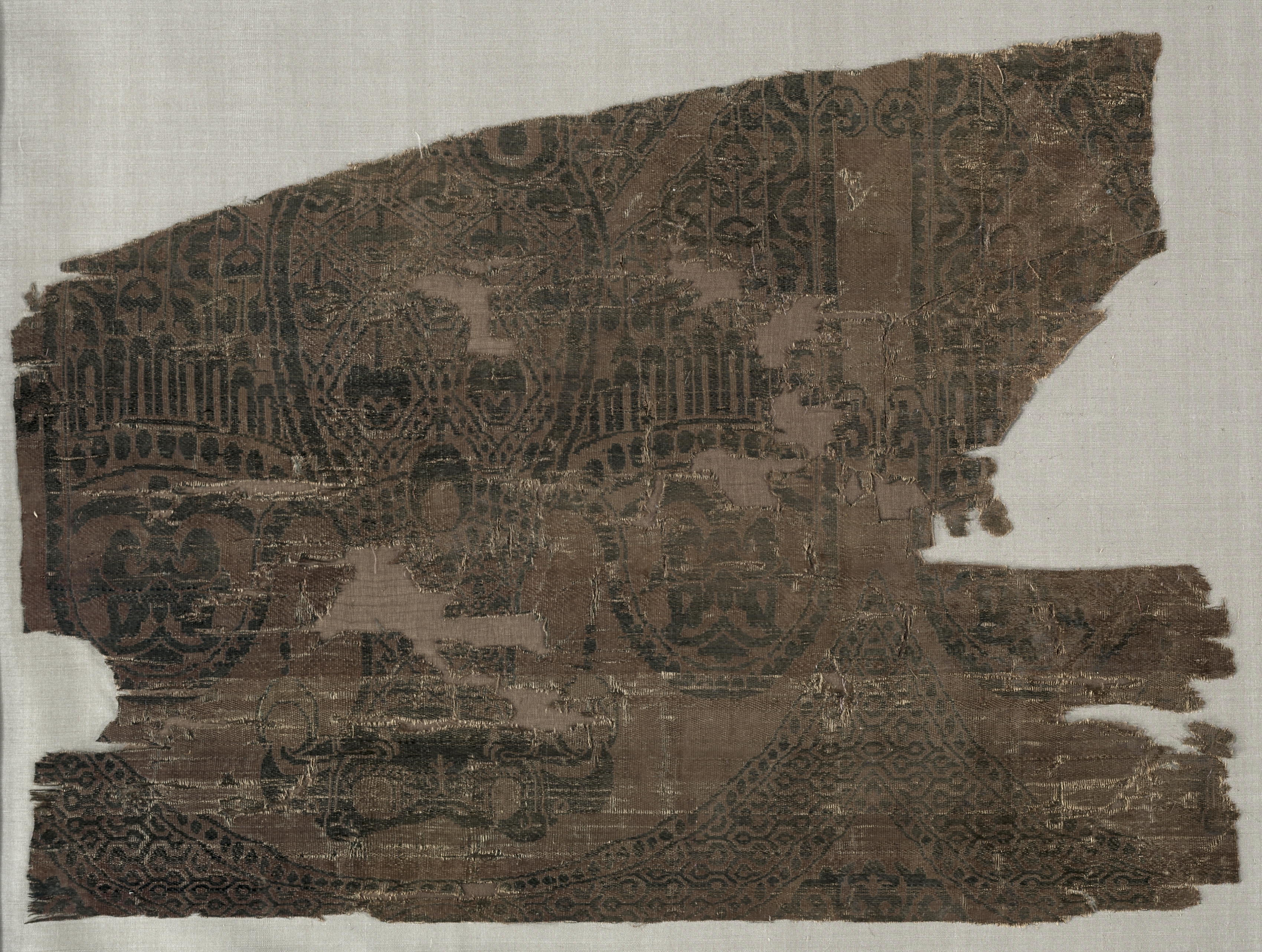
At Zoey Fashion Lab, our mandate transcends mere garment construction. We engage in a dialectical process with history, extracting structural and symbolic DNA from archaeological textiles to re-sequence them into future-facing silhouettes. The subject of this analysis—the samite fragments bearing double-headed eagles, recovered from the tomb of Saint Bernard Calvo—presents a singular opportunity. These are not simply remnants of medieval luxury; they are a compressed archive of political theology, technical virtuosity, and material transcendence. Our task is to deconstruct this archive and re-synthesize its core principles into a new avant-garde paradigm, one that challenges the contemporary fashion system’s obsession with novelty over depth.
I. Material Provenance and Technical Autopsy
The fragments, attributed to probable Byzantine workshops of the 12th to 13th centuries, are executed in samite, a weave of profound complexity. Technically, samite is a compound twill, typically in silk, where multiple warp systems—main, binding, and pattern—interlace to create a dense, often polychromatic ground. The result is a fabric of exceptional weight, drape, and reflective luminosity, a far cry from the flimsy, disposable textiles of our current fast-fashion economy. The weave itself is a testament to a pre-industrial patience, where a single square centimeter could contain over a hundred warp threads per centimeter, producing a surface that behaves less like cloth and more like a flexible mosaic.
For the Lab, the structural DNA extracted from this samite is not its visual motif alone, but its tensile logic. The compound structure allows for the simultaneous existence of a ground plane and a raised, patterned plane. This dual-plane architecture is our first design directive. We translate this into avant-garde garments through double-faced weaving techniques and laminated silk organza, where an outer shell of crisp, sculptural form conceals a softer, fluid interior. The garment becomes a palimpsest: the exterior speaks in hard, architectural lines; the interior whispers in yielding, tactile silk. This is not mere layering; it is a structural dialogue, a literal embodiment of the samite’s dual-warp system.
II. The Double-Headed Eagle: A Semiotic Overload
The iconographic centerpiece—the double-headed eagle—is a masterclass in semiotic density. Originating in Byzantine imperial heraldry, the motif signifies the Emperor’s dominion over both the secular (West) and the spiritual (East), or, alternately, the unity of the Roman and Constantinopolitan thrones. Its presence on funerary textiles, specifically in the tomb of a bishop like Saint Bernard Calvo, complicates this reading. Here, the eagle is not merely a political emblem; it is a theological assertion. It becomes a symbol of the soul’s dual nature—mortal and immortal—and the Church’s claim to a terrestrial authority that mirrors celestial order. The eagle’s gaze, fixed in opposite directions, is a metaphor for the eternal vigilance of the divine.
In our avant-garde translation, we refuse a literal reproduction. Instead, we deconstruct the heraldic form into its geometric and kinetic components. The eagle’s bilateral symmetry is broken, its wings abstracted into sharp, asymmetric shoulder pads and cape structures. The two heads are re-imagined as detachable, sculptural collars—one oriented forward, one backward—that challenge the viewer’s perception of the garment’s frontality. This is not a costume; it is a conceptual intervention. We are asking: what does it mean to wear power that looks in two directions at once? In an era of globalized, fractured identity, this motif becomes a potent metaphor for the individual who must navigate multiple loyalties, multiple histories, and multiple futures simultaneously. The garment becomes a wearable meditation on polycentric identity.
III. The New DNA Strand: From Relic to Algorithm
The reference to a “New DNA Strand” in our brief is critical. We interpret this not as biological modification, but as a re-sequencing of material and symbolic codes. The original DNA of this textile is its function as a reliquary wrapper—an object of veneration, hidden from view, yet imbued with spiritual potency. Our new strand must retain this aura of the hidden and the sacred, but translate it into a contemporary, secular language of fashion.
Our process involves three key mutations:
1. Chromatic Extraction: The original silks, now faded and oxidized, offer a limited palette of ochre, faded madder red, and tarnished gold. We do not restore these colors; we amplify their decay. We create fabrics dyed with bio-acid washes and photochromic pigments that shift hue under different lighting, mimicking the way the original textile’s colors would have changed as candles flickered across its surface in the tomb. The garment is not static; it is a living, reactive surface.
2. Structural Fragmentation: The original fragments are incomplete, their edges frayed and lost to time. We celebrate this incompleteness. We produce garments with laser-cut, raw-edged seams that are deliberately left un-finished, exposing the internal structure of the fabric. This is a direct nod to the archaeological fragment, but re-contextualized as an aesthetic of radical transparency. The garment reveals its own construction, its own “bones,” just as the samite fragment reveals the weaver’s hand.
3. Kinetic Iconography: Instead of embroidering a static eagle, we employ micro-servo motors and shape-memory alloys embedded within the textile. The eagle motif is rendered in a flexible, metallic thread matrix that can subtly shift and flutter, as if the bird is breathing or about to take flight. This is the ultimate avant-garde gesture: the transformation of a funerary symbol into a biomorphic, autonomous entity. The garment becomes a companion, a living relic that responds to the wearer’s pulse.
IV. Conclusion: The Future Wears the Past
The samite fragments of Saint Bernard Calvo are not anachronisms; they are prophetic texts. They speak of a time when cloth was a carrier of cosmic meaning, when the weave itself was a form of prayer. Our avant-garde collection, “Bicephalic Horizon,” does not seek to replicate this past, but to re-ignite its core energy. We are building garments that function as portable architecture, as semiotic engines, and as intimate, reactive companions. The double-headed eagle, stripped of its imperial dogma, becomes a symbol of the individual’s internal multiplicity. The samite’s dense, compound weave becomes a blueprint for fabrics that are both structurally sound and emotionally resonant.
At Zoey Fashion Lab, we believe the most radical future is one that has the courage to re-interrogate its own archaeological foundations. By extracting the DNA of this Byzantine relic—its technical rigor, its symbolic density, its sacred function—we have engineered a new strand of fashion that is intellectually rigorous, materially innovative, and profoundly human. The tomb has yielded not death, but a generative, avant-garde life.