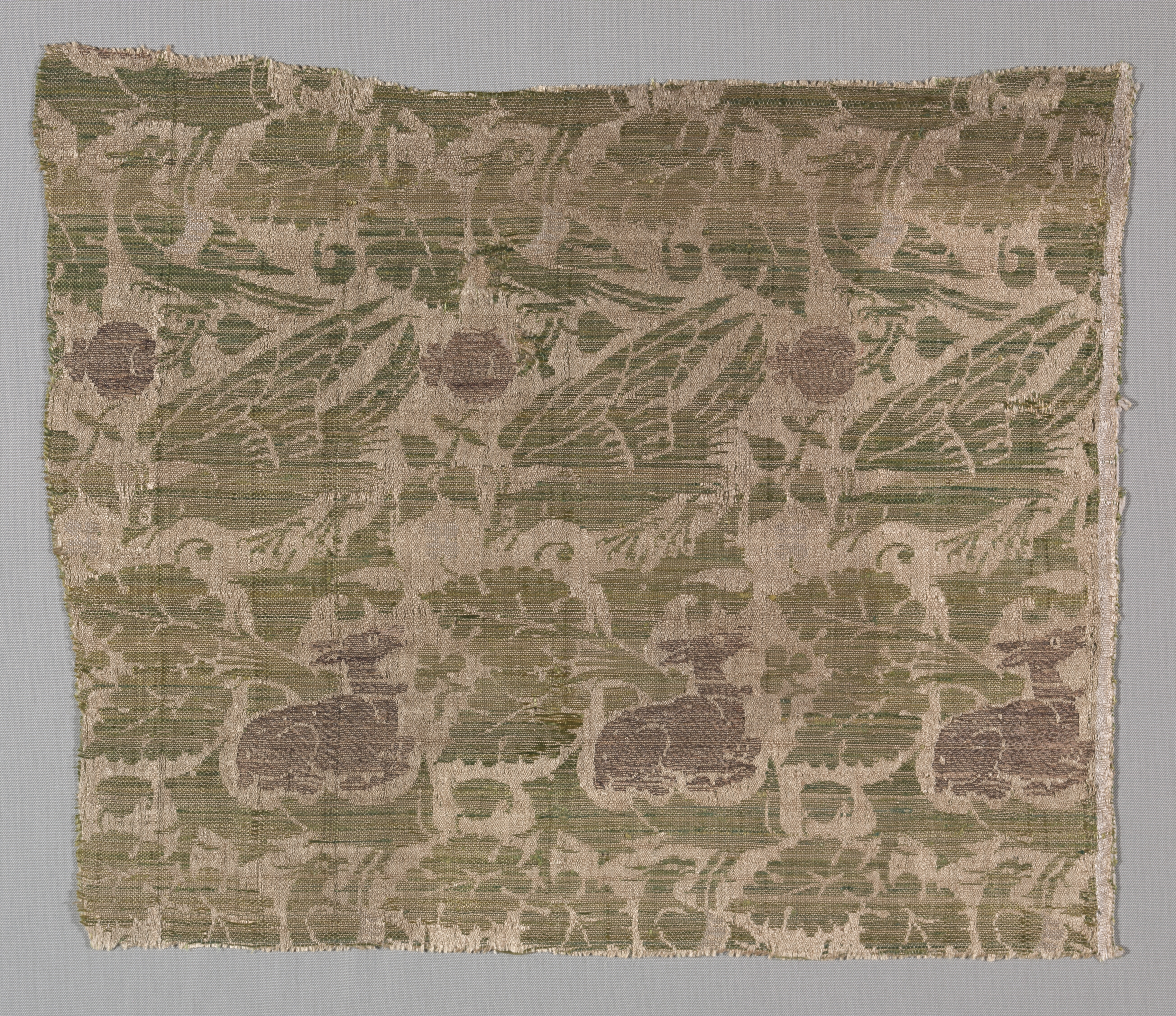
Deconstructing the Loom: Silk, Gold, and the New DNA Strand
At Zoey Fashion Lab, we do not merely study historical textiles; we interrogate them. We pull apart their warp and weft, not to destroy, but to expose the genetic code of their construction. Our latest subject—a 15th-century Italian lampas weave in silk and gold—presents a paradox. It is the pinnacle of aristocratic opulence, a relic of Florentine and Venetian power, yet within its shimmering surface lies a structural blueprint that resonates profoundly with our contemporary, avant-garde design ethos. We have codenamed this project “New DNA Strand,” recognizing that the material’s true innovation is not its historical context, but its latent, structural logic—a logic we are re-sequencing for the future.
The Technical Matrix: Beyond Surface Luxury
To understand the avant-garde potential, we must first master the technical reality. The lampas weave is a compound structure, a sophisticated binary system that predates computing. It is not a single cloth, but a dialogue between two distinct sets of warps and wefts. In this 15th-century Italian example, the ground weave—typically a silk taffeta or satin—provides the structural stability. Upon this, a second, supplementary warp and weft system creates the figurative pattern, often featuring pomegranates, thistles, or heraldic motifs.
Gold as a Structural, Not Decorative, Element
The critical distinction in our analysis is the role of the gold. In lesser textiles, metallic thread is a superficial addition, an embroidery applied post-weave. Here, the gold is integral. It is a laminated metal strip, often gilt silver wound around a silk core, or a pure gold membrane cut into fine strips. This is not a passive decoration; it is an active component of the fabric’s tensile strength and drape. The gold acts as a rigid, reflective skeleton, while the silk acts as a fluid, organic muscle. The interaction creates a fabric that is simultaneously stiff and supple, heavy yet ethereal. This duality—the rigid and the fluid—is the first strand of our new DNA.
Our deconstruction reveals a third, often-overlooked element: the binding warp. This is the silent architect, the hidden thread that locks the gold pattern to the silk ground. Without it, the gold would float freely, a chaotic shimmer. The binding warp imposes order, creating a precise, pixelated grid of metallic reflection. We see this not as a limitation, but as a proto-digital pixelation. The lampas is, in effect, a 15th-century bitmap, with each binding point a pixel of light. This is the second strand: the recognition of order within opulence.
Avant-Garde Re-Sequencing: From Relic to Prototype
Our lab’s methodology is not restoration; it is mutation. We take the historical DNA and splice it with contemporary technology and radical aesthetics. The “New DNA Strand” is our speculative garment series, where the lampas structure is abstracted and reimagined.
Deconstructing the Motif: From Figurative to Fractal
The first mutation is the elimination of the figurative pattern. The pomegranate and thistle are historically loaded, tied to specific dynasties and religious symbolism. For the avant-garde, this narrative is a cage. We have stripped the surface pattern, leaving only the raw, structural grid of the binding warps. The result is a monochromatic, textured surface where the gold appears not as a picture, but as a rhythmic, abstract pulse. The garment becomes a study in light modulation—a shifting field of metallic intensity that changes with every movement of the wearer. This is not a dress; it is a wearable light installation.
Material Subversion: The Gold-Silk Hybrid
Our second mutation involves material science. We are not using historical gold thread. Instead, we are creating a bio-engineered silk filament infused with metallic nanoparticles. This new fiber retains the drape and breathability of the original silk but possesses the reflective properties of the gold, without the weight or rigidity. The fabric becomes a true hybrid—no longer two systems (silk and gold) but a single, continuous material. This allows for radical draping techniques that the original lampas could never achieve. We can now create garments that fold, twist, and compress in ways that mimic organic forms, referencing the fluidity of the original silk while embodying the luminosity of the gold.
This new material also challenges the concept of value. The original textile’s worth was tied to the intrinsic value of gold bullion. Our version’s value lies in its programmability. The nanoparticles can be aligned to create specific light-polarizing effects, making the fabric responsive to environmental stimuli. A garment could change its reflectivity based on temperature or light, a dynamic, living surface. This is the ultimate avant-garde statement: not a static object, but a reactive environment.
Structural Re-Engineering: The Exoskeleton
The third mutation is architectural. We have taken the rigid, structural logic of the lampas—the interplay of ground and supplementary warp—and applied it to the garment’s silhouette. Instead of a soft, draped gown, we are constructing an exoskeletal form. The garment is built in layered panels, each one a separate lampas structure. The outer panel is stiff, almost armor-like, using a high-density gold-silk composite. The inner panel is fluid, using a loose, low-density weave. The space between them is a negative volume, a pocket of air that creates a thermal and visual barrier.
The result is a garment that looks like a fossilized insect carapace—a structure of segmented, reflective plates that articulate with the body. It is not comfortable in a traditional sense; it is empowering. It transforms the wearer into a cyborg-like figure, a fusion of organic silk and metallic exoskeleton. The historical lampas was worn by royalty to project power through wealth. Our version projects power through structural intelligence and material innovation.
Conclusion: The Thread of Continuity
The 15th-century Italian lampas is not a dead artifact. It is a living code. Its genius was not in its beauty, but in its systemic complexity—the seamless integration of disparate materials into a unified, functional whole. At Zoey Fashion Lab, we honor that genius by breaking it apart and re-sequencing it. The “New DNA Strand” collection is not a historical pastiche; it is a proof-of-concept. It demonstrates that the most radical future of fashion lies not in rejecting the past, but in mining its deepest technical truths.
We have extracted the structural DNA—the binding warp, the dual-system weave, the rigid-fluid dichotomy—and spliced it with 21st-century material science. The result is a garment that is both a tribute and a rebellion. It is a tribute to the anonymous weavers of Florence and Venice, who understood that true luxury is a matter of engineering. And it is a rebellion against the idea that fashion must be either decorative or functional. Our avant-garde lampas is both, and neither. It is a new species of textile, born from a 600-year-old strand of silk and gold, now re-coded for the future. The loom is silent, but the code is still running.