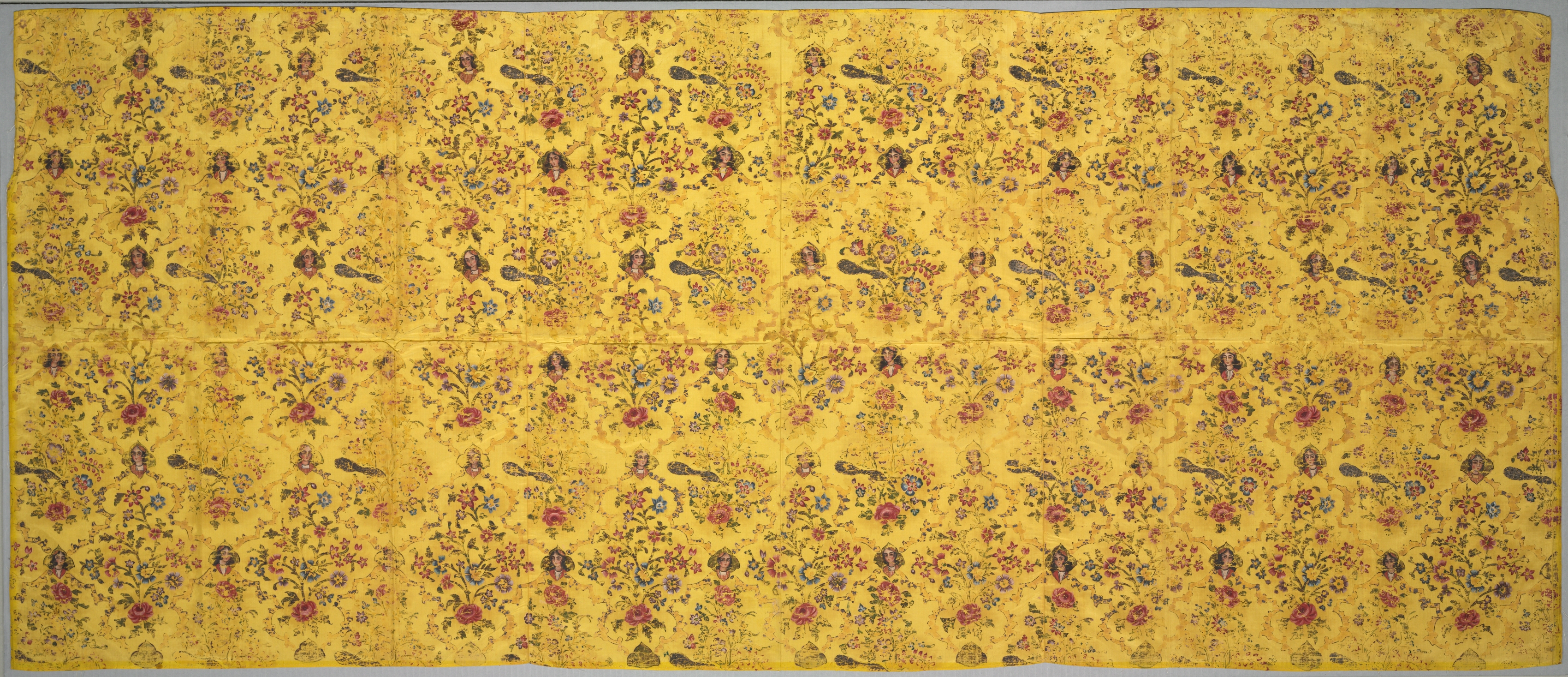
Executive Summary: The Qajar Palimpsest
At Zoey Fashion Lab, our mandate transcends mere garment construction; we engage in the poetic archaeology of cloth. The subject of this analysis—a Qajar-period wall covering from Iran (1779-1925) executed in hand-painted and block-printed silk taffeta—is not a relic to be preserved under glass, but a living genetic code to be sequenced, mutated, and re-expressed. Referencing our internal "New DNA Strand" protocol, this document deconstructs the artifact’s material, iconographic, and chromatic systems to propose an avant-garde fashion capsule that challenges Western linear temporality. We do not copy the past; we cross-pollinate its dormant genes with the volatile energy of the contemporary.
Material Autopsy: The Taffeta Substrate
The technical foundation of this piece is taffeta—a crisp, plain-weave silk known for its iridescent sheen and structural memory. Unlike heavier brocades or velvets, taffeta possesses a paradoxical quality: it is simultaneously rigid in its drape and fluid in its surface shimmer. For the avant-garde designer, this is a critical material metaphor. The wall covering’s original function was to create an immersive, luxurious interior; its stiffness allowed it to hang flat against architectural planes. In our deconstruction, we propose to liberate this substrate from its two-dimensional servitude.
The hand-painting and block-printing techniques present a dual textural language. The block-printed elements provide a repetitive, mechanical rhythm—a proto-industrial cadence that speaks to the grid of the loom. Conversely, the hand-painted florals and peacock feathers introduce organic, gestural brushstrokes that break the pattern’s uniformity. This tension between the regulated and the spontaneous is the first "new strand" we isolate. In our collection, this translates to garments where laser-cut, geometric perforations (echoing block prints) overlay hand-dyed, painterly gradients on the same silk panel, creating a fabric that is both algorithmic and expressionist.
Iconographic Deconstruction: Peacocks, Flora, and the Gaze
The iconography is a dense semiotic field. The peacock, a symbol of immortality and divine majesty in Persian art, is rendered with a fanned tail that mimics the radiating sun. The flora—likely roses, irises, and lotus—are not botanical illustrations but stylized emblems of paradise. The portrait medallions, often featuring idealized courtly figures, serve as focal points that interrupt the continuous pattern. These medallions are not merely decorative; they are architectural windows into a social hierarchy, a literal "face" of power within the ornamental field.
For Zoey Fashion Lab, we interpret these medallions as proto-surveillance devices. The gaze of the painted figure is fixed, authoritative, yet rendered in a flat, non-naturalistic style. Our avant-garde response is to abstract these medallions into oversized, mirrored lenses or embroidered "digital eyes" placed at the shoulder blades, elbows, or the nape of the neck. This subverts the original power dynamic: the wearer does not display a portrait for others to admire; instead, the garment itself looks back, challenging the viewer’s gaze with a cold, reflective surface. The peacock’s tail, meanwhile, is deconstructed from a single fan into fragmented, kinetic panels—pleated silk feathers that rustle and shift with movement, turning the wearer into a mobile, living tapestry.
Chromatic Sequencing: From Antique Patina to Neon Acid
The original palette of Qajar taffeta typically features deep madder reds, indigo blues, emerald greens, and gold or silver metallic accents. These colors, aged over centuries, now possess a muted, dusty patina. The "New DNA Strand" protocol demands we extract the energy of these hues, not their literal value. The deep red is not a crimson; it is a desiccated rust, a dried blood tone. The green is not fresh foliage; it is a verdigris copper, oxidized and acidic.
Our avant-garde translation involves a radical saturation shift. We propose a "Qajar Acid" palette: the antique red becomes a fluorescent magenta, the indigo becomes an electric cobalt, and the gold is replaced with iridescent, dichroic Lurex that shifts from green to purple under artificial light. This is not a desecration but a chronological acceleration. We are simulating what the fabric would look like if it had absorbed 200 years of industrial pollution, digital screens, and nightlife neon. The hand-painted flora, once delicate, are now rendered in high-contrast, pixelated brushstrokes—a glitch in the matrix of Persian miniature painting.
Silhouette and Structure: The Wall Becomes the Body
Since the original object is a wall covering, its primary structural logic is flatness, repeat, and verticality. To translate this into avant-garde fashion, we must first break the rectilinear grid. We propose a series of asymmetric, cocoon-like silhouettes that distort the body’s natural proportions. The taffeta’s stiffness is an asset here: we can create architectural protrusions—sharp, origami-like shoulders, and sculptural hip panels that jut out like cornices. The block-printed border, originally a repetitive frame, is now repurposed as a frieze running diagonally across a bias-cut skirt, disrupting the vertical fall of the fabric.
Furthermore, we introduce the concept of the "wearable room." The portrait medallions, abstracted into large, circular embroideries, are placed over the chest and back, but they are not flat. They are quilted and padded to create a bas-relief effect, literally lifting the "wall" off the body. This creates a negative space between the garment and the wearer, a micro-architecture of air. The peacock feathers, deconstructed into individual, hand-cut silk fronds, are then re-attached at random intervals using a crinoline or horsehair base, allowing them to flutter independently, creating a chaotic, organic movement that contrasts with the rigid taffeta shell.
Deconstruction as a Philosophical Stance
This analysis is not about nostalgia. It is about extracting the structural DNA of a historical artifact and forcing it to evolve in a hostile, accelerated environment. The Qajar wall covering is a document of a specific courtly aesthetic, but its underlying codes—tension between pattern and gesture, the power of the gaze, the interplay of flatness and volume—are timeless. By subjecting this silk to our avant-garde protocol, we produce garments that are simultaneously ancient and alien. They are not costumes; they are critical essays written in fiber.
The final collection, titled "Paradise in Reverse," will feature taffeta treated with a crushed, metallic foil finish to mimic the aged patina, but then overlaid with UV-reactive inks that only appear under blacklight. The block-printed motifs will be re-cut into laser-perforated screens that reveal a sheer, nude-toned underlayer. The peacock feathers will be re-imagined as 3D-printed polymer fronds, attached to the silk with visible, industrial rivets. The portrait medallions will be replaced with holographic, lenticular prints that shift from a serene face to a screaming digital glitch depending on the viewer’s angle. This is the Zoey Fashion Lab methodology: we do not preserve the past; we weaponize its beauty for the future. The wall no longer separates; it becomes a second skin, a provocative armor for the contemporary flâneur.