Deconstructing the Mythic Loom: A Speculative Archaeology for SS26
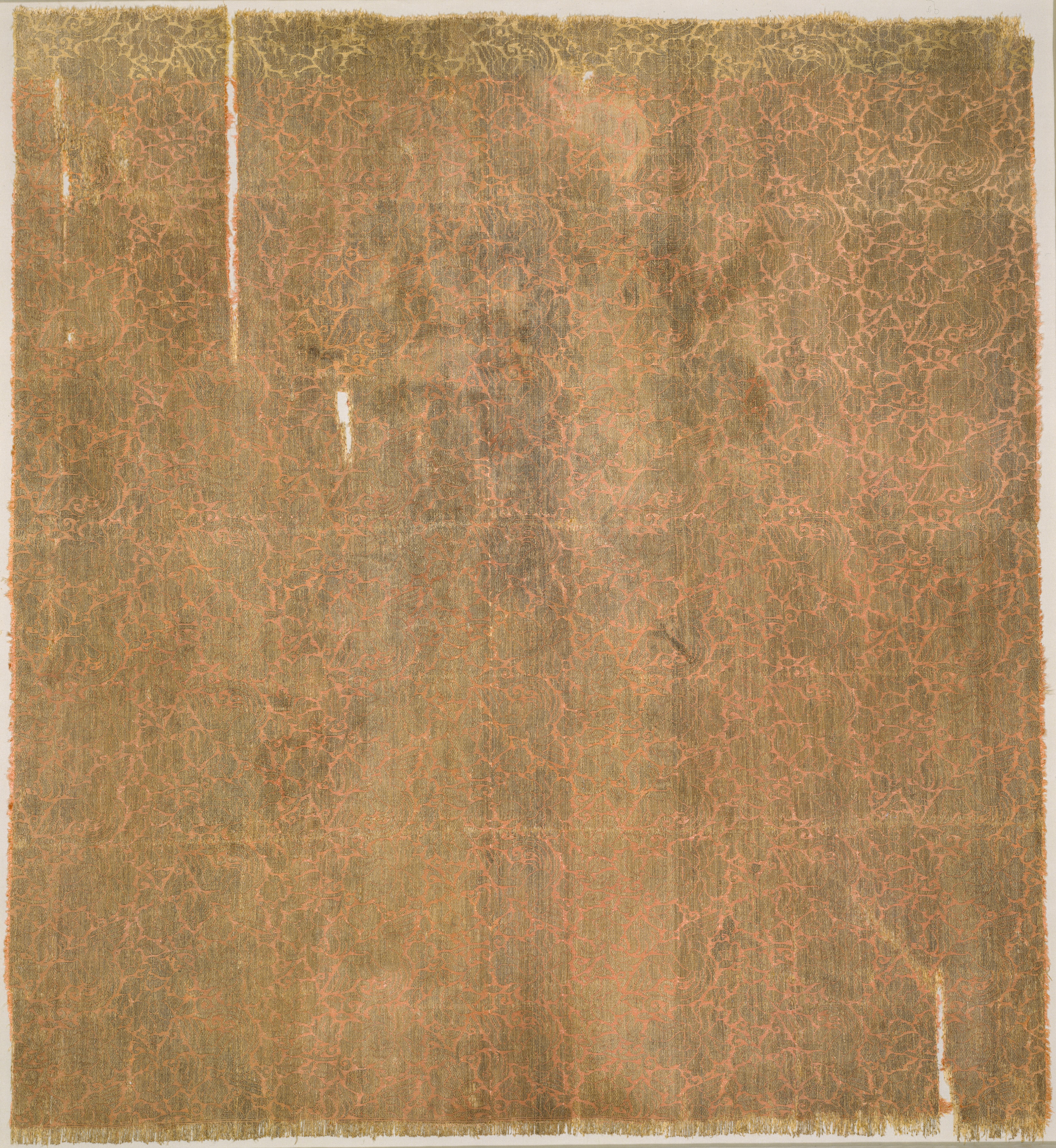
The Central Asian lampas—a textile whose very etymology suggests the intertwining of warp and weft into a singular, luminous narrative—presents a paradox to the contemporary fashion laboratory. Composed of silk and metal thread, its surface depicts a phoenix in ascension, flanked by winged animals and a riot of botanical life. To the conventional eye, this is heritage; to the avant-garde, it is a blueprint for a future that has not yet occurred. At Zoey Fashion Laboratory, we do not view this artifact as a relic to be preserved under glass, but as a generative matrix—a set of structural instructions encoded in metallic filament and organic protein, awaiting translation into the radical silhouettes of SS26.
Our analysis begins with a refusal of the flat plane. The lampas’s technical brilliance lies in its compound weave, creating a raised, almost bas-relief texture where the phoenix’s feathers are not merely printed but architecturally present. This is the foundational principle of our new collection: textile as load-bearing structure. We are not draping fabric over a body; we are constructing a wearable environment where the garment’s surface tension is the primary design driver. The metal thread—historically gilded silver—becomes a conductive skeleton, allowing for garments that hold their own shape without internal boning. Imagine a jacket whose lapels are not cut but woven into a cantilevered arc, mimicking the phoenix’s wing mid-beat, stiffened by the metallic weft’s inherent rigidity.
Futuristic Silhouettes: The Phoenix's Exoskeleton
The phoenix, in Central Asian mythology, is not merely a symbol of rebirth but of cyclical transcendence. For SS26, we translate this into a silhouette that is both armored and ethereal. The primary form is the “Aviary Carapace”—a modular bodice that integrates the lampas’s winged animal motifs as articulated panels. These are not decorative appliqués; they are engineered to function as a secondary skeletal system, hinged at the shoulder and spine, allowing the wearer’s movement to activate the garment’s form. When the arm raises, the wing-shaped panels of silk and metal fan outward, creating a dynamic, living silhouette that responds to kinetic energy. This is a direct inversion of traditional couture’s static, sculpted forms. Here, the garment is a partner in motion, a kinetic sculpture that exists only in the space between intention and action.
Furthering this deconstruction, we propose the “Asymmetric Burn” silhouette. The lampas’s floral elements—often rendered in a stylized, almost geometric precision—are abstracted into a jagged, laser-cut hemline that mimics the phoenix’s regenerative fire. The garment appears to be in a state of perpetual immolation, with the silk fraying into delicate, metallic-tipped tendrils that suggest both decay and renewal. This is not a nostalgic nod to distress; it is a futuristic proposal for garment obsolescence as a design feature. The wearer chooses the moment of transformation, tearing away the woven flowers to reveal a new, more minimal layer beneath—a literal embodiment of the phoenix’s cycle, executed through modular construction and snap-release seams.
Structural Innovation: From Weave to Wearable Architecture
The technical innovation for SS26 lies in our reinterpretation of the lampas’s compound weave as a form of 3D printing avant la lettre. We are collaborating with textile engineers to recreate the lampas’s density using a hybrid of bio-engineered silk and recycled metallic alloys, but with a critical twist: the weave is programmed to have variable stiffness. The warp threads are thicker and more rigid along the spine and shoulders, while the weft loosens towards the hem, allowing for fluidity where the body bends. This creates a gradient of structural integrity within a single piece of fabric, eliminating the need for seams or darts. The result is a dress that is a single, continuous textile organism—a second skin that is simultaneously armor and air.
Our most radical proposal is the “Phoenix’s Breath” gown, a full-length piece constructed entirely from a single, uncut panel of the re-engineered lampas. The garment is shaped not by cutting, but by thermal manipulation of the metal threads. Heat is applied to specific zones, causing the metallic weft to contract and curl, drawing the silk into a series of organic, fluted folds that cascade from the shoulders like a waterfall of molten gold and feathers. This process, which we term “thermo-architectural draping,” allows for a zero-waste construction method where the garment’s form is derived from the material’s intrinsic memory. The flowers and winged animals are not printed on the surface; they are activated by the heat, their metallic outlines rising from the silk to create a tactile, topographic map of the mythic narrative.
Conceptual Framework: The Cybernetic Phoenix
Beyond the physical construction, this study posits a new conceptual paradigm: the “Cybernetic Phoenix.” In this framework, the textile’s metallic threads are not merely decorative but are viewed as an early form of data transmission. The intricate patterns of the winged animals and flowers become a lost language, a visual code encoding astronomical cycles, tribal genealogies, or shamanic rituals. For SS26, we embed micro-sensors into the weave that respond to the wearer’s biometrics—heart rate, temperature, galvanic skin response. When the wearer’s stress levels rise, the metal threads subtly shift, altering the garment’s opacity and silhouette. The phoenix’s rebirth becomes a real-time, physiological event: a garment that breathes with its wearer, expanding and contracting in a silent, luminous dialogue.
This is the ultimate avant-garde gesture: not to costume the body, but to merge the body with its own mythology. The Central Asian lampas, with its phoenix and flowers, is not a historical object to be replicated. It is a provocation to consider how we might weave our own future—a future where clothing is not passive, but a responsive, intelligent, and structurally autonomous extension of the self. The silk provides the memory, the metal provides the will, and the wearer provides the spark. In this synthesis, the ancient craft of the lampas finds its most radical, futuristic expression yet.