Deconstructing the Celestial Dragon: An Avant-Garde Analysis of a Southern Song Masterpiece
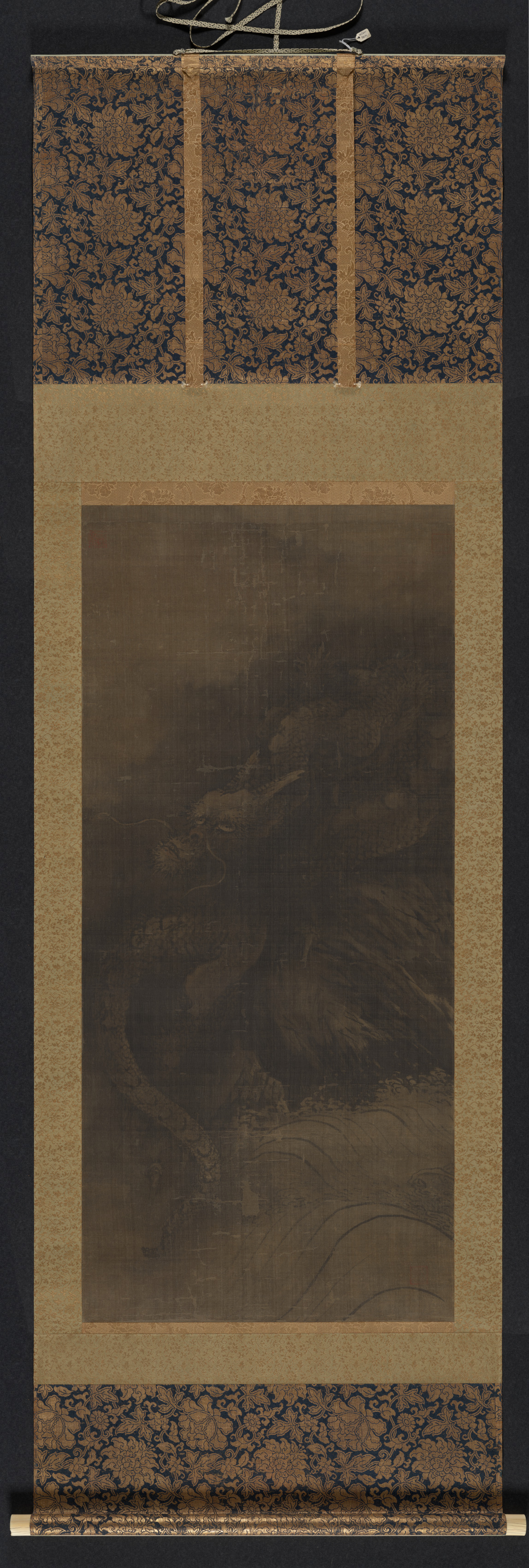
At Zoey Fashion Lab, our mandate transcends the conventional boundaries of garment construction. We do not merely observe textiles; we interrogate them, dissecting their historical, cultural, and material DNA to extract the primordial codes that inform our avant-garde silhouettes. Today, our subject is not a fabric, but a myth rendered in ink—a hanging scroll depicting a Dragon, attributed to the Southern Song dynasty (1127–1279). This work, executed in monochromatic ink on silk, presents a paradox: it is simultaneously a pinnacle of classical restraint and a volatile blueprint for radical, contemporary form. Our analysis, therefore, will treat this scroll not as a static artifact, but as a living New DNA Strand—a genetic sequence of aesthetic energy that we can splice, mutate, and re-engineer for the future of fashion.
I. The Material Dialectic: Silk as a Conductive Membrane
The technical substrate of this scroll is foundational to our deconstruction. The artist chose silk, not merely as a surface, but as an active participant in the visual drama. In the Southern Song era, silk was a luxury commodity, its production a tightly guarded imperial secret. Its warp and weft create a luminous, semi-translucent field that absorbs and reflects light differently depending on the viewing angle. For our lab, this is not a passive backdrop; it is a conductive membrane. The ink, composed of pine soot and animal glue, does not sit atop the silk; it penetrates the fibers, creating a capillary action that blurs the boundary between drawing and ground. This is the first strand of our DNA: Material as Medium. In our avant-garde practice, we translate this by using technical silks and bio-engineered membranes that allow for reactive pigmentation—fabrics that shift color or texture with body heat or ambient light, echoing the ink’s osmotic relationship with the silk.
Furthermore, the monochromatic palette is a deliberate act of extreme reduction. By stripping away color, the artist forces the viewer to engage with pure line, mass, and negative space. This is not an absence of expression, but a hyper-concentration of it. The ink’s varying dilutions—from dense, almost black washes to ethereal, water-like veils—create a tonal spectrum that functions as a chromatic narrative. In our collections, we replicate this through a study of monochromatic layering, using varying weights of organza, matte jersey, and patent leather in a single hue, allowing shadow and light to sculpt the wearer’s form with the same dramatic intensity as the ink defines the dragon’s sinews.
II. The Dragon’s Anatomy: Deconstructing the Form
The dragon itself is a masterclass in kinetic anatomy. Unlike Western depictions of dragons as lumbering beasts, the Southern Song dragon is a serpentine entity of pure energy, often depicted coiling through clouds or water, its body a continuous, unbroken spiral. This is not a zoological study; it is a calligraphic exercise in controlled chaos. The artist’s brush strokes are the dragon’s bones. The spine is a thick, undulating line; the scales are suggested by rapid, overlapping arcs; the whiskers are hair-thin, whip-like extensions that pierce the surrounding space. This is our second DNA strand: Kinetic Linearity. We deconstruct the dragon’s body into its constituent strokes—the spiral, the arc, the tangent—and translate them into pattern pieces. A coat’s seam becomes the dragon’s spine; a drape’s fold becomes the curve of its neck; a pleat’s edge becomes the flick of its tail. The goal is to create garments that suggest motion even at rest, as if the fabric itself is about to uncoil.
The dragon’s claws, often depicted with three or four sharp talons, are not mere appendages but symbols of imperial power and cosmic control. In our avant-garde interpretation, these become architectural closures and structural fastenings. We envision garments with asymmetric, claw-like zippers that grip the fabric, or shoulder pads that terminate in sharp, talon-like points, echoing the creature’s latent ferocity. The dragon’s head, with its fierce, penetrating gaze, is translated into a bold, asymmetric collar or a sculptural hood that frames the face, projecting an aura of commanding presence.
III. Negative Space and the Void: The Unpainted as Fabric
Perhaps the most radical element for our lab is the artist’s use of negative space. The dragon is often depicted emerging from or dissolving into an unpainted void. This emptiness is not a lack; it is a deliberate, powerful presence. The silk’s bare surface becomes the clouds, the water, the cosmos—an infinite field of potential. This is our third DNA strand: The Architecture of Absence. In fashion, this translates to a radical rethinking of the garment’s silhouette. We are not interested in covering the body; we are interested in framing it. We design garments with strategic cut-outs, sheer panels, and asymmetric hemlines that expose the skin—the wearer’s own “negative space”—as an integral part of the design. The void becomes a design element, just as the unpainted silk is a compositional element. This creates a dialogue between the clothed and the unclothed, the structured and the organic, the defined and the infinite.
This concept extends to the garment’s construction. We employ deconstructed seams and raw, unfinished edges, allowing the fabric’s internal structure to become visible, much like the ink’s penetration into the silk. This is not a sign of neglect, but a declaration of process. We expose the “bones” of the garment—the interfacing, the lining, the internal stitching—as artistic statements, echoing the artist’s decision to expose the raw energy of the brushstroke. The avant-garde garment, like the scroll, becomes a document of its own creation.
IV. Synthesis: From Scroll to Silhouette
The Southern Song dragon is not a costume to be replicated, but a philosophical paradigm to be absorbed. Its DNA—the material dialectic, the kinetic linearity, and the architecture of absence—provides a complete design language for our next collection. We envision a series of garments that are not merely worn but inhabited. A floor-length, ink-dyed silk coat with a train that spirals like the dragon’s tail. A structured bodice with negative-space cut-outs that trace the path of the dragon’s spine. A pair of wide-leg trousers with asymmetrical pleats that mimic the undulation of its body through water. The color palette is strictly monochromatic: deep blacks, ash greys, and bone whites, allowing the texture and structure to carry the narrative.
In conclusion, this ancient scroll provides a startlingly modern blueprint. Its avant-garde potential lies not in its historical imagery, but in its radical formal principles. By deconstructing its technical and aesthetic DNA, Zoey Fashion Lab can create garments that are not just clothing, but wearable manifestations of cosmic energy—a synthesis of ancient Chinese aesthetics and contemporary, forward-thinking design. The dragon is not dead; it is merely waiting to be re-woven.