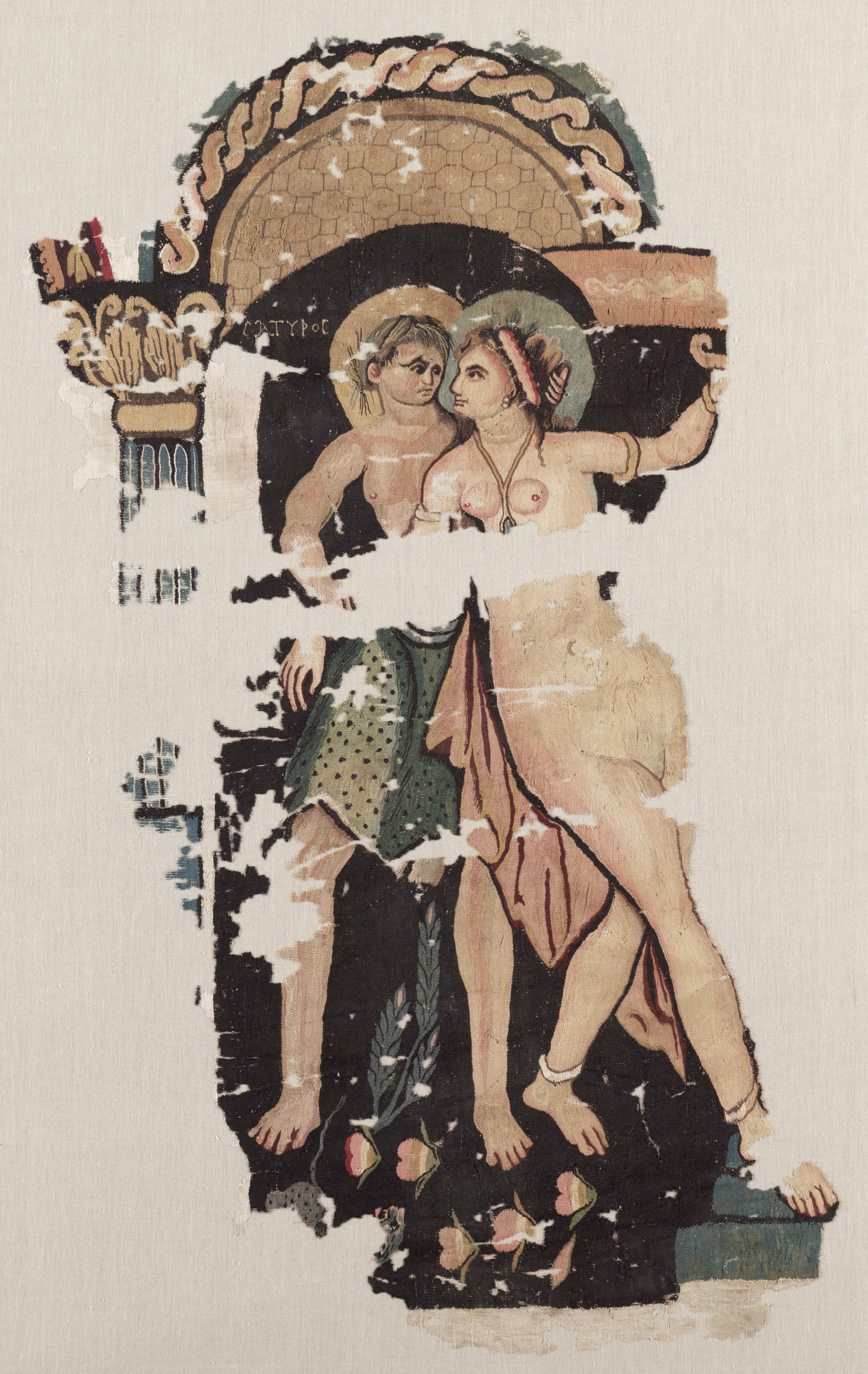
Technical Deconstruction & Material Analysis: Fragment with Satyr and Maenad
This textile fragment, a silent yet potent witness to cross-cultural currents, presents a compelling case study in material intelligence and technical hybridity. Our analysis begins at the fiber level. The ground is plain weave linen, undyed. This is a strategic, economical, and structurally sound choice. Egyptian linen, renowned for its high quality, provides a stable, cool, and durable foundation. Its lack of dye speaks to a hierarchy of value and resource allocation—the precious dyes are reserved for the narrative. The figurative elements are executed in tapestry weave (weft-faced plain weave) using dyed wool. This technique allows for curvilinear design and chromatic variation, creating a painterly effect against the linen grid. The wool, with its affinity for dyes, would have yielded more saturated reds, blues, and yellows than plant-dyed linen could achieve. The combination exploits the tensile strength of linen with the chromatic and textural warmth of wool, a classic partnership that here serves a deeply syncretic vision.
Iconographic Deconstruction: A Pagan Motif in a Byzantine Context
The subject matter—a Satyr and Maenad—is immediately arresting. These are core figures from the Greco-Roman Dionysiac retinue, representing untamed nature, ecstatic ritual, and mythological drama. Their presence on a textile produced in the Byzantine Empire, circa 5th-7th century Egypt, is not an archaeological anomaly but a profound statement on cultural endurance and aesthetic translation. This fragment likely originated from a larger hanging or garment in a late antique Egyptian context, where Hellenistic heritage remained a vibrant visual language among the educated and wealthy elite, even as Christian iconography became dominant in public and ecclesiastical spaces.
The depiction is not mere replication. The Byzantine hand has filtered the classical motif through a lens of stylization and symbolic resonance. The fluid, naturalistic movement of earlier Roman art may be tempered by a more hierarchical, rhythmic arrangement suited to the tapestry medium. The Maenad's dance and the Satyr's pursuit are captured within a framework that balances narrative action with decorative order. This fragment is a palimpsest: the pagan past is not erased but rewoven into the fabric of a new era, speaking to a sophisticated audience that could appreciate mythological allegory alongside Christian doctrine.
Archive Resonance & Avant-Garde Interpretation
The archival note references a resonance with the 16th-17th centuries. This is a critical insight. That period witnessed the European Renaissance and the global Baroque, eras defined by the rediscovery and exuberant reinterpretation of classical forms, often filtered through complex, cross-cultural exchanges (e.g., the "Oriental" influences in Venetian textiles). Similarly, this Byzantine fragment is itself a product of an earlier "renaissance"—the late antique preservation and re-contextualization of classical motifs. It stands as a pre-modern testament to the avant-garde principle of anachronism and appropriation.
Zoey Fashion Lab: Avant-Garde Translation Protocol
For Zoey Fashion Lab, this fragment is not a relic but a generative code. Our avant-garde interpretation moves beyond pastiche to engage with its core conceptual tensions:
1. Material Dialectic: We would explore the stark contrast of the undyed, structural linen and the dyed, expressive wool. Modern translation: Technical foundations in sustainable, unbleached organic cotton or innovative bast fibers (ramie, hemp) juxtaposed with hyper-saturated, digitally printed silks or recycled polyester jacquards. The "plain weave ground" becomes a minimalist, deconstructed base garment—a raw-edge tunic or tailored trouser. The "tapestry" elements manifest as bold, appliquéd or fused motifs, perhaps using laser-cutting or heat-bonding to create a layered, textured narrative on the surface.
2. Iconographic Re-contextualization: The Satyr and Maenad are archetypes of ecstasy and abandon. In a modern avant-garde context, they are liberated from their mythological frame to symbolize the clash between the structured self and the primal, chaotic identity. Their forms could be abstracted into dynamic, asymmetrical pattern pieces—a sleeve that twists like a Maenad's drapery, a pant leg that suggests the Satyr's agile leg. The motif would be fractured, mirrored, and multiplied across the garment, using embroidery, devoré, or contrasting weaves to create a disorienting, rhythmic visual pulse.
3. Cultural Palimpsest as Design Method: The fragment’s very existence is a act of bold synthesis. Our design process would mirror this by layering seemingly incongruent techniques. Imagine the precision of Japanese sashiko stitching reinforcing a seam, alongside the fluid drape of classical Hellenistic chiffon. Or, the use of AI to generate new, hybrid creatures from the Satyr/Maenad form, which are then translated into jacquard woven labels or holographic foil prints. The "Byzantine Egypt" origin invites a fusion of Coptic weaving structures with Greco-Roman form and a futuristic material palette.
This 1500-year-old fragment ultimately teaches a radical lesson: the avant-garde is not solely forward-facing. It is the conscious, critical, and creative act of weaving time itself. It demonstrates that the most groundbreaking statements often emerge from the deep, deliberate, and dissonant recombination of histories. For Zoey Fashion Lab, it provides a blueprint where the austerity of linen meets the ecstasy of color, where a pagan myth is encoded in a Christian-era textile, and where an ancient tapestry becomes a manifesto for a garment that is simultaneously an archive, a canvas, and a prophecy.