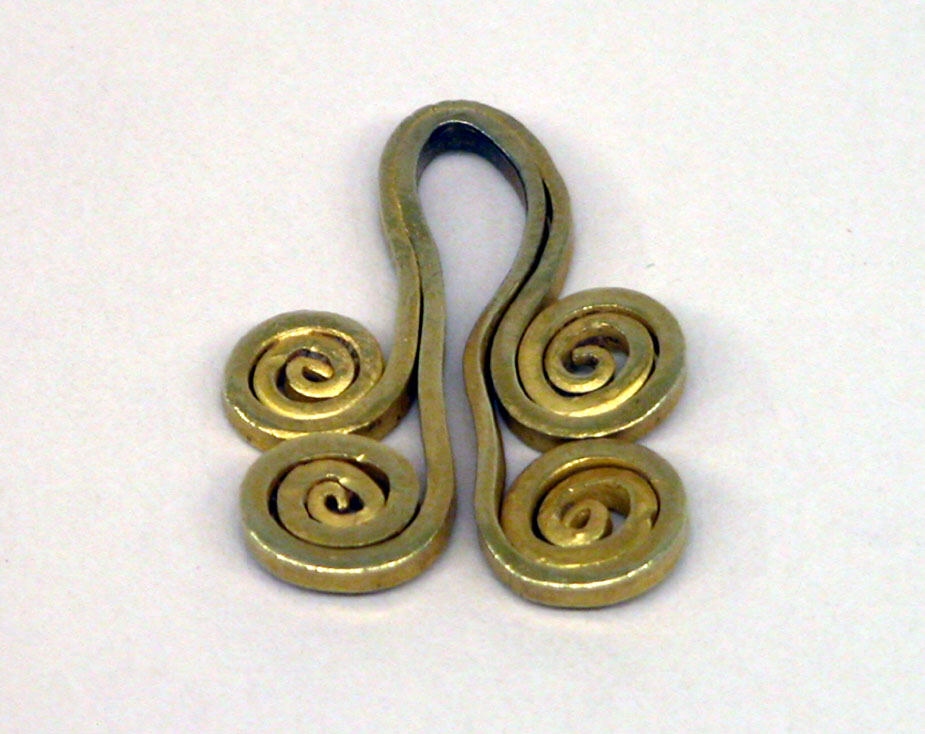
The Volute as Interface: Deconstructing Javanese Gold for the SS26 Silhouette
In the relentless pursuit of the next structural vernacular, the fashion laboratory often looks to the distant past not for nostalgia, but for blueprints of radical geometry. The subject of this analysis—a Javanese pendant composed of two sets of opposing gold volutes—is not merely an artifact of ornamental wealth. It is a proto-cybernetic device, a manual for spatial tension that predates the digital rendering software we use today. For SS26, Zoey Fashion Laboratory identifies this object as a critical node in the deconstruction of the human silhouette, specifically through the lens of asymmetrical balance and gravitational defiance.
The pendant’s structure is deceptively simple: two distinct spirals, or volutes, locked in a perpetual, silent argument. One curls inward, suggesting introspection and compression; the other flares outward, implying expansion and release. This is not a static equilibrium. It is a dynamic stasis, a frozen moment of kinetic potential. For the contemporary designer, this translates into a design philosophy where garments do not drape, but rather orbit the body. The SS26 collection, therefore, rejects the passive flow of fabric in favor of engineered tension points that mimic the volute’s push-pull dynamic.
From Metal to Membrane: Translating Rigidity into Fluid Architecture
The materiality of the original—high-carat gold—speaks to permanence and value, but its application in a futuristic context must be subversive. We are not interested in literal gilding. Instead, we extract the formal logic of the spiral and translate it into high-tensile, recycled technical meshes and liquid-metal coated organza. The volute’s curve is deconstructed into paneling seams that wrap the torso in a spiral trajectory, creating a silhouette that appears to be perpetually twisting in space.
Consider the archive node reference: a mirror with split-leaf ornamentation on one side, and a sarcophagus relief narrating life on the other. This duality is crucial. The mirror represents the superficial, the reflective, the immediate; the sarcophagus represents the narrative, the historical, the buried. The Javanese volute pendant sits precisely at the intersection of these two states. For SS26, this means constructing garments that are Janus-faced—a stark, polished, almost sterile exterior that gives way to a complex, narrative-driven interior structure. The volute becomes the hinge between these two identities.
Structural Innovation: The "Dual-Spiral" Corsetry System
The most significant innovation derived from this analysis is the Dual-Spiral Corsetry System. Traditional corsetry relies on a single, linear compression axis. The Javanese volute dictates a bifurcated approach. We propose a system of articulated, gold-anodized aluminum boning that does not merely cinch the waist, but creates two opposing torque zones on the torso. The first volute spirals from the left hip, wrapping under the bust and over the right shoulder. The second volute originates from the right hip, curving around the lower back and terminating at the sternum.
This architecture produces a silhouette that is neither purely hourglass nor columnar, but a hyperbolic paraboloid—a saddle shape that challenges the eye’s expectation of the body’s natural topography. The visual effect is one of controlled instability. The garment appears to be in the process of unscrewing itself from the wearer, yet it is held in perfect tension by invisible micro-latches. This is not about comfort; it is about kinetic presence. The wearer becomes a living sculpture, their movement calibrated by the metallic resistance of the spirals.
Surface Treatment: The Palimpsest of Reflection and Narrative
Moving beyond structure, the surface treatment of SS26 pieces must echo the pendant’s dual nature. The gold is not polished to a high shine, but rather treated with a dichroic patina that shifts between a mirror finish and a matte, bone-like texture depending on the angle of light. This directly references the archive’s mirror/sarcophagus duality. On the right side of the garment, the fabric is a seamless, silver-backed film that reflects the environment—the "mirror" node. On the left side, the same fabric is laser-cut with a pattern derived from the volute’s spiral geometry, revealing a darker, bronze underlayer—the "sarcophagus" narrative.
This is not a print. This is a topographical excavation. The laser-cutting process removes the reflective surface to expose the structural narrative beneath, much like the sarcophagus relief tells a story through carved depth. The volute pattern is scaled and repeated, but never perfectly symmetrical, ensuring that the garment retains a sense of organic, hand-wrought imperfection despite its industrial production.
Stylistic Correlations for the Modernist Body
For the SS26 runway, this analysis manifests in a series of "armor" pieces that are paradoxically weightless. A sleeveless shell dress uses the Dual-Spiral Corsetry System as exposed external seams, rather than hidden internal structure. The volutes act as exoskeletal appendages that frame the hips and shoulders, creating a futuristic silhouette reminiscent of biomechanical exosuits, yet rooted in the ancestral goldwork of Java.
Another key piece is a high-collar vest, constructed from the dichroic film and cut in a single, continuous spiral seam. It wraps the body three times, with each rotation increasing in width, culminating in a dramatic, asymmetric cape-like flourish at the lower back. This echoes the volute’s outward flare, giving the wearer a powerful, architectural presence that dominates the space around them. The collar itself is a rigid, gold-laminated structure that rises to the jawline, framing the face as the central "jewel" of the composition, mirroring the pendant’s role as the focal point of the original artifact.
In conclusion, the Javanese volute pendant is not a relic to be copied, but a mathematical formula for tension. By extracting its core principles—dual forces, opposing directions, and the tension between reflection and narrative—Zoey Fashion Laboratory redefines the SS26 silhouette. We move away from the body as a passive hanger of cloth and toward the body as an active participant in a dynamic, sculptural dialogue. The gold is gone, but the geometry remains, whispering a futuristic language of spirals and torque that will define the next decade of avant-garde construction.