Deconstructing the Sovereign Membrane: The Half Guinea as Proto-Modernist Artifact
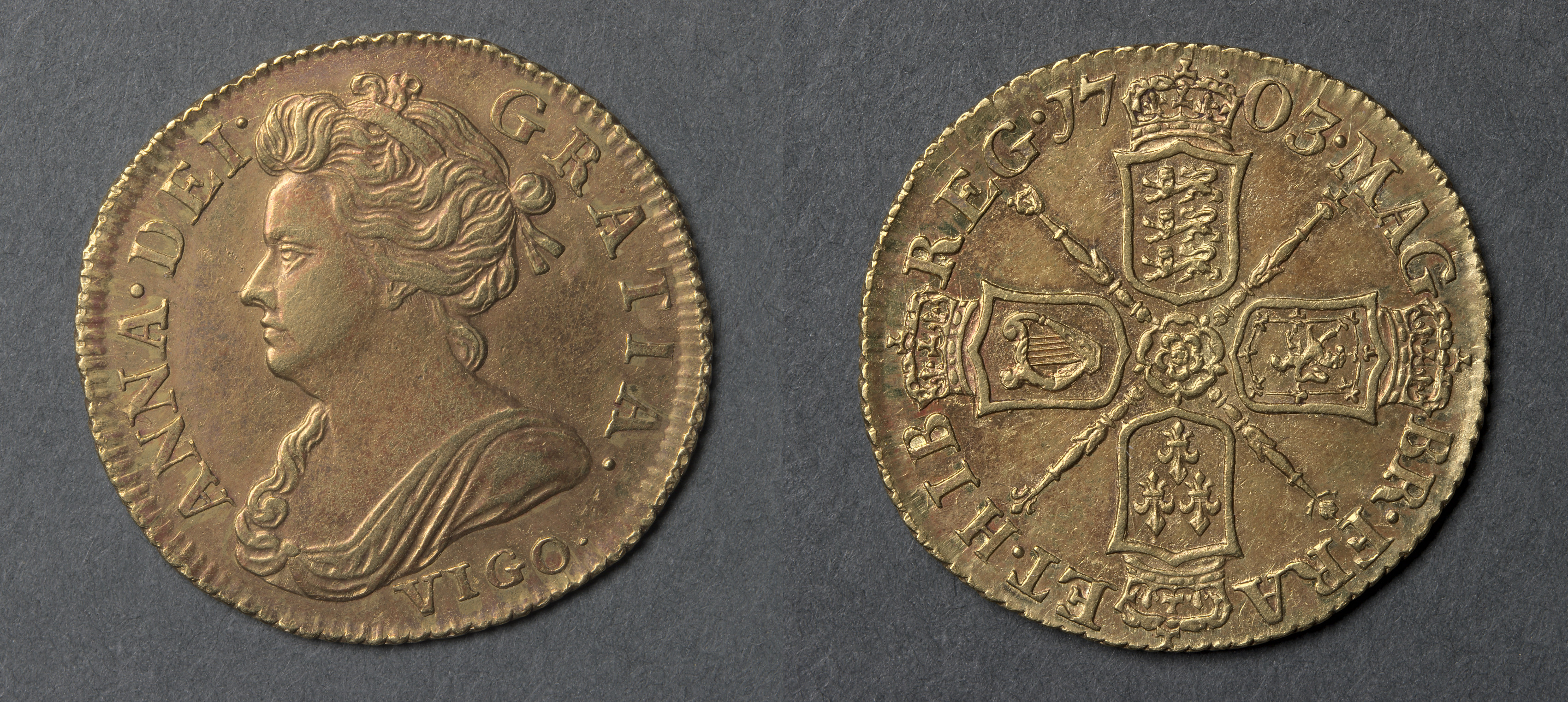
At Zoey Fashion Lab, we do not merely observe historical artifacts; we dissect them, extracting their structural DNA to inform a future of wearable narratives. The Half Guinea of Queen Anne (1702-1714), a golden disc of immense political and economic gravity, presents a unique challenge to our avant-garde methodology. Stripped of its numismatic context, it emerges not as a currency, but as a dualistic sculpture—a compressed, tactile manifesto of power and mortality. The obverse presents Anne as a classical matron, a frozen visage of imperial authority, while the reverse offers a complex heraldic arrangement of shields and a rose, a coded language of unification and dynastic tension. Our analysis, guided by the “Archive Resonance” reference, decodes this coin through the lens of the “Mirror with Split-Leaf”—a juxtaposition of polished surface and fragmented organic form. This is not a coin; it is a wearable micro-architecture of a nation’s psyche, and its resonance is profoundly contemporary.
The Obverse: The Gilded Mirror of Authority
The “Mirror” aspect of our reference is most potent on the obverse. Anne’s portrait, rendered in high-relief gold, functions as a polished, reflective surface—not in the literal sense, but as a projection of the state’s idealized self-image. The technical execution is paramount. The gold is not merely a medium; it is a light-trapping membrane. The craftsman’s control over the die’s depth creates a chiaroscuro effect, where the queen’s brow and cheekbones catch the light with the cold precision of a modern high-fashion editorial shot. Her hair, tightly bound and adorned with a diadem, is a study in controlled chaos—each strand a deliberate line, contributing to a texture that our lab’s fabric specialists would classify as “compressed luxury.”
Yet, the avant-garde eye sees beyond the regal visage. We observe the tension between permanence and decay. The portrait is an attempt to freeze time, to assert an eternal reign. But the very materiality of the gold—its softness, its susceptibility to scratches and wear—betrays this ambition. The coin’s surface becomes a palimpsest of handling, a record of countless anonymous fingers. This is the “split-leaf” of the obverse: the pristine imperial image is inevitably fractured by the entropy of circulation. For our design philosophy, this suggests a collection where hardness is an illusion, where structured silhouettes are subtly undermined by fluid, decaying layers. We propose garments with metallic, mirrored panels that are deliberately distressed, echoing the coin’s worn relief, creating a dialogue between the ideal and the actual.
The Reverse: The Stone Slab of Collective Narrative
If the obverse is the mirror, the reverse is the “cold stone sarcophagus”—a carved relief that narrates a collective story. The arrangement of shields (representing England and Scotland) and the rose (the Tudor emblem) is not a simple decorative motif. It is a geometric treaty, a visual constitution of the 1707 Act of Union. The shields are not flat; they are beveled, layered, and imbued with a three-dimensional weight that suggests monumental architecture. The rose, naturalistic yet stylized, erupts from the center, a symbol of life and lineage amidst the rigid geometry of statecraft. This is the “split-leaf” in its most literal form—the organic rose, with its delicate petals, is juxtaposed against the hard, angular shields. It is a visual paradox: the softness of the flower is imprisoned by the strength of the state.
Our deconstruction focuses on this tectonic layering. The reverse is not a single image but a stack of semiotic plates. The shields are the bedrock, the rose the topsoil, and the legend (the inscription) the binding mortar. For an avant-garde collection, this translates into a study of architectural draping. We envision garments that mimic this geological stratification: heavy, structured outer shells (the shields) that open to reveal delicate, embroidered underlayers (the rose). The technique of reverse appliqué becomes our primary tool, where the outer fabric is cut away to expose the narrative beneath, just as the coin’s design is exposed by the removal of the field. The color palette is stark: the deep, burnished yellow of the gold, the cold grey of the stone, and the vivid crimson of the rose’s petals, used as a shocking accent against monochromatic structure.
Technical Resonance: The Gold as a Structural Fabric
Let us move beyond iconography to the material’s tactile and acoustic properties. Gold, in this context, is not a color; it is a sonic and kinetic element. The Half Guinea’s weight is its primary characteristic—a dense, reassuring heft that speaks to value and substance. In our lab, we translate this into weighted textiles, using metallic thread woven with dense wool or silk to create a fabric that drapes with a similar gravity. The sound of the coin—a sharp, clear ring when struck—is translated into the crisp rustle of layered taffeta or the metallic chime of integrated chainmail elements.
The technical precision of the engraving—the fine lines of Anne’s hair, the delicate veins of the rose—demands a corresponding level of craftsmanship in our textiles. We employ laser-cut leather to mimic the die’s precision, creating filigree patterns that echo the coin’s relief. The “split-leaf” motif is realized through perforation and cutout techniques, where the fabric is literally split to reveal a contrasting under-layer, mirroring the coin’s design process. The overall aesthetic is one of compressed maximalism: every surface is loaded with meaning, every seam is a potential fault line, and every garment is a wearable archive of a forgotten empire.
Conclusion: Wearing the Archive
The Half Guinea of Queen Anne is more than a historical relic; it is a blueprint for a future of meaningful adornment. Its dual nature—the polished mirror of self-image and the carved stone of collective memory—provides a profound template for contemporary design. At Zoey Fashion Lab, we reject the superficiality of fast fashion in favor of this archaeological approach, where each piece is an excavation of cultural memory. The coin teaches us that true luxury is not about pristine surfaces, but about the tension between creation and erosion, between the individual and the state, between the organic and the architectural.
Our proposed collection, “Sovereign Membrane,” will not replicate the coin but will channel its structural and conceptual energy. We will create garments that are both mirror and sarcophagus—reflective on the surface, yet heavy with the narrative of their construction. The gold is not a color to be used; it is a philosophy of weight, light, and permanence to be embodied. The Half Guinea, in its silent, golden authority, offers a radical lesson: that fashion can be a form of counter-monumentality, a way to wear history not as a costume, but as a living, breathing skin. This is the resonance we seek—a dialogue between the cold metal of the past and the warm, mutable fabric of the future.