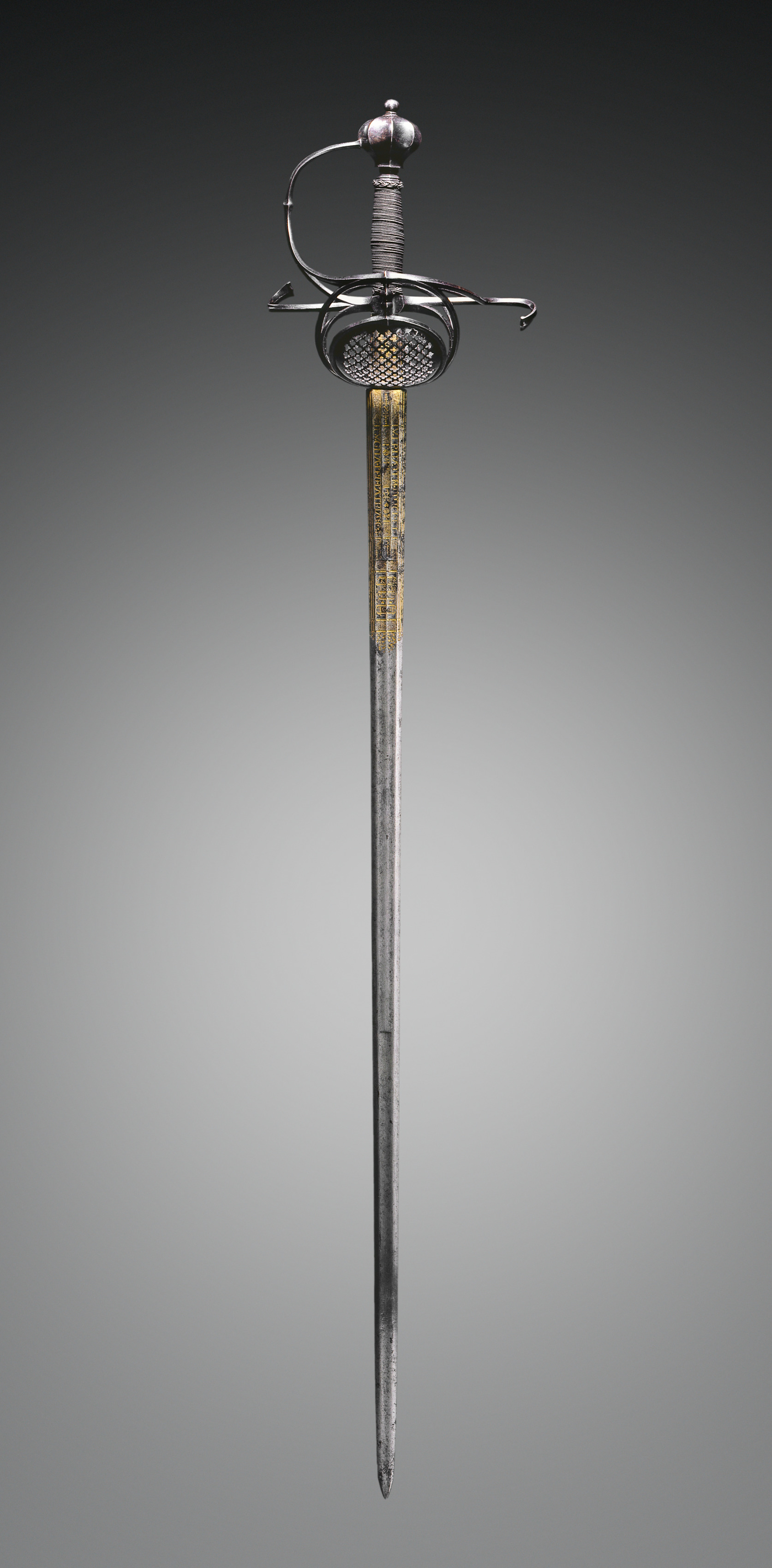
Deconstructing the Solingen Rapier: A New DNA Strand for Avant-Garde Fashion
At Zoey Fashion Lab, our mandate extends beyond the mere observation of historical artifacts. We engage in a process of fabric deconstruction, extracting the structural, textural, and philosophical DNA from objects of power and translating them into wearable, avant-garde statements. Our latest subject—a 17th-century Solingen rapier, blued and gilded—presents a paradox of extreme elegance and lethal precision. Its "New DNA Strand" is not about replicating a weapon, but about distilling its essence: the tension between rigid control and fluid motion, the interplay of dark oxidation and brilliant light, and the architecture of a line that both defends and attacks. This analysis dissects the rapier’s components to propose a radical new language for the modern silhouette.
I. The Blade: Linear Rigidity and the Illusion of Fluidity
The rapier’s blade is its primary narrative—a long, slender, and acutely tapered form designed for thrusting rather than slashing. In fashion terms, this translates directly into the vertical line of a garment. However, the deconstruction lies in the blade’s cross-section. The hexagonal or diamond profile catches light differently along its length, creating a play of brilliance and shadow that is not uniform. For Zoey Fashion Lab, this suggests a departure from flat, static panels. We propose a new cut: a “facetted bias”—a garment constructed from multiple, narrow, structurally distinct panels that twist slightly along the torso. These panels, cut on the bias but fused with a rigid interlining, would mimic the blade’s ability to appear fluid while maintaining an unyielding verticality. The hem would not be straight but would follow a subtle, sharp V-point, echoing the blade’s tip, creating a line that visually "thrusts" forward with the wearer’s movement.
Material Translation: Steel as Second Skin
The physical steel cannot be worn, but its properties can be simulated. We move beyond literal metallics. The blued finish—a heat-treated oxidation that produces a deep, gunmetal blue-black—is our primary color story. This is not a simple navy or black; it is a reactive, depth-filled hue that shifts from charcoal to midnight depending on the angle. Our fabric development team is experimenting with a high-density, liquid-coated wool that possesses a subtle, metallic sheen without the coldness of a laminate. The coating is applied in uneven strokes, mimicking the hand-rubbed nature of the bluing process. This creates a fabric that feels like a soft, supple leather but behaves with the drape of a heavy silk, offering both structure and a mysterious, light-absorbing quality.
II. The Hilt: Ornamentation as Structural Counterweight
The rapier’s hilt is a masterpiece of contradictory engineering. The complex, swept guard—often a basket of interlocking rings and quillons—is an explosion of ornamental complexity that serves a purely functional purpose: hand protection. The gilding, applied in delicate arabesques over the blued steel, adds a layer of precious, fragile beauty to an object of violence. This is the core of our avant-garde reinterpretation: ornamentation as a functional necessity, not mere decoration.
Architectural Collars and Cuffs
We translate the hilt’s structure into dramatic, wearable architecture at the extremities. Instead of a traditional sleeve, we propose detachable "quillon collars"—rigid, sculptural pieces worn at the shoulder or wrist. These are not soft ruffles. They are constructed from a new composite: a thermoformable, gilded leather that can be shaped into sharp, sweeping arcs. The gilding is applied in a distressed, cracked pattern, suggesting age and use, while the leather’s core is dyed in the deep blue of the blade. These collars would articulate with the wearer’s joints, moving like the rings of the guard, offering a sense of protective armor while remaining entirely avant-garde in their silhouette. The visual weight is placed at the shoulder and forearm, creating a powerful, authoritative frame that contrasts with the blade-like fluidity of the main garment.
III. The Grip: Ergonomics of Tension and Release
The grip of a rapier is often wrapped in twisted wire or leather, providing a secure hold that allows for a relaxed wrist but a firm hand. This duality—the need for both tension and release—is a profound concept for garment construction. The grip’s spiraling texture suggests a dynamic, twisting energy that is held in check. For our collection, this translates into directional stitching and seam placement. We propose a bodice where the primary seams do not run vertically but follow a subtle, continuous spiral from the right hip, across the torso, and over the left shoulder. This "twisted seam" technique, executed in the liquid-coated wool, would create a sense of contained energy, visually pulling the fabric taut in one direction while allowing it to drape freely in another.
The Pommel: A Point of Finality and Balance
The pommel, the counterweight at the end of the hilt, is essential for balance. Without it, the rapier is unwieldy. In our design, the pommel is represented by a weighted, sculptural hemline. The back of a jacket or the train of a gown would feature a dense, gilded metal bead or a cluster of heavy, polished steel rings, echoing the pommel’s form. This is not a decorative afterthought; it is a functional counterweight that changes the garment’s center of gravity. When the wearer moves, the weighted hem swings with a deliberate, pendulum-like motion, creating a powerful, rhythmic presence. This physical weight grounds the ethereal, blade-like upper body, creating a complete, balanced silhouette that is both imposing and graceful.
IV. Synthesis: The New DNA Strand
The Solingen rapier, when deconstructed, reveals a design philosophy of controlled aggression and refined power. Its DNA is not in its steel, but in its contradictions: the rigid line that moves with fluidity, the dark surface that gleams with gold, the complex hilt that enables a simple thrust. Our collection for Zoey Fashion Lab will embody these principles through:
- Facetted Bias Cuts: Creating dynamic, light-reactive vertical lines that mimic the blade’s profile.
- Reactive Coloration: Using deep, blued tones with uneven, liquid coatings to simulate the oxidation process.
- Functional Ornamentation: Employing gilded, thermoformable leather for sculptural collars and cuffs that serve as protective, architectural elements.
- Spiral Seam Construction: Engineering garments with twisting seams to generate a sense of contained kinetic energy.
- Weighted Counterpoints: Adding heavy, gilded hemlines to balance the silhouette and create a deliberate, powerful movement.
This is not a historical costume. It is a new species of fashion, born from the cold logic and ornate beauty of a 17th-century blade. It is for the modern individual who understands that true elegance is not passive, but a poised, precise, and powerful form of expression. The rapier is no longer a weapon of the hand; it is a weapon of the wardrobe.