The Geometry of Becoming: Deconstructing the Global Frontier Sampler for SS26
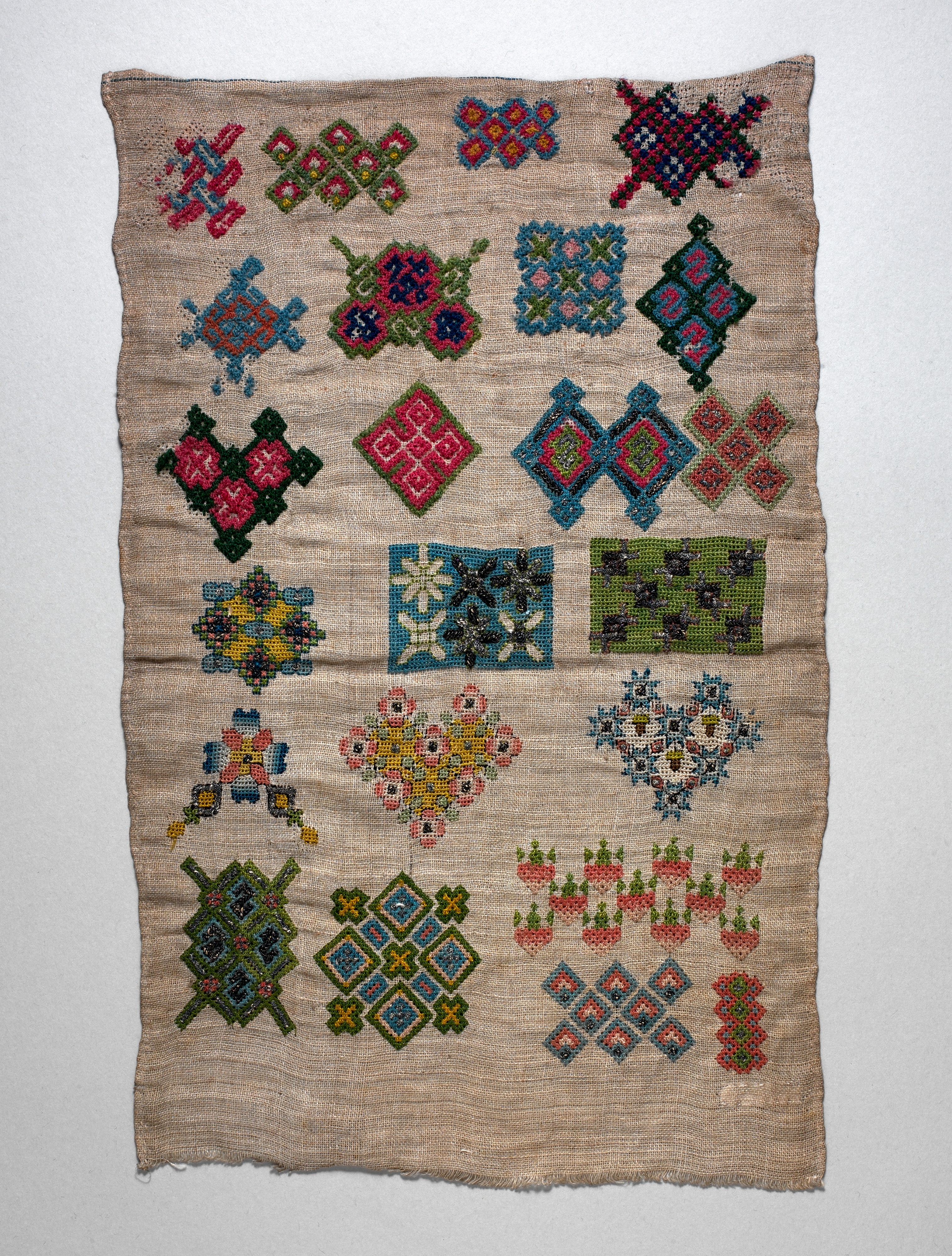
The avant-garde imperative is not to decorate the body, but to interrogate its very architecture. In the hallowed confines of Zoey Fashion Laboratory, we do not merely observe artifacts; we dissect them as blueprints for a future yet unstitched. The subject of this definitive analysis—a sampler bearing geometric motifs, hailing from the nebulous origin of the Global Frontier, and rendered in silk, wool, and silver thread on a ground of linen—presents a paradox of material humility and conceptual audacity. For the Spring/Summer 2026 (SS26) season, this object is not a nostalgic relic. It is a manifesto. It is a coded schematic for a new corporeal topology, one that rejects the passive drape of the past in favor of an active, structural dialogue between the human form and the garment’s own deliberate, almost architectural, will.
Our laboratory’s methodology eschews the superficial reading of pattern as mere ornament. Here, the geometric motifs are understood as a primitive computational language—a pre-digital algorithm of order, repetition, and rupture. The sampler’s construction, a meticulous layering of silk’s fluid luminescence, wool’s dense, fibrous memory, and silver thread’s conductive, reflective energy, offers a tripartite material system that is ripe for radical extrapolation. The linen ground, humble and unyielding, serves as the foundational chassis. This is not a textile; it is a structural composite, a progenitor of the future garment’s exoskeletal logic.
Deconstructive Topology: From Flat Sampler to Three-Dimensional Silhouette
The first act of our transmutation is the violent, yet precise, deconstruction of the sampler’s planar geometry. The squares, diamonds, and chevrons are not to be confined within a two-dimensional frame. Instead, they become the generative nodes for a new form of garment architecture. We propose a silhouette that is fundamentally sculptural, one that moves away from the body-hugging or the voluminous, toward a state of active tension. Imagine a jacket where the front panel is a direct, enlarged transcription of the sampler’s central medallion, but engineered with internal boning and cantilevered seams that project the motif outward, creating a three-dimensional relief that sits several centimeters from the torso. This is not a print; it is a topographical elevation. The silver thread, in this context, is not merely embellishment but a functional tracing of the garment’s load-bearing seams, conducting both visual light and structural stress.
The future of SS26, as dictated by this artifact, lies in a silhouette we term the “Geometric Carapace.” It is a form that suggests a protective, almost ceremonial armor, yet is rendered with the suppleness of silk and the breathability of linen. The wool is used for its felting and shrinking properties, allowing us to create areas of controlled collapse—zones where the fabric is manipulated to buckle and fold in a pre-determined, geometric pattern, creating a dynamic interplay of shadow and light. This is a deliberate counterpoint to the rigid, projected elements. The body becomes a landscape of peaks and valleys, of hard and soft, of projected and recessed. The garment does not follow the body; it engages in a dialogue of forces with it.
Material Alchemy: The Conductive and the Organic
Material science is the bedrock of our avant-garde practice. The silk, wool, and silver thread are not passive participants but active agents in the design process. The silk, in its raw and un-spun forms, is utilized to create a skin-like underlayer, a second epidermis that is both sensuous and resilient. It is the base onto which the structural elements are fused, not sewn, using a process of heat-activated bonding that eliminates traditional seam allowances, creating a seamless, almost organic, integration of parts.
The wool, specifically a tightly woven twill, is subjected to a process of selective carbonization. This chemical treatment partially degrades the cellulose impurities, allowing us to create intricate, lace-like perforations that follow the sampler’s geometric grid. These are not random holes; they are negative spaces that form part of the overall pattern, reducing weight and enhancing ventilation while maintaining incredible tensile strength. The silver thread is then woven into these perforations, not as a flat embroidery, but as a three-dimensional lattice, creating a micro-architecture that can flex and move with the body. This conductive network is not just for aesthetics; it is a speculative interface, a nod to wearable technology that reads the body’s biometric data and adjusts the garment’s tension accordingly. The future is not in adding screens, but in weaving intelligence into the very fabric of our being.
Structural Innovation: The Articulated Frame and the Fluid Core
The most radical innovation derived from this sampler is the concept of the “Articulated Frame.” Traditional couture uses a rigid corset or a soft drape. We propose a third way: a garment that is a hybrid of both, using the geometric motifs as hinged joints. The silver thread, in a thicker gauge, is used to create a network of exoskeletal struts that run along the seams, mimicking the structural ribs of a leaf or the chassis of a futuristic vehicle. These struts are not fixed; they are connected by a system of micro-pivots, allowing the wearer to alter the silhouette’s volume and angle with a subtle shift of the shoulder or hip.
Consider a skirt that starts as a slim column at the waist, but as it descends, the geometric panels begin to fan out, locked into place by these silver pivots. The wearer can, with a deliberate gesture, release a catch and let the skirt collapse into a fluid drape of silk and wool, or re-engage the struts to create a dramatic, architectural volume that stands independent of the body. This is transformative couture; it is a garment that is not a static object but a dynamic instrument. The linen base, treated with a resin finish, provides the necessary rigidity for these pivot points, ensuring the structure holds its shape while remaining lightweight and breathable.
This approach fundamentally redefines the relationship between garment and wearer. The wearer is no longer a passive mannequin but an active operator, a co-author of the silhouette. The garment becomes a tool for personal expression, a kinetic sculpture that responds to the wearer’s will. The geometric motifs of the sampler are thus liberated from the frame of the cloth, becoming the functional grammar of a new, dynamic body. This is the true legacy of the Global Frontier sampler: not a pattern to be copied, but a system to be decoded and re-engineered for a future where clothing is not just worn, but wielded.
In conclusion, the Zoey Fashion Laboratory’s SS26 collection, born from this singular artifact, is a testament to the power of radical reinterpretation. We have taken a piece of domestic craft and elevated it to the level of high-concept structural engineering. The result is a line of garments that are at once ancient and futuristic, organic and mechanical, soft and unyielding. They are not for the faint of heart, but for the avant-garde warrior who understands that true innovation lies not in the new, but in the audacious re-framing of the old. The sampler was the seed; our collection is the bloom of a new, geometric dawn.