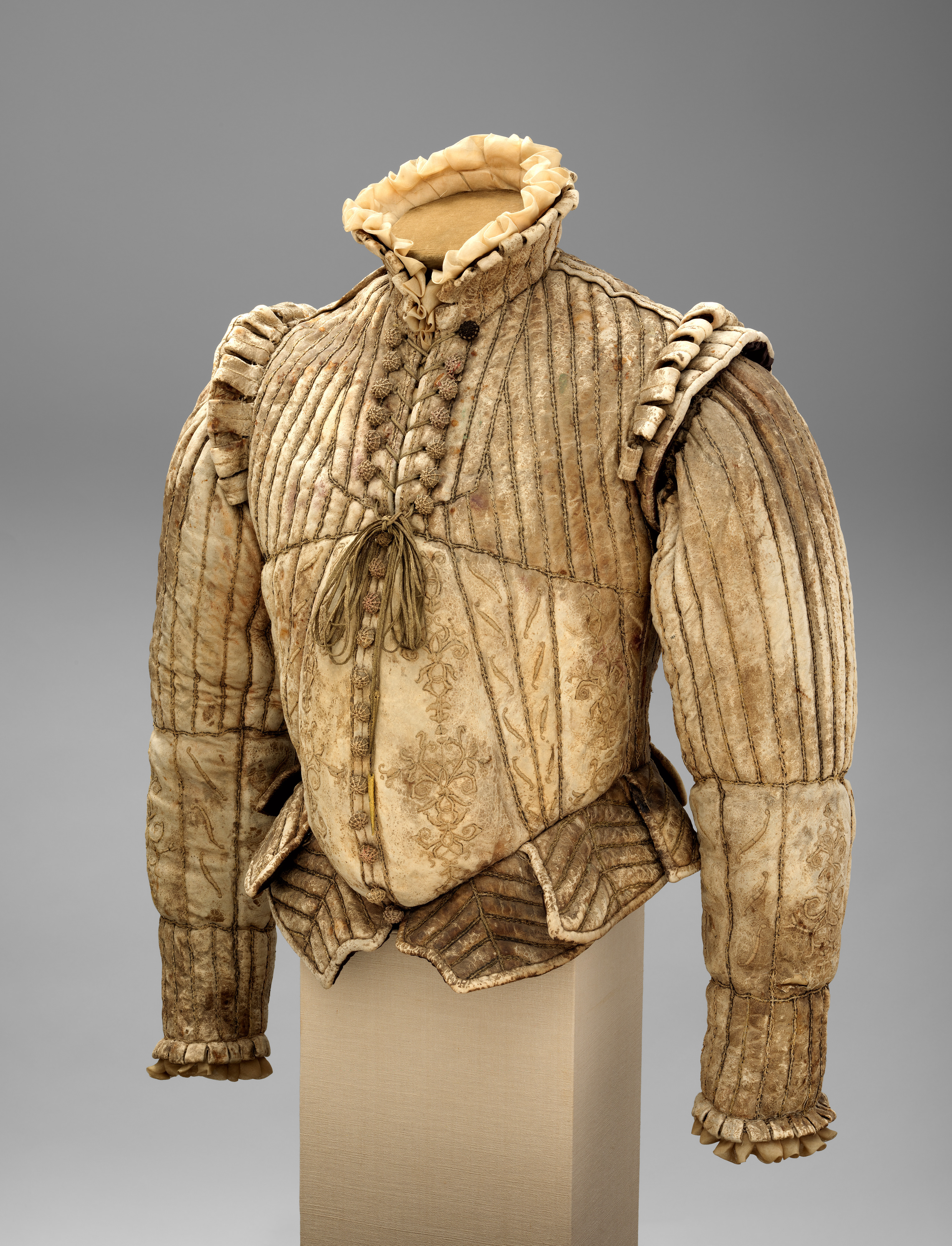
The Jerkin Reconstructed: An Avant-Garde Autopsy for SS26
The jerkin—that stalwart of Western European menswear, a vestigial shell of utilitarian armor—has long been confined to the amber of historical dress. For Zoey Fashion Laboratory’s SS26 directive, we reject the jerkin as relic. Instead, we dissect it as a primitive exoskeleton, a modular chassis awaiting radical reprogramming. Our analysis moves beyond mere silhouette to interrogate the garment’s structural DNA, its relationship to the human form, and its potential as a vehicle for futuristic sartorial architecture. The jerkin is not a jacket; it is a boundary condition—a membrane between body and environment. In this standalone study, we propose its violent, elegant evolution.
Deconstructing the Historical Shell: From Armor to Interface
Originating in 16th-century Western Europe, the jerkin was a practical garment—a fitted, sleeveless doublet worn over the shirt, often constructed from leather for defense or silk for courtly display. Its historical function was containment and protection, a rigid carapace that disciplined the torso into a masculine, conical ideal. But the avant-garde imperative is not preservation; it is rupture. For SS26, we strip the jerkin of its historical nostalgia and re-contextualize its materials—leather, silk, linen, cotton—as a palette of reactive, intelligent surfaces. The leather is no longer cured hide but bio-tanned, laser-perforated membrane; the silk is no longer luxury drape but structural tension webbing; the linen and cotton become compressed, resin-bonded composites. This is not historical revival; it is archaeological futurism.
Silhouette as Architecture: The Asymmetric Torsion Form
Our primary intervention is the asymmetric torsion silhouette. Traditional jerkins are symmetrical, mirroring the body’s bilateral symmetry. We break this axis. The SS26 jerkin features a single, sweeping diagonal seam that begins at the left shoulder, cuts across the sternum, and terminates at the right hip. This seam is not decorative; it is a load-bearing structural element, engineered to create a permanent, three-dimensional twist in the garment’s fabric. The result is a torso that appears to be in a state of kinetic arrest—a freeze-frame of a rotational movement. The front panel is elongated, extending past the waist to form a sharp, blade-like point, while the back panel is cropped, exposing the lumbar spine. This differential volume creates a dramatic, sculptural profile that challenges the wearer’s static posture, forcing a new, dynamic stance.
Material Alchemy: The Reactive Composite System
Materiality is the cornerstone of our innovation. We propose a three-layer composite system that re-engineers the jerkin’s historical materials. The outer layer is a hand-burnished, vegetable-tanned leather, but treated with a micro-embossed, hexagonal pattern that mimics the tessellation of future armor. This pattern is not merely visual; it creates a directional flexibility, allowing the leather to bend along specific axes while remaining rigid on others. The middle layer is a fluid silk membrane, suspended in tension between the leather shell and an inner cotton-linen mesh. This silk is not passive; it is pleated into a lateral accordion structure that expands and contracts with the wearer’s breath, acting as a living, pneumatic cushion. The innermost layer is a compressed linen-cotton matrix, laser-cut with a lattice of micro-perforations for breathability, but also fused with a thermochromic pigment that shifts from deep charcoal to a ghostly silver when exposed to body heat. This is not a garment; it is a responsive environmental interface.
Fastening as Futurist Ritual: The Magnetic Tension System
Traditional jerkins rely on buttons, laces, or hooks—all mechanical, all visible, all archaic. Our SS26 iteration eliminates all conventional fasteners. In their place, we introduce a magnetic tension system. Embedded along the diagonal seam are a series of neodymium micro-magnets, concealed within leather channels. The closure is not a zip or a button; it is a magnetic kiss. The wearer brings the two edges together, and the magnets snap into alignment, creating a seamless, invisible bond. This system offers more than convenience; it enables a dynamic adjustability. The magnets can be partially separated at the shoulder or hip, creating intentional, controlled gaps that expose the silk underlayer—a deliberate act of structural revelation. This is a futuristic ritual of dressing, where the act of closure is instantaneous, silent, and almost magical. The jerkin becomes a piece of wearable technology, not in a digital sense, but in a purely physical, engineered one.
Volume Manipulation: The Detachable Cape Module
To further expand the silhouette’s potential, we introduce a detachable cape module. This is not a romantic, flowing cape. It is a rigid, cantilevered structure that attaches to the jerkin’s shoulders via a secondary magnetic rail. Constructed from the same composite leather, the cape is pre-molded into a sweeping, aerodynamic arc that extends outward and backward, defying gravity. When detached, it can be folded into a flat, geometric disc and carried as a separate object—a sculptural accessory. When attached, it transforms the jerkin from a torso-hugging shell into a monumental, winged presence. This modularity is key to the avant-garde ethos: the garment is not a fixed object but a system of configurations, allowing the wearer to shift between a compact, aggressive form and an expansive, ceremonial one.
Structural Innovation as Social Commentary
The SS26 jerkin is not merely a formal exercise. Its asymmetric torsion and differential volumes serve as a metaphor for the fragmented, multi-directional pressures of contemporary identity. The exposed lumbar region suggests vulnerability beneath the armored exterior. The thermochromic shift implies a permeable boundary between self and environment. This is a garment that does not hide the body; it re-negotiates the body’s relationship to space and power. The jerkin’s historical role as a marker of status is inverted; here, status is not inherited but constructed through kinetic and material intelligence. The wearer is not a passive display of wealth but an active participant in a formal dialogue about the future of dress.
In conclusion, the jerkin is reborn. It is no longer a historical artifact but a prototype for a new species of garment. By fusing deconstructive aesthetics with rigorous structural engineering, Zoey Fashion Laboratory transforms this Western European archetype into a futuristic instrument of the body. The SS26 jerkin is a manifesto in leather and silk—a declaration that innovation lies not in novelty for its own sake, but in the radical re-reading of what a garment can be. It is architecture, technology, and philosophy, worn on the skin.