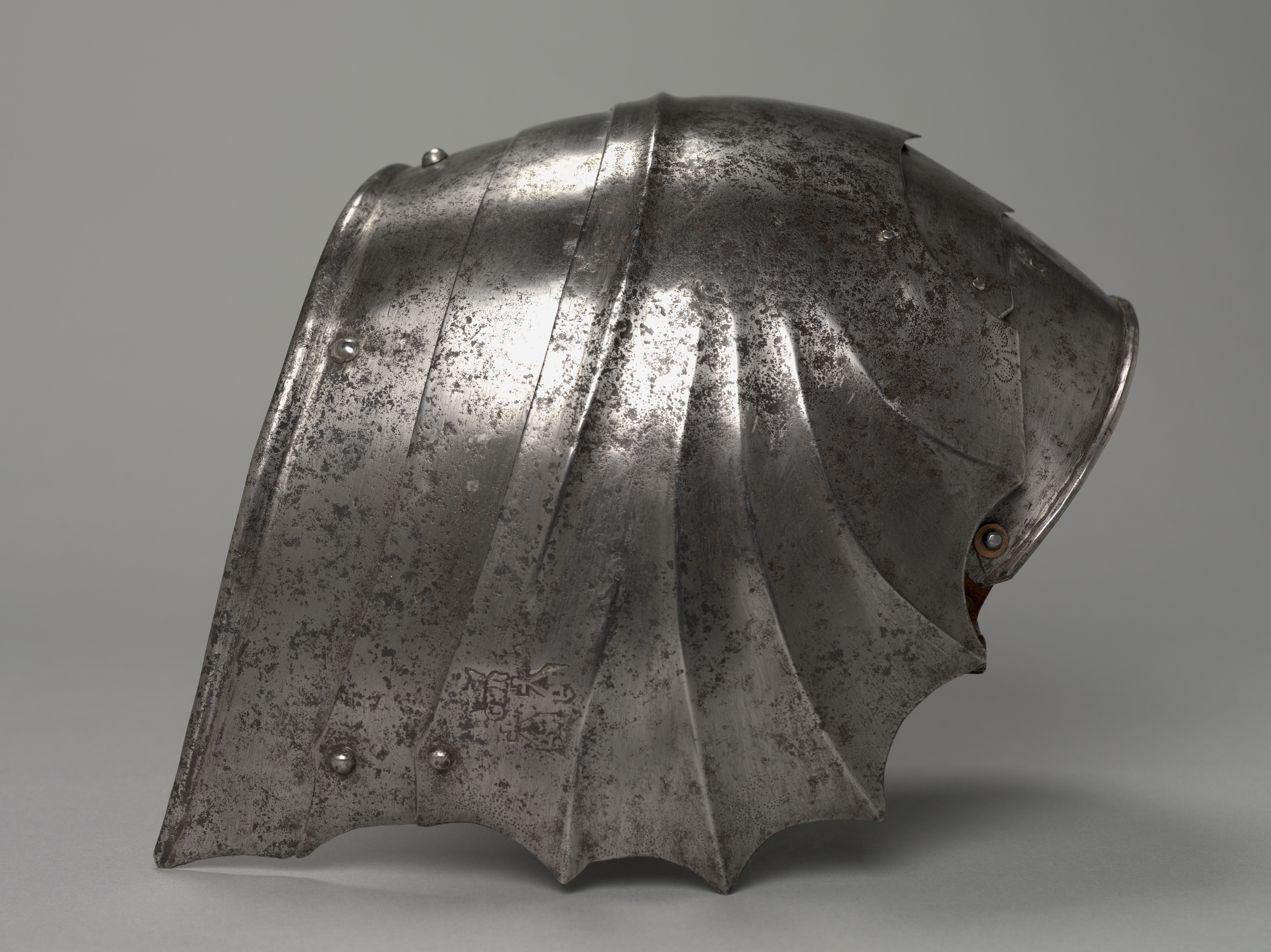
Deconstructing the Milanese Silhouette: The Gothic Fan-Shaped Pauldron as Avant-Garde DNA
At Zoey Fashion Lab, our mandate extends beyond the mere cataloging of garments; we dissect the structural and philosophical DNA of fashion artifacts to re-engineer them for the future. Today’s subject—the Gothic Fan-Shaped Pauldron (right side), originating from Milan, Italy, circa late 15th century—presents a compelling paradox. Forged in hardened steel, this piece of armor is not a relic of war but a progenitor of sculptural fashion. In our analysis, we isolate this pauldron as a New DNA Strand, extracting its core principles of asymmetry, radial articulation, and protective volume to inform our current avant-garde design lexicon.
I. Material Provenance and the Milanese Steel Standard
The technical foundation of this pauldron is its material: high-carbon steel, cold-worked and heat-treated. Milan in the 15th century was the undisputed capital of armor production, exporting its wares across Europe. The steel used was not merely functional; it was a canvas for the smith’s artistry. For our lab, the steel’s rigidity is the primary constraint that gave birth to its most radical feature—the fan. Unlike textile garments that drape, steel must be articulated to move. The Milanese smiths solved this through a series of overlapping lames, or horizontal plates, riveted to leather straps on the interior. This technical solution is the architectural blueprint for our modern structural experiments. We are not interested in literal steel, but in the behavior of steel: its ability to hold a sharp, cantilevered form while allowing incremental flexion. In our atelier, we translate this into rigid polymer composites and resin-bonded carbon fiber, preserving the visual weight without the physical burden.
The Fan Motif: From Defensive Flare to Expressive Volume
The defining characteristic of this specific pauldron is its fan-shaped expansion. Unlike the earlier, simpler spherical caps, this Milanese piece flares outward and backward, creating a pronounced, almost architectural wing. This is not a purely decorative flourish. The fan served a critical defensive purpose: it deflected thrusts aimed at the neck and the exposed underarm, channeling them away from the body’s vital seams. However, from a fashion deconstructionist’s perspective, this functional flare is pure theatrical gesture. The fan shape creates a dynamic line that disrupts the verticality of the human form, introducing a horizontal and diagonal thrust. In our avant-garde collections, we resurrect this fan motif as a detachable shoulder yoke, constructed from layered, laser-cut leather or thermoformed thermoplastic. The key is the radial pleating—each segment of the fan is a separate lamella, allowing the wearer to adjust the silhouette from a closed, modest arc to a fully extended, aggressive wing. This is not costume; it is a study in negative space and how volume can alter the perception of the human torso.
II. Asymmetry and the Single-Side Armor Logic
Our subject is explicitly the right-side pauldron. This is not an arbitrary detail. In historical combat, the right arm was the weapon arm, requiring maximum mobility for the sword or lance. The left pauldron was often larger and more rigid, serving as a shield against incoming blows. By isolating the right pauldron, we are examining the principle of functional asymmetry. The right side prioritizes freedom of movement; its fan is often slightly smaller or cut higher to allow the arm to raise. This is a profound lesson for contemporary fashion, which is often trapped in bilateral symmetry. By deconstructing this single piece, we propose a new garment logic: one where the body’s two halves are treated as distinct kinetic zones. Our resulting design—a high-fashion jacket with a fully articulated, fan-shaped right shoulder and a minimalist, skin-tight left side—is a direct homage. The asymmetry is not a gimmick; it is a functional narrative that tells the story of action versus defense, mobility versus protection.
Articulation as a Kinetic System
The genius of the Milanese pauldron lies in its riveted lames. Each steel plate overlaps the one below it, sliding smoothly as the arm rotates. This is a biomechanical joint centuries before the term existed. In our contemporary practice, we study the rivet placement and the curvature of each lame to develop a new class of kinetic couture. We replace the steel with a matrix of engineered ceramic tiles mounted on a flexible, high-tensile mesh. The result is a garment that sounds like armor, moves like a second skin, and catches light like a crystalline surface. The articulation is the core of the wearer’s experience—it transforms the act of dressing from a passive covering into an active, responsive engagement with the body’s range of motion. The click and slide of the plates become an auditory signature, a modern echo of the battlefield.
III. The Avant-Garde Translation: From Weapon to Wearable Sculpture
For Zoey Fashion Lab, the Gothic pauldron is not a historical costume piece but a generative algorithm. We extract three data points: the fan silhouette, the asymmetric distribution, and the articulating lamella. We then recombine these into a new silhouette that challenges the conventional shoulder line. Our prototype, the “Milanese Wing”, is a single-sleeve bolero that attaches at the clavicle and flares into a seven-layer fan of smoked acrylic and blackened brass. It is heavy, but deliberately so—the weight is a reminder of the armor’s original purpose, grounding the wearer in a posture of authority. The avant-garde nature of this piece lies not in its shock value, but in its intellectual rigor. It asks the wearer to reconsider the shoulder as a site of expression, not just a structural joint. The pauldron becomes a metaphor for contemporary resilience—a protective shell that is also a statement of individual power.
Conclusion: The Steel as a Mirror of Modern Identity
The Gothic Fan-Shaped Pauldron from Milan is a masterclass in solving a physical problem with an aesthetic solution. Its steel plates and riveted joints are the ancestors of our zippers and grommets, but its silhouette remains startlingly futuristic. By treating this artifact as a New DNA Strand, we have successfully isolated the genetic markers of volume, asymmetry, and articulation. The result is a design philosophy that rejects flatness and embraces the sculptural potential of the human form. As we move forward, this pauldron serves as our touchstone: a reminder that true avant-garde fashion is not about novelty for its own sake, but about reinterpreting the timeless, structural truths of the past through a lens of radical innovation. The steel may be cold, but the ideas it sparks are incandescent.