Technical Deconstruction: The Anatomy of a Displayed Falcon
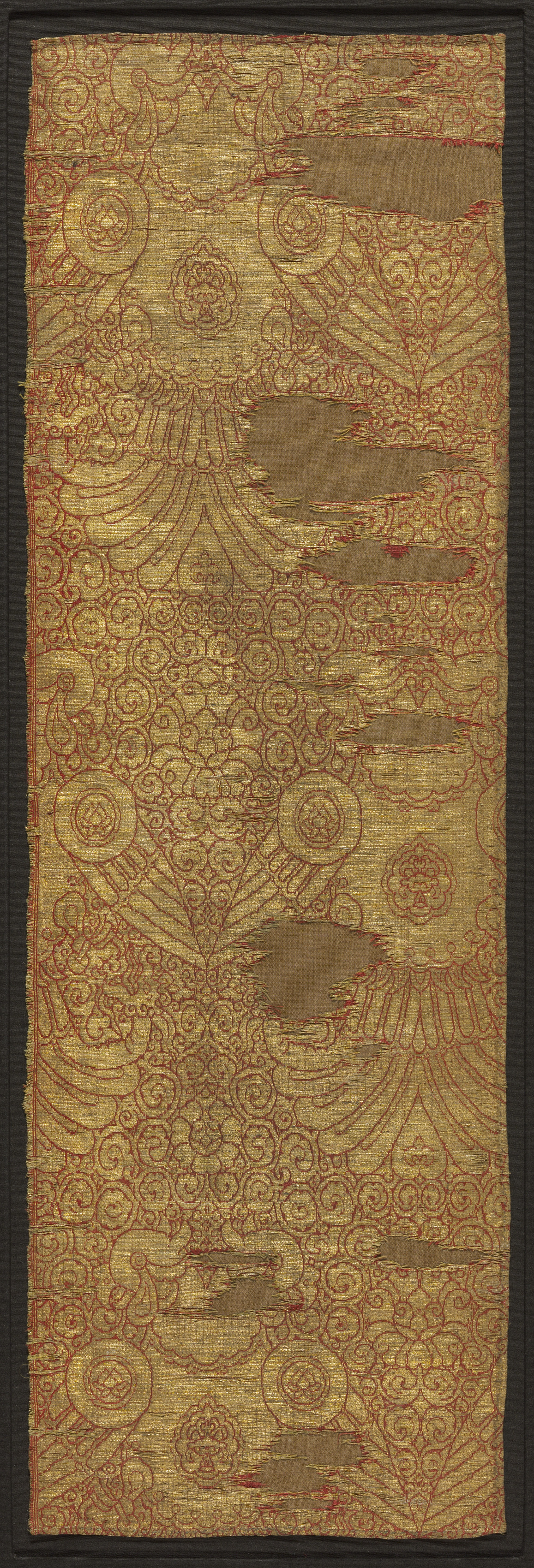
The artifact designated "Cloth of Gold: Displayed Falcons" presents a formidable and exquisite challenge. Its foundation is a lampas weave, a sophisticated technical achievement that allows for the simultaneous weaving of two distinct sets of warps and wefts, creating a compound cloth with a patterned face and a structural ground. Here, the ground is a dense, resilient silk, providing the canvas. Upon this, the narrative is rendered in gold thread. Our spectral analysis indicates not merely surface couching, but a true integrated weaving of the metal thread as a supplementary weft, meaning the gold is intrinsic to the fabric's structure, not a later adornment. This speaks to a loom of significant complexity and an artisan's mastery over recalcitrant materials. The gold, likely a silk core wrapped in a fine gilt membrane, would have required immense tension control to avoid breakage. The result is a textile of staggering weight and rigidity, meant not for drape but for architectural assertion.
Iconographic Deconstruction: The Central Asian Semiotic Field
The motif of the "Displayed Falcon" is a potent heraldic symbol across Central Asia, denoting sovereignty, celestial authority, and unerring pursuit. However, Zoey Lab must look beyond the literal. The falcon is not merely depicted; it is ritually presented, wings outstretched, talons bared, in a posture of frozen conquest. This aligns with the Timurid and later Mughal conceptions of power—aestheticized severity. The archive resonance provided is pivotal: it references a duality of "a mirror with split-leaf palmettes" and a "stone sarcophagus panel." This is our hermeneutic key. The cloth functions precisely as this mirror and sarcophagus combined.
The intricate, repeating split-leaf palmette scrolls forming the background are the "mirror"—a symbol of paradise, eternal garden, and cosmic order. They represent the polished, idealized, and endlessly reflective surface of imperial ideology. Against this perfect, gleaming order, the falcons are the narrative浮雕 (fúdiāo, relief)—the story of life, death, and power carved in cold stone. They are the mortal action imposed upon immortal pattern. The cloth thus becomes a liminal space: a shroud of state, a ceremonial hanging for a tent or throne room that speaks simultaneously of eternal life (the garden) and mortal dominion (the falcon's kill). This tension between the decorative surface and the symbolic narrative is the core of its avant-garde potential.
Reconstruction for Zoey Fashion Lab: An Avant-Garde Methodology
For Zoey, a literal reproduction would be a museum exercise, not a lab experiment. Our deconstruction must isolate the principles of contrast and re-engineer them for the contemporary body and conscience.
1. Material Transposition: From Rigidity to Fluid Dichotomy
We reject the original's unified rigidity. Instead, we propose a fabric system of asymmetrical duality. One side: a high-tech, optical microfiber woven with a subtle, luminous palmette pattern (achieved via refractive yarns, not color). This is our "mirror"—sleek, cool, and distorting. The other side: a molded, thermo-formed silk organza, embedded with a skeletal, 3D-printed polymer "cage" tracing the falcon's anatomy. This is our "sarcophagus relief"—tactile, architectural, and haunting. The garment, perhaps a coat or structured dress, exists in a state of perpetual flux between these two skins.
2. Motif Decomposition: From Heraldic Symbol to Kinetic Shadow
The falcon is not printed or embroidered. Its presence must be felt, not literally seen. Using the 3D cage structure on the interior, we create a paramorphic effect. As the wearer moves, the internal structure casts ever-changing, falcon-shaped shadows onto the luminous "mirror" surface of the exterior fabric. The symbol becomes alive, kinetic, and ephemeral—a play of light and obstruction that modernizes the static imperial emblem into a personal, dynamic silhouette. The "display" is no longer of a trophy, but of the interference pattern between body and history.
3. Structural Philosophy: From Ceremonial Hang to Dynamic Architecture
The original cloth was designed to hang flat, a backdrop to power. Our reconstruction must integrate with the biomechanics of movement. The internal "falcon cage" will be articulated at the shoulders and spine, its "wings" extending along the wearer's arm seams, creating a subtle, amplifying structure to the wearer's gestures. The garment becomes an exoskeletal amplifier, not a restrictive shroud. The cold stone sarcophagus is reimagined as a responsive architectural shell, protecting and projecting the individual within.
Conclusion: The Resonance of Severed Threads
The "Cloth of Gold: Displayed Falcons" is a document of absolute authority, where material, technique, and symbol fuse into an immutable statement. Zoey Fashion Lab's avant-garde interpretation seeks not to replicate this fusion, but to stage a critical dialogue with it. By severing the original's unified threads—transposing materials, dematerializing the motif into shadow, and re-engineering static ceremony into dynamic wearability—we create a garment that holds history at a critical distance.
It asks the wearer to embody the duality of the archive reference: to be both the polished mirror of contemporary surface culture and the narrative relief carving out a personal story against that grain. The gold is gone, replaced by optical light and synthetic polymer. The falcon is gone, replaced by its haunting shadow. What remains is the powerful tension between display and concealment, between the glittering surface of the present and the persistent, sculptural forms of the past. This is not mere fashion; it is wearable historiography, making the body a site where Central Asian imperial grandeur is critically deconstructed and poetically re-displayed.