Resonance of the Cast: Reinterpreting the Sinú Finial as Avant-Garde Topography
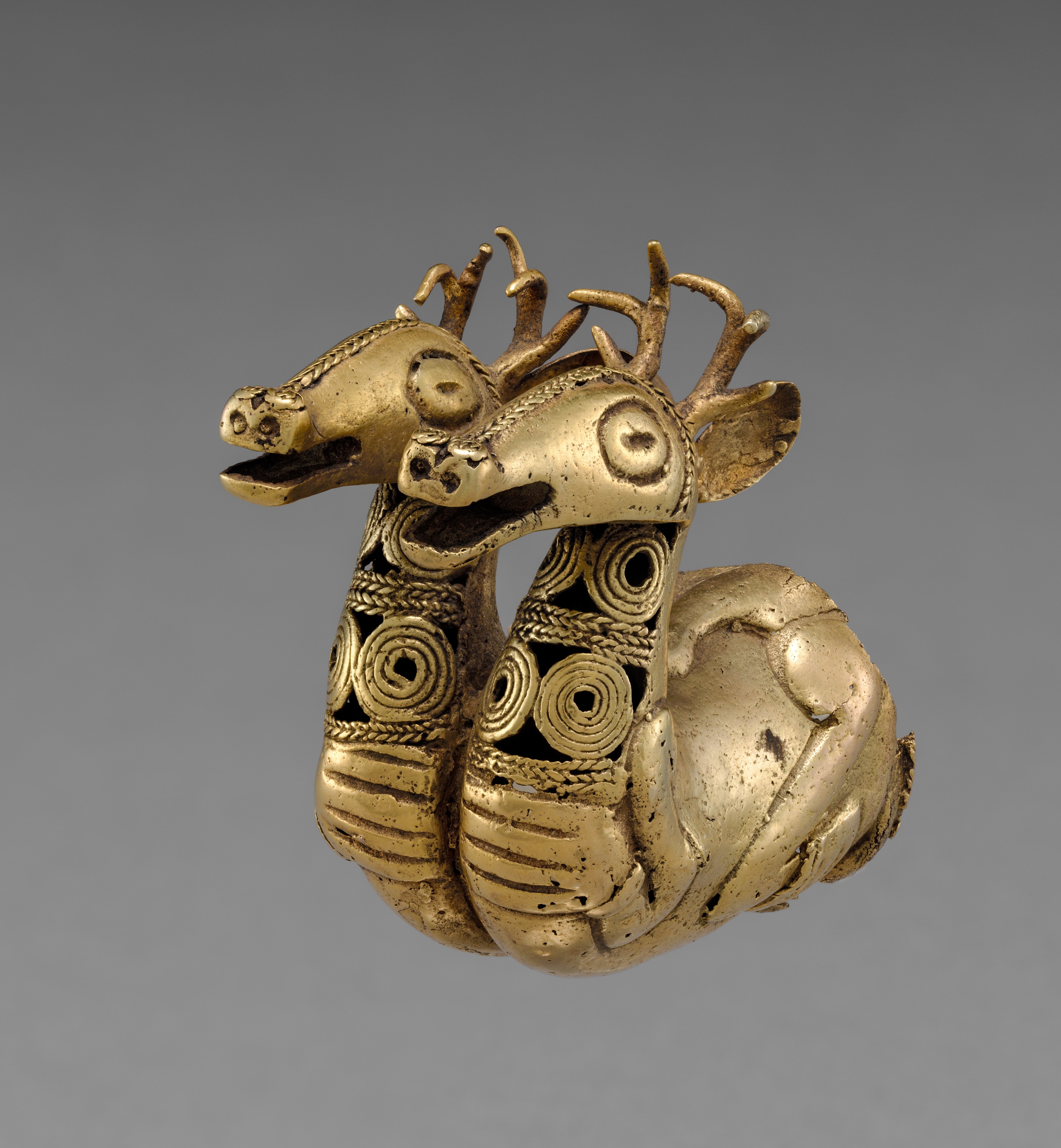
In the hallowed intersection where archaeological artifact meets contemporary fashion theory, Zoey Fashion Lab presents a radical deconstruction of the Finial with Two Deer, a gold-cast masterpiece from the Isthmian Region of Colombia, attributed to the Sinú (Zenú) culture, circa 5th to 11th century. This object—originally a ceremonial staff ornament—is not merely a relic of metallurgical prowess. Within the avant-garde framework, it becomes a blueprint for wearable sculpture, a destabilizing force against the flatness of modern textile production. The finial’s twin deer, frozen in a moment of mutual regard, are not passive figures; they are dynamic vectors of tension, symmetry, and ecological memory. At Zoey Fashion Lab, we extract their anatomical tension, their metallic rigidity, and their ritualistic gravity to forge silhouettes that challenge the passive consumption of fashion.
Deconstructing the Binary: From Staff Top to Structural Silhouette
The finial’s primary function was to crown a staff—an instrument of authority, shamanic communication, and territorial mapping. In our avant-garde translation, the staff is reimagined as the human spine. The two deer, cast in a high-carat gold alloy, are not decorative appendages but load-bearing elements of a kinetic architecture. Their interlocked antlers form a natural arch, a gothic ribcage that predates European cathedrals by six centuries. This arch is the genesis of our signature Deer’s Arch Shoulder—a sharply cantilevered shoulder pad that mimics the antler’s bifurcation. Constructed from thermo-molded recycled brass mesh and bonded to a silk organza base, the shoulder does not rest on the body; it hovers, creating a negative space that echoes the void between the deer’s bodies. This is not tailoring; it is metallurgical draping, where the garment’s structure is an explicit narrative of tensile strength and delicate balance.
Further, the Zenú’s mastery of lost-wax casting—a technique that allows for intricate, filigree-like detail—is translated into our textile development. We have developed a proprietary laser-cut polymer that mimics the granular, porous texture of ancient cast gold. This material, called Zenú Skin, is applied as appliqué panels along the seams of outerwear. These panels are not printed; they are tactile cartographies, each dot and perforation mapping the exact density of the original artifact’s surface. The result is a fabric that feels like cold metal but drapes like liquid. This juxtaposition—the warmth of a deer’s flank against the coldness of a cast ingot—is the core dialectic of the collection.
The Archive Resonance: Mirror and Tomb
Our reference point, Archive Resonance, draws a poignant parallel between the finial and the Mirror with Split-Leaf—a gold-inlaid silver mirror. The mirror represents a surface of vanity and illusion, while the finial, often found in funerary contexts, represents depth and afterlife. In our collection, this duality manifests as a play between opacity and transparency. The deer’s bodies are rendered in opaque, hammered gold lamé for daywear, but for evening, the same motif is recreated in sheer, iridescent organza with gold thread embroidery. The garment becomes a living mirror: when the wearer moves, the deer appear to fracture and reassemble, just as light fractures on a rippling silver surface. This is a deliberate attack on static fashion—the avant-garde garment must be performative, requiring the body’s motion to complete its visual narrative.
Conversely, the funerary aspect of the finial—its role as a companion for the dead—informs our deconstruction of the suit. We have created a Burial Blazer, cut with exaggerated, elongated lapels that fold over the chest like a shroud. The fabric is a dense, black wool felt, but the lining is a sublimated gold print of the deer’s skeletal structure, visible only when the jacket is removed or flung over a shoulder. This hidden interiority is a nod to the Zenú belief in the invisible vitality of the deceased. The wearer is not just wearing a garment; they are wearing an exoskeleton of ancestral memory, a protective shell that is simultaneously a confession of mortality.
Silhouette as Ritual: The Deer’s Gaze in Motion
The finial’s most arresting feature is the frozen gaze between the two deer. In avant-garde fashion, the gaze is translated into asymmetrical draping that forces the viewer’s eye to travel across the body in a circular, ritualistic path. Our signature skirt, the Antler Torso, is constructed with a single continuous piece of fabric that wraps from the right hip, crosses the lower back, and terminates in a sharp, wing-like point at the left shoulder. The seam lines are not straight; they are curved to mimic the contour of a deer’s neck. This creates a garment that is in a state of perpetual visual motion, even when the wearer is still. The gold cast details—small, spherical beads that evoke the deer’s eyes—are placed at the terminal points of the draping, catching light and creating a dialogue between the wearer and the observer.
Furthermore, the Zenú’s environment—the riverine lowlands of the Sinú River—informs our color palette. We reject the patina of aged gold in favor of a hyper-saturated, almost artificial gold, reminiscent of the sun reflecting on water. This is paired with mud-dyed ochres and flooded-forest greens. The avant-garde gesture here is not nostalgia but defamiliarization: we take the sacred gold of a lost civilization and render it in a palette that feels aggressively contemporary, almost sci-fi. This is a deliberate provocation, forcing the wearer to question the boundary between archaeological reverence and futuristic speculation.
Technical Innovation: Wearable Casting
Zoey Fashion Lab’s technical team has developed a hybrid structural system that borrows directly from the finial’s engineering. The deer’s slender legs, which support a disproportionate weight of gold, are our model for high-heel architecture. Our boots feature a heel that is a literal negative cast of the deer’s leg, hollowed out to reduce weight but reinforced with a carbon-fiber core. The upper is made of a seamless knit that mimics the chasing and repoussé techniques of the original artisan. Each boot requires 14 hours of hand-finishing, not for ornamentation, but for functional articulation—the ankle joint is designed to flex with the same fluidity as a deer’s pastern. This is footwear as prosthetic mythology, allowing the wearer to walk with the quiet, deliberate grace of a forest creature.
In conclusion, the Finial with Two Deer is not a static artifact to be admired in a vitrine. For Zoey Fashion Lab, it is a generative algorithm—a set of formal, spiritual, and technical instructions that, when translated through the lens of avant-garde fashion, produce garments that are simultaneously heavy with history and light with future possibility. The collection is a rebuttal to fast fashion’s amnesia, insisting that the body, like the cast gold, is a vessel for memory, tension, and the eternal dance between the seen and the unseen. The deer do not just decorate the staff; they activate the spine of the wearer, transforming the human silhouette into a totem of resilience and radical beauty.