Executive Analysis: The Battle Axe as a Structural Blueprint for Avant-Garde Construction
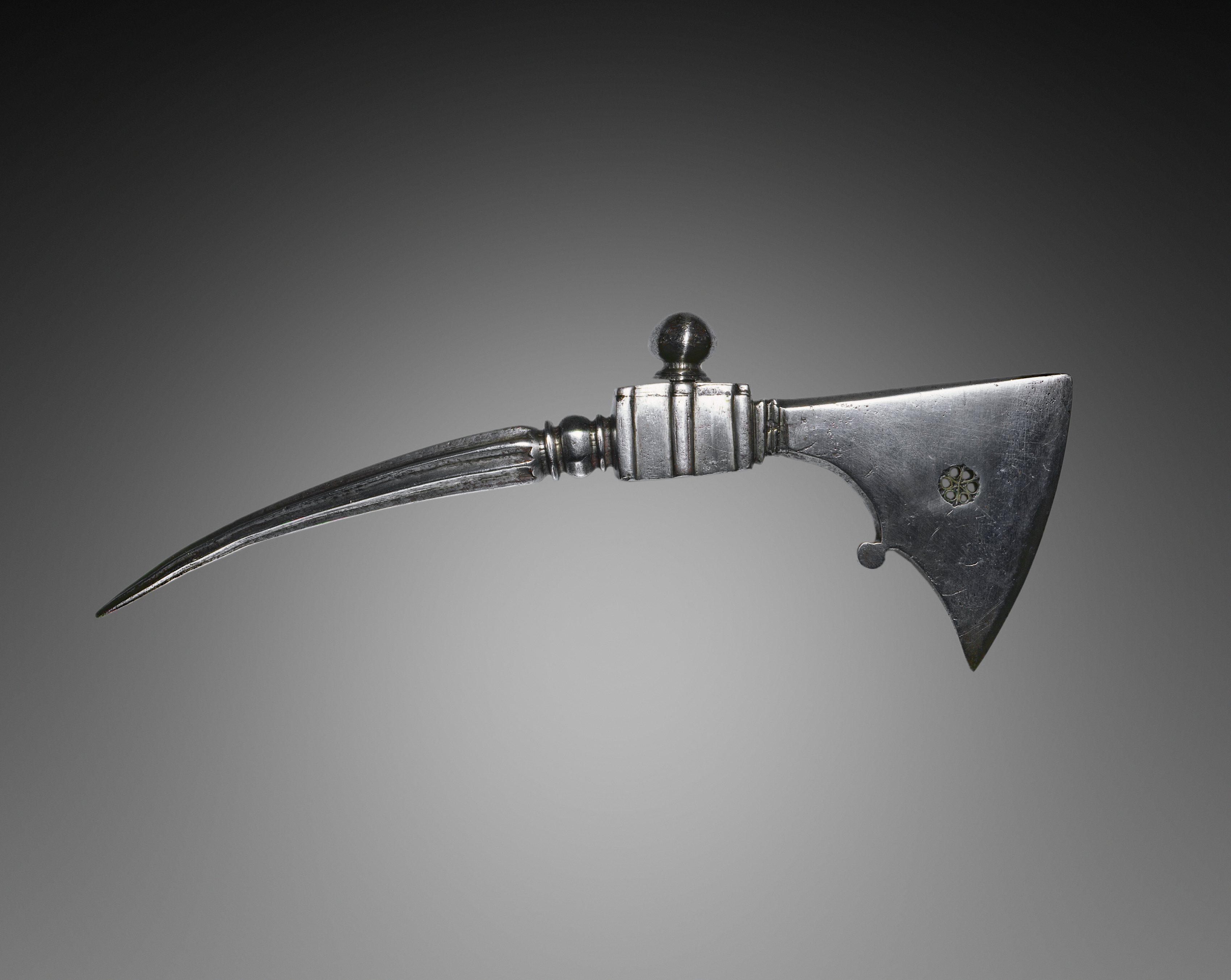
At Zoey Fashion Lab, our mandate is not merely to observe historical artifacts but to deconstruct their physical logic and re-sequence their material DNA into wearable architecture. The subject of this analysis—a late 16th-century Italian battle axe, forged in steel and inset with copper rosettes—presents a paradoxical lexicon of brutality and ornament. While its primary function was martial, its secondary language is one of deliberate, artisanal embellishment. This dichotomy forms the core of our new design strand, which we term “Ferrous Ornamentalism.” This report dissects the axe’s technical anatomy, its metallurgical contrasts, and its historical syntax to propose a framework for avant-garde silhouettes that challenge the softness of contemporary fashion.
I. Metallurgical Dichotomy: The Steel and Copper Dialogue
The axe’s primary material—high-carbon steel—represents the pinnacle of Renaissance military metallurgy. Its surface, likely darkened or blued for corrosion resistance, offers a matte, absorptive quality that rejects light. In contrast, the inset copper rosettes introduce a warm, reflective, and distinctly non-ferrous accent. This is not a random decorative choice; it is a calculated tension between functional mass and decorative precision.
For Zoey Fashion Lab, this translates directly into fabric and construction strategy. We propose a two-layer textile system. The base layer will be a rigid, densely woven carbon-fiber-infused wool, mimicking the axe’s structural gravity and matte finish. This fabric will be cut with zero ease, creating a shell that stands away from the body, much like the axe head’s profile. The secondary layer consists of hand-patinated copper mesh, applied in rosette-shaped appliqués along the seams and collar. This is not a simple print; the copper is physically inset, riveted through the wool using oxidized brass grommets, echoing the axe’s forged attachment method. The visual result is a garment that appears both immovable and precious—a paradox where the wearer becomes a mobile fortress adorned with jewelry.
II. Silhouette Geometry: The Asymmetrical Crescent
The battle axe’s defining feature is its crescent-shaped blade, which arcs asymmetrically from the haft. This geometry—a sweeping, off-center curve that terminates in a sharp point—is the primary structural DNA we extract for this strand. Traditional fashion symmetry relies on balance; the axe demands dynamic imbalance.
Our proposed silhouette is a deconstructed overcoat with a single, exaggerated shoulder cape. The cape’s hemline will be cut in a parabolic arc, descending sharply from the left shoulder to a point at the right hip, mimicking the blade’s edge. The right sleeve will be eliminated entirely, replaced by a detachable, rigid cuff that extends beyond the hand, referencing the axe’s poll (the blunt back). The left side of the garment will be elongated, trailing behind the wearer like a haft, while the right side is cropped above the waist. This creates a visual torque—the garment appears to be mid-swing, frozen in a moment of violent elegance. The internal structure will be reinforced with molded thermoplastic boning, not for shaping the body, but to maintain the garment’s independent, sculptural stance, ensuring the silhouette does not collapse under its own weight.
III. Surface Treatment: The Patina of Conflict
Beyond its geometry, the axe’s surface tells a story of use, oxidation, and time. The steel bears micro-scratches from combat, while the copper rosettes have developed a greenish verdigris in the crevices. We interpret this not as damage, but as a narrative of environmental interaction. Our fabric surface must therefore resist the sterile perfection of new textiles.
We will employ a technique of controlled chemical distressing on the wool base. Using a dilute ferric chloride solution, we will selectively etch the fabric’s surface to create a mottled, uneven texture that mimics the pitting of aged steel. This is not a random destruction; it is mapped to the garment’s stress points—the elbows, the underarm, the leading edge of the cape. The copper appliqués will be pre-oxidized in a humidity chamber to develop a natural patina, then polished on their highest points to reveal the bright metal beneath. The result is a garment that appears to have been worn through centuries of conflict, yet is freshly constructed—a temporal paradox that aligns with avant-garde fashion’s obsession with distressed futurism.
IV. Fastening and Closure: The Haft Mechanism
The axe’s haft is the intermediary between the weapon and the wielder. In our design, the haft translates into the garment’s closure system. Traditional buttons and zippers are rejected. Instead, we propose a skeletal steel clasp system—a series of articulated, claw-like hooks that interlock along the side seam. These clasps are forged from stainless steel, but each is inset with a small, cabochon-cut copper rosette, echoing the axe head’s detailing.
The closure is not discreet; it is a prominent, functional sculpture. To fasten the garment, the wearer must physically engage with these mechanisms, a ritualistic act that recalls the arming of a soldier. The clasps are positioned asymmetrically, following the crescent hemline, forcing the garment to drape in a specific, controlled manner. This hardware is not an afterthought but a primary design element, bridging the gap between armor and couture.
V. Contextual Styling and Conceptual Framing
Within the “New DNA Strand,” this piece is not intended for daily wear. It is a statement of extremity, a wearable manifesto against the tyranny of comfort. Styling will be stark: the wearer will be barefoot, with the head shaved, and the skin painted in a matte, gunmetal pigment. The garment will be worn over a single, sheer layer of silk organza, dyed in a deep, blood-rust tone—a subtle nod to the axe’s lethal purpose. The overall presentation is one of controlled violence—a silent, armored figure whose presence disrupts the passive softness of the runway.
The Italian origin of the piece is crucial. Renaissance Italy was the crucible of both high art and mercenary warfare, producing objects that were simultaneously utilitarian and exquisite. Our design honors this duality. It rejects the modern separation of function and ornament, insisting that a garment can be both a weapon of psychological presence and a masterpiece of metallurgical craft. The copper rosettes, in particular, are a deliberate reference to the fleur-de-lis and other decorative motifs found on Milanese armor, elevating the axe from a peasant’s tool to a nobleman’s accessory.
VI. Technical Implementation and Fabrication Challenges
Executing this design requires a hybrid atelier. The wool base will be cut and assembled by traditional tailors, but the thermoplastic boning and carbon-fiber reinforcement require industrial molding equipment. The copper appliqués must be hand-fabricated by a metalsmith, not a fashion technician. This cross-disciplinary approach is the hallmark of Zoey Fashion Lab’s avant-garde research. We estimate a production time of 120 hours per garment, with a material cost exceeding standard couture by 300% due to the precious metal content. However, the conceptual value is immeasurable—it positions the wearer as a living artifact, a bridge between the brutal past and an uncertain, armored future.
In conclusion, the Italian battle axe provides a perfect blueprint for our new strand. Its steel offers structural rigidity, its copper offers warmth and contrast, and its crescent form offers a dynamic, anti-symmetric silhouette. By deconstructing these elements and re-sequencing them through modern fabrication, we create a garment that is not merely clothing, but a sculptural commentary on power, protection, and the enduring human desire to adorn that which is dangerous.