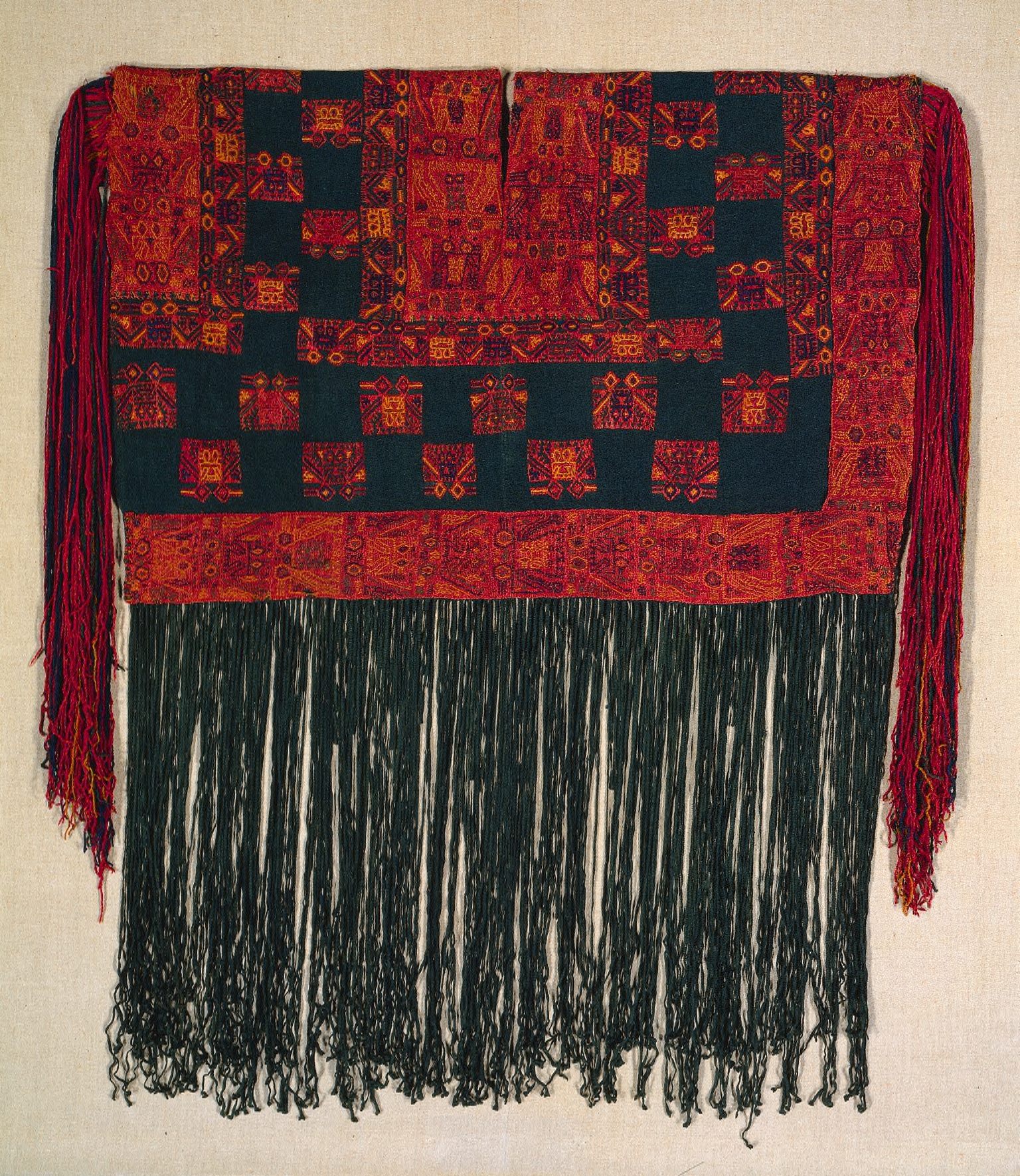
Deconstructing the Paracas Cavernas Tunic: An Avant-Garde Blueprint for Zoey Fashion Lab
The tunic, a garment of seemingly simple geometry, becomes a profound narrative device when examined through the lens of cultural archaeology. At Zoey Fashion Lab, we do not merely study historical textiles; we dissect them to understand their structural DNA and translate their ancient logic into a contemporary, avant-garde vernacular. The subject of this analysis—a Paracas (Cavernas) style tunic from the South Coast of Peru, crafted from alpaca wool—is a masterclass in proto-constructivist design. Its technical execution, a combination of plain weave, intricate embroidery, and warp substitution, predates modern textile engineering by two millennia. This garment is not a relic; it is a blueprint for radical, structural fashion.
Technical Provenance: The Architecture of Alpaca and Warp
The foundational material—alpaca wool—is the first point of departure. Unlike the sheep’s wool prevalent in European textile history, alpaca fiber offers a unique combination of tensile strength, thermal regulation, and a natural, silky luster. For the avant-garde designer, this is not merely a fabric; it is a structural composite. The plain weave base provides a stable, grid-like substrate, reminiscent of a minimalist canvas. However, the genius of the Paracas weaver lies in the deliberate disruption of this grid. The technique of warp substitution—whereby threads of different colors are introduced during the weaving process to create geometric blocks and bands—transforms the two-dimensional surface into a topographic map of intention. This is not surface decoration; it is integral construction. The pattern is the weave, and the weave is the pattern. For Zoey Fashion Lab, this validates a core avant-garde principle: ornament is structure. We reject appliqué in favor of engineered textiles where the design is locked into the very warp and weft of the garment.
Embroidery as Dissonance: The Cavernas Aesthetic
The Paracas Cavernas style, named for the deep, bottle-shaped tombs where these textiles were found, is characterized by a fierce, almost chaotic energy. Unlike the later, more refined Paracas Necropolis style, Cavernas embroidery is bold, graphic, and often employs high-contrast color palettes—deep indigos, ochre reds, and stark whites. The embroidery is executed with a needle, often using a stem stitch or a variant of cross-stitch, to outline and fill anthropomorphic and zoomorphic figures—condors, felines, and shamanic beings. In our analysis, this embroidery functions as controlled dissonance. It is a layer of hand-applied information that sits atop the mechanical precision of the warp-substituted weave. This juxtaposition—the rigid, mathematical grid versus the fluid, expressive hand—is the very essence of avant-garde tension. It is the collision of the rational and the irrational, the Apollonian and the Dionysian. For our lab, this translates into a design philosophy where machine-cut, geometric silhouettes are deliberately interrupted by hand-finished, irregular details—raw seams, exposed threads, or asymmetric draping that mimics the organic flow of the embroidered line.
Archive Resonance: Bridging the 16th Century and the Future
The reference to "Archive Resonance" and the 16th to 17th centuries is critical. This period marks the violent collision of the Andean and Iberian worlds, a moment of cultural syncretism that is deeply embedded in the textile history of Peru. While the Cavernas tunic predates this, its survival and subsequent interpretation are filtered through this colonial lens. The resonance we seek at Zoey Fashion Lab is not nostalgic; it is discordant and provocative. We acknowledge that the tunic is a site of cultural negotiation. The geometric abstraction of the Paracas weavers is often misread as mere decoration, but it is a complex semiotic system—a visual language encoding kinship, cosmology, and status. In our avant-garde reinterpretation, we strip the iconography of its literal meaning but retain its structural syntax. We are not copying the condor or the feline; we are abstracting the rhythm of the pattern, the tension between negative and positive space, and the logic of the warp substitution to create new, non-representational forms. This is the resonance of a code, not a copy.
Silhouette and Form: Deconstructing the Tunic's Geometry
The tunic's silhouette is fundamentally a rectangle with a central neck slit. In its original context, it was a poncho-like garment, a tube of fabric folded and sewn at the sides. For the avant-garde, this rudimentary form is a point of departure for extreme exploration. We propose a radical re-proportioning of this basic shape. Imagine the tunic deconstructed into its constituent parts: the front panel, the back panel, and the side seams. At Zoey Fashion Lab, we would:
- Fragment the Grid: Slice the primary rectangle into asymmetric panels, re-joining them with visible, engineered seams that mimic the warp substitution lines.
- Subvert the Neckline: Transform the simple slit into a dramatic, architectural cowl or a sharp, asymmetric cut-out that exposes the clavicle, referencing the ritualistic exposure of the body in shamanic practice.
- Weight and Movement: The dense alpaca weave has a substantial drape. We would exploit this by adding internal weights or integrating metallic threads into the warp, creating a garment that moves with a deliberate, sculptural heaviness—a kinetic sculpture rather than mere clothing.
Color Theory as Ritual
The Paracas palette is not arbitrary. The deep reds are derived from cochineal insects, the blues from indigo, and the yellows from various plants. These are not just colors; they are substances with ritual power. In our avant-garde application, we treat color as a material, not a hue. We would experiment with bio-engineered dyes and photochromic pigments that shift color with light or body heat. The tunic becomes a living organism, a reactive surface that changes its appearance, echoing the transformative power of the shaman who wore the original. The static geometry of the warp substitution would be contrasted with a dynamic, color-shifting embroidery that appears and disappears, creating a dialogue between the permanent and the ephemeral.
Conclusion: The Tunic as a Theoretical Object
The Paracas Cavernas tunic is more than a historical artifact; it is a theoretical proposition. It argues that clothing is a form of writing, that structure is a form of meaning, and that the hand and the machine can coexist in productive tension. For Zoey Fashion Lab, this analysis is not an exercise in historical replication. It is a methodology. We extract the principles of structural color, grid disruption, and hand-machine dichotomy to forge a new path in avant-garde fashion. The tunic teaches us that the most radical future is often found in the most ancient of pasts, waiting to be deconstructed and re-encoded for a new generation. Our garments will not look like this tunic, but they will think like it—complex, grounded, and unapologetically structural. This is the resonance we seek: not an echo, but a new sound born from an ancient frequency.