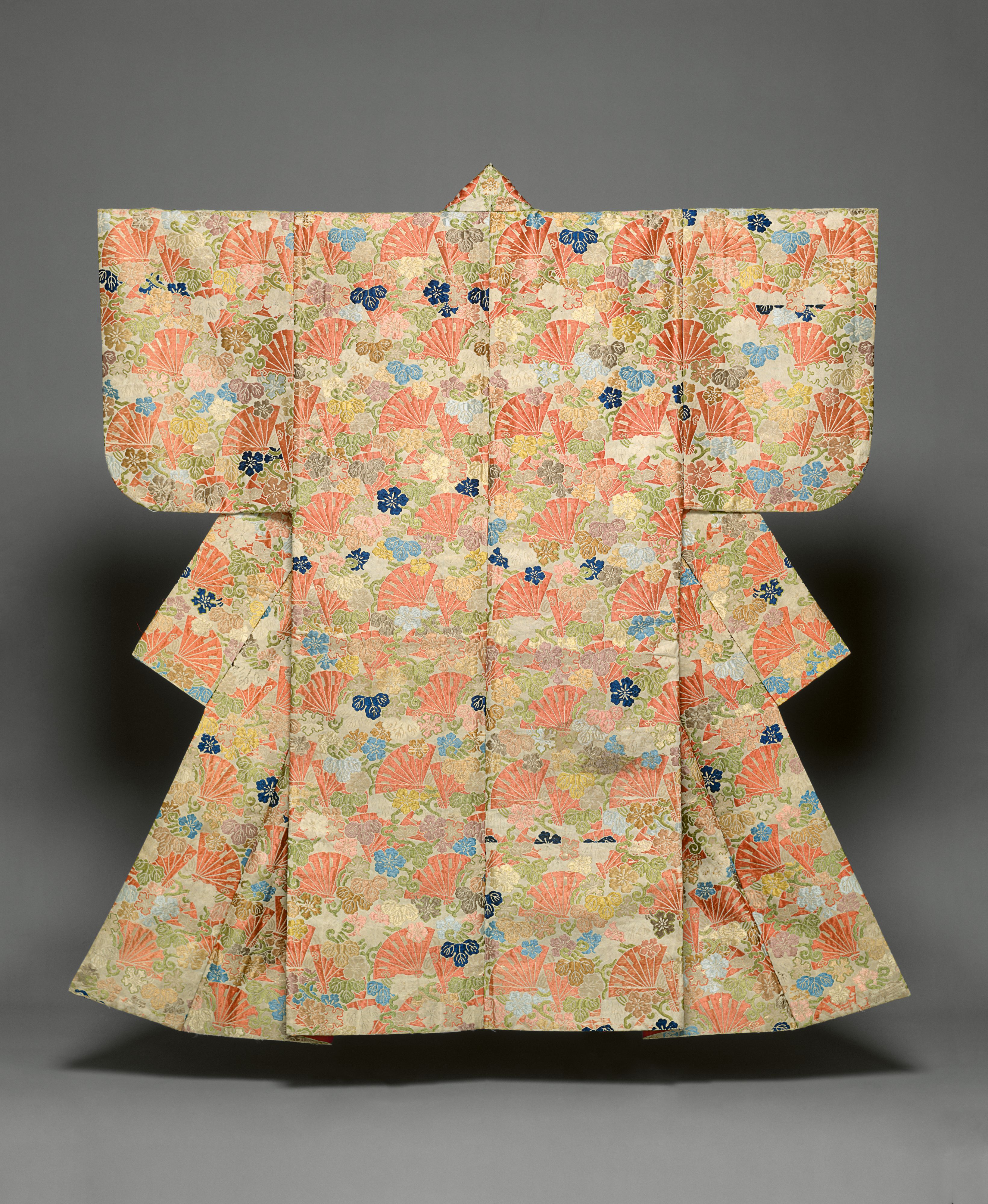
Deconstructing the Spectral: Karaori as Proto-Avant-Garde Architecture
In the hallowed lexicon of fashion history, the Japanese Noh costume—specifically the Karaori—occupies a paradoxical space. It is at once a relic of feudal theatricality and a blueprint for a future that fashion has yet to fully inhabit. For Zoey Fashion Laboratory’s SS26 conceptual framework, we must strip away the ethnographic veneer and confront the Karaori not as a costume, but as a pre-industrial system of wearable structural engineering. Its twill-weave silk ground, fortified by supplementary-weft patterning in metallic thread, is not merely decorative; it is a load-bearing matrix. The garment’s historical function—to embody the ghost of a woman, a spirit, a supernatural entity—renders it the ultimate precursor to the avant-garde’s obsession with the disembodied silhouette. This analysis dissects the Karaori’s material logic and recontextualizes its cypress fans and moonflower (Yūgao) blossoms into a speculative SS26 manifesto on kinetic sculpture and spectral futurism.
Material Alchemy: The Twill Matrix as Digital Precedent
Contemporary fashion’s flirtation with 3D printing and algorithmic weaving finds an unwitting ancestor in the Karaori’s construction. The twill-weave silk ground is not a passive canvas; its diagonal ribbing creates a subtle optical vibration, a moiré effect that destabilizes the viewer’s perception of volume. For SS26, we propose a radical reinterpretation: this twill base becomes a generative grid, upon which supplementary-weft patterning functions as a binary code of raised and recessed surfaces. The metallic thread—historically gold or silver leaf wrapped around silk—is not embellishment but conductive circuitry. It traces pathways across the garment’s surface, suggesting a garment that could, in a speculative future, modulate its own thermal or acoustic properties. The Karaori’s density—its astonishing weight and stiffness—is a precursor to modern tech-shell fabrics, yet it achieves this rigidity without synthetic polymers. This is the ultimate sustainable paradox: a fabric that stands autonomously, a self-supporting exoskeleton that prefigures the architectural couture of Iris van Herpen by five centuries. The lesson for Zoey’s SS26 lab is clear: true innovation lies not in new fibers, but in the structural interrogation of ancient weaves.
The Cypress Fan: From Prop to Prosthetic Appendage
The cypress fans (Hiōgi) affixed or associated with the Karaori are typically dismissed as mere props. In our avant-garde reading, they are articulated prosthetic joints. The fan’s pleated structure—a series of rigid slats radiating from a single pivot—is a primitive hinge mechanism. In the Noh theater, the fan’s movement conveys emotion, but in a deconstructed SS26 context, it becomes a morphing silhouette modifier. Imagine a sleeve that terminates not in a cuff, but in a fan of lacquered cypress slats, capable of expanding from a tight, cylindrical form into a 180-degree plane of dramatic volume. This is not ornament; it is transformative geometry. The fan’s ability to collapse and expand offers a dynamic counterpoint to the Karaori’s static, imposing mass. For Zoey’s future-forward design language, we integrate this principle into modular outerwear: garments that possess mechanical memory, allowing the wearer to alter their own architectural footprint in real-time. The cypress fan, therefore, is a precursor to the robotic exosuit, a manual interface between the body and its atmospheric presence.
Moonflower (Yūgao) Blossoms: Bioluminescent Embellishment
The Yūgao—the moonflower that blooms only at dusk—is a motif of ephemeral beauty and tragic transience in the Tale of Genji. In the Karaori’s brocading, these blossoms are rendered in stiff, raised silk, catching light like tiny, pale lanterns. For SS26, we reimagine these blossoms not as static embroidery but as photochromic and thermochromic nodes. The metallic thread that outlines each petal becomes a conduit for light-reactive pigments. As the wearer moves from shadow into direct sunlight, the moonflowers would shift from a ghostly ivory to a luminous, spectral violet. This is not mere gimmickry; it is a commentary on the temporality of presence. The Noh ghost appears and fades; the SS26 garment performs a similar vanishing act through material science. Furthermore, the Yūgao’s placement on the Karaori—typically clustered around the lower hem and shoulders—suggests a gravitational gradient. In our deconstruction, these blossoms migrate to the seams and stress points, acting as structural rivets that visually and physically anchor the garment’s drape. They are the points where the fabric’s tension is released, creating a topography of bulges and recesses that mimics the lunar surface.
Silhouette Deconstruction: The Ghost in the Machine
The Karaori’s silhouette is famously monolithic—a wide, cylindrical mass that obliterates the human form. This is its most potent avant-garde feature. Unlike Western tailoring, which seeks to accentuate or idealize the body, the Karaori erases and replaces it. The wearer becomes a moving architecture, a pillar of fabric that breathes with a ghostly autonomy. For SS26, Zoey Fashion Laboratory proposes the “Spectral Volume” silhouette: a garment that maintains the Karaori’s imposing width at the shoulders and hem, but introduces a radical negative space at the waist. Through the integration of the cypress fan mechanism, the midriff can be cinched or released, creating a silhouette that oscillates between a rigid obelisk and a segmented, insectoid form. The metallic supplementary-weft is not hidden; it is exposed at the seams, creating visible circuit-like joints that suggest a garment that is assembled, not sewn. This is a futuristic archaeology, a nod to a future where couture is a form of wearable robotics, yet rooted in the handcrafted precision of feudal Japan.
Structural Innovation for SS26: A Synthesis of Ritual and Robotics
The definitive takeaway from this analysis is that the Karaori is not a costume to be replicated, but a thesis on material autonomy. Its stiffness, its weight, its metallic threads—these are not limitations but design parameters. For SS26, we propose a capsule collection titled “Yūgao Protocol”, which operationalizes three core innovations derived from this study. First, Adaptive Stiffness: utilizing a bio-resin-infused silk twill that softens at body temperature but stiffens when exposed to cooler air, mimicking the Karaori’s static drape without its impracticality. Second, Hinged Silhouettes: integrating the cypress fan’s pivot logic into shoulder and hip constructions, allowing for a 360-degree volumetric transformation. Third, Luminous Patterning: using metallic-thread embroidery as a substrate for electroluminescent micro-filaments, so the Yūgao blossoms literally glow in the evening, echoing their name. This is not nostalgia; it is a recursive evolution. The Noh stage’s ghostly, timeless realm finds its contemporary expression in a garment that exists between states—between solid and fluid, between past and future. The Karaori teaches us that the most radical future is often hidden in the most rigid of pasts.