Deconstructing the Qajar Tapestry: An Avant-Garde Reinterpretation for Zoey Fashion Lab
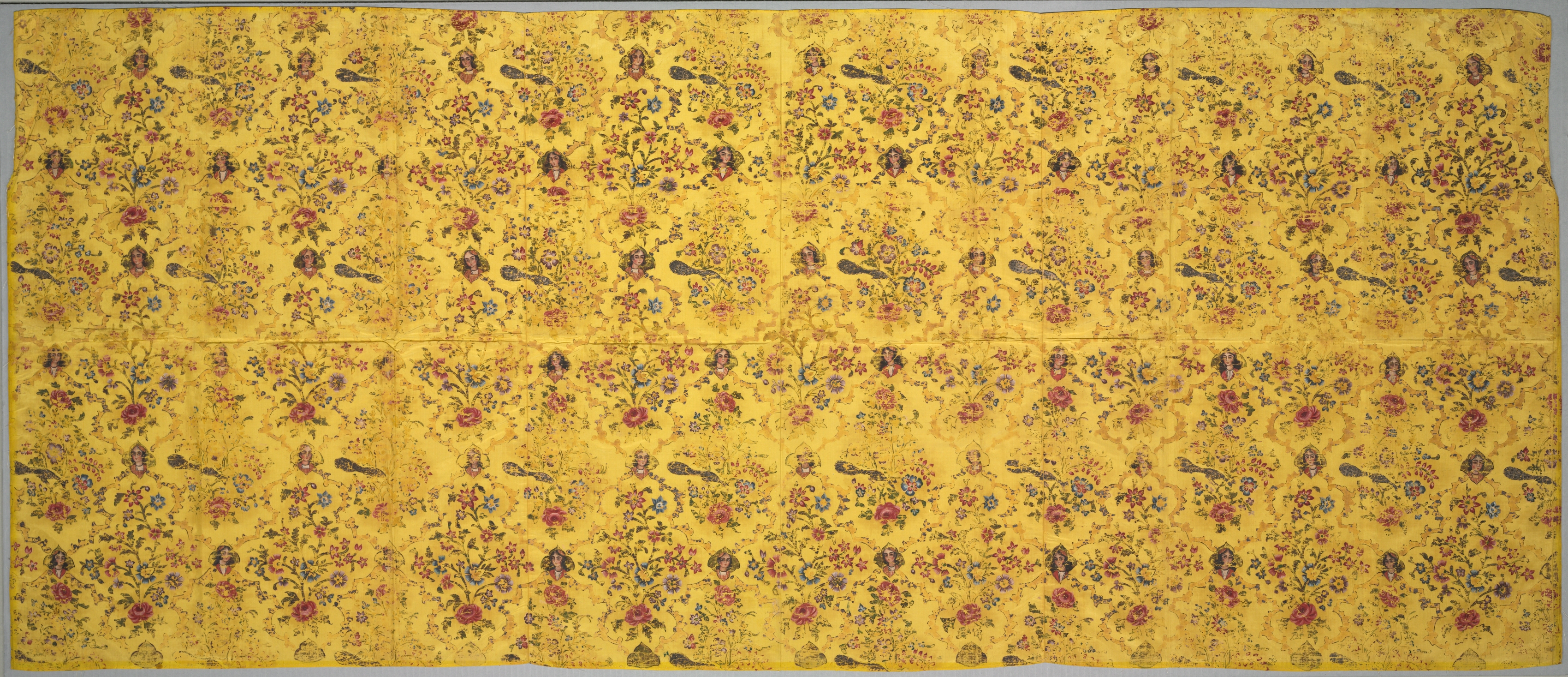
At Zoey Fashion Lab, our mandate transcends the mere replication of historical textiles. We engage in a process of fabric deconstruction, extracting the latent energy, structural logic, and cultural semiotics embedded within a material artifact to re-synthesize them into a new, avant-garde language. The subject of this analysis—a Qajar-period wall covering from Iran (1779-1925) rendered in hand-painted and block-printed silk taffeta, featuring a dense field of flora, peacocks, and portrait medallions—presents a uniquely fertile ground for this exercise. Referencing our internal "New DNA Strand" protocol, we will dissect this object not as a finished decorative piece, but as a genetic blueprint for disruptive fashion design.
I. Material Memory: The Taffeta Substrate as a Structural Metaphor
The technical foundation of this artifact is its taffeta weave. Taffeta, characterized by its crisp hand, subtle ribbed texture, and characteristic rustle, is a fabric of inherent tension and luminosity. It is a plain weave, yet its tightly twisted filament silk creates a surface that catches light with a metallic sheen, shifting between opaque and translucent depending on the angle. For the avant-garde designer, taffeta is not merely a canvas; it is a pre-stressed architectural membrane. The Qajar artisans exploited this by applying pigment directly onto the silk, allowing the weave's texture to interrupt the painted strokes, creating a moiré-like, vibrating surface.
In our deconstruction, the taffeta's structural memory informs a new approach to garment construction. We propose asymmetric paneling that mimics the fabric's natural bias and tension, rather than traditional flat pattern cutting. The garment should not drape; it should stand—creating volumes that are simultaneously rigid and fluid. The characteristic rustle of taffeta is amplified and weaponized as an auditory component of the design, a sonic signature that announces presence, much like the ceremonial nature of the original wall covering. The substrate is not a background; it is the primary scaffolding for a new silhouette that defies gravity and conventional body mapping.
II. Chromatic and Iconographic Disruption: The Peacock and the Medallion
The iconography of the Qajar piece is a dense, almost claustrophobic, visual field. The peacock, a symbol of immortality and royal majesty in Persian culture, is rendered with a fan of iridescent tail feathers that often dissolve into floral arabesques. The portrait medallions, likely depicting courtly figures or idealized beauties, are framed within cartouches, acting as static focal points within the dynamic floral chaos. This is a visual paradox: the static portrait versus the kinetic flora.
For the avant-garde application, we do not reproduce these images literally. Instead, we extract their structural opposition. The peacock's eye pattern—a concentric circle of intense color—is translated into a modular, laser-cut appliqué system that can be layered over transparent organza or bonded to recycled technical mesh. These "eyes" become functional grommets or magnetic closures, transforming a decorative motif into a fastening mechanism. The portrait medallion is deconstructed into a facial framing device—not as a print, but as a sculptural collar or a headpiece that isolates the wearer's face, creating a living portrait within an abstracted frame. The floral field is not painted; it is embroidered with conductive thread that can illuminate or heat up, turning the garment into a responsive, interactive surface that references the original's static grandeur but operates in real-time.
III. The "New DNA Strand" Protocol: From Surface to System
Our internal "New DNA Strand" protocol mandates that we extract the algorithmic logic of a source material, not its surface appearance. The Qajar wall covering is a masterclass in repetition with variation. The block-printing technique itself is a form of proto-industrial reproduction, yet the hand-painted overpainting ensures that no two elements are identical. This is a generative design system avant la lettre.
We translate this into a parametric pattern-making algorithm. The base unit is a single floral sprig, digitized and then mutated across a grid. The mutation parameters are derived from the original's color palette—crimson, lapis, emerald, and gold—but applied to a new material palette of recycled PET satin, bio-based polyurethane, and upcycled silk offcuts. The algorithm generates a unique, non-repeating "wall" of fabric for each garment, ensuring that every piece is a one-of-one artifact, just like the original hand-painted panels. The peacock and medallion motifs are not printed; they are woven into jacquard panels that are then deconstructed and re-joined, creating deliberate seams and gaps that expose the garment's internal structure—a nod to the original's function as a wall covering, revealing the "structure" behind the surface.
IV. Avant-Garde Application: The Wearable Architecture
The final synthesis is a collection that is neither historical costume nor futuristic fantasy, but a hyper-contemporary hybrid. The primary silhouette is an exaggerated, cocoon-like outer shell constructed from the parametric taffeta, its volume referencing the monumental scale of the wall covering. This shell is deconstructed—slashed, inverted, and re-pinned—to reveal an inner layer of the conductive embroidered "flora." The portrait medallion is reimagined as a detachable, rigid visor made from cast bio-resin, embedded with crushed pigments from the original palette. The peacock's eye becomes a kinetic jewelry piece that spins, echoing the fanning motion of the tail.
The garment is designed to be modular and convertible. The outer shell can be detached and worn as a standalone cape, referencing the original's function as a wall hanging. The inner layer can be worn alone as a body-conscious, almost architectural undergarment. This modularity challenges the traditional lifecycle of a garment, aligning with Zoey Fashion Lab's commitment to circular design and deconstructive sustainability.
In conclusion, the Qajar wall covering is not a relic to be preserved under glass but a vibrant source code for radical innovation. By deconstructing its material memory, iconographic paradoxes, and generative logic, we have developed a design system that honors the craft's complexity while propelling it into a new, avant-garde dimension. The result is not a costume, but a wearable argument about the intersection of history, technology, and identity—a true new strand in the DNA of fashion.