The Cartography of Absence: Deconstructing the Marquetry Box as a Wearable Metric
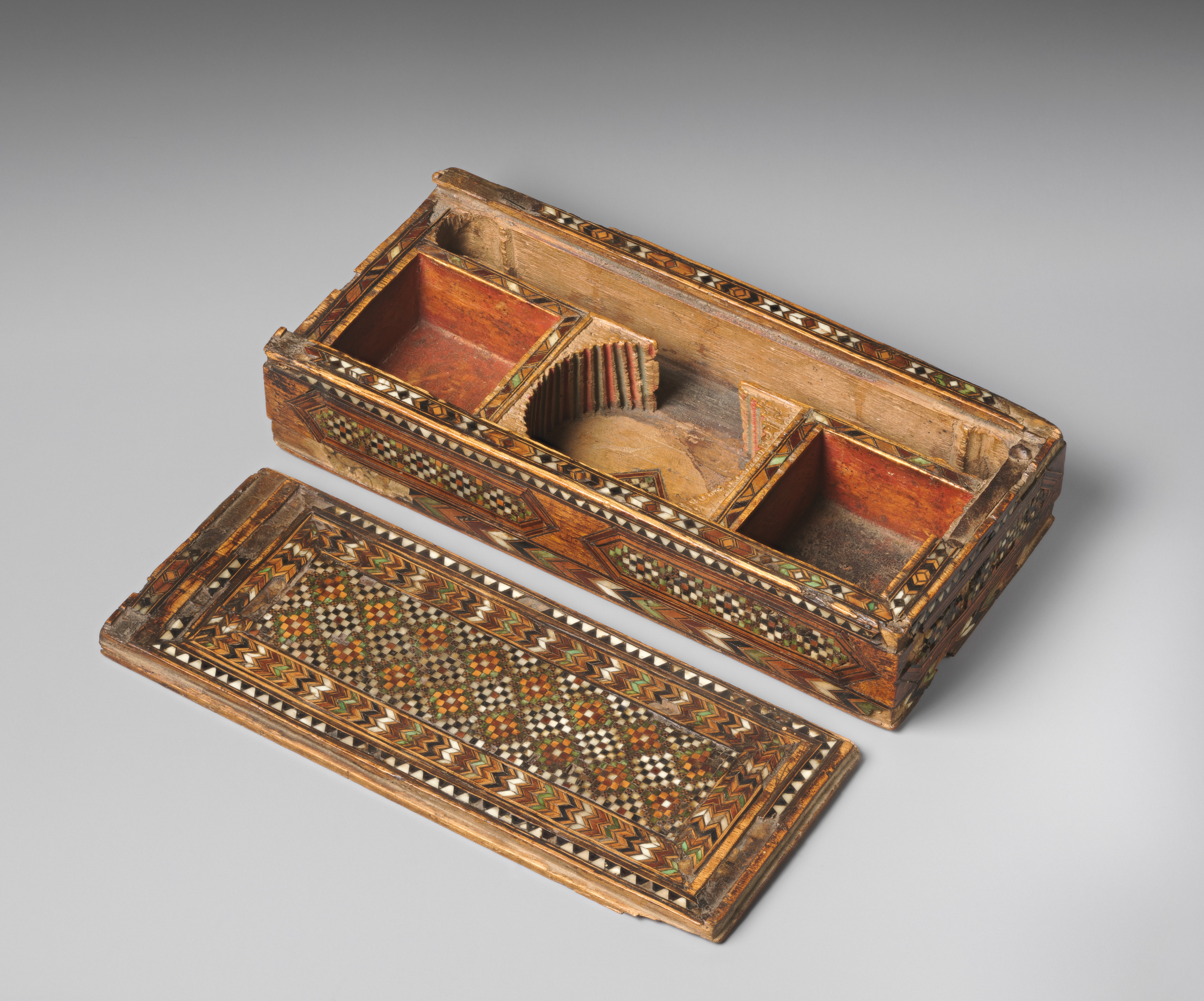
In the rarefied atmosphere of Zoey Fashion Laboratory’s SS26 exploratory cycle, we do not seek inspiration from the garment. We seek it from the instrument. The subject of this definitive analysis—a marquetry box for weighing scales, sourced from the Global Frontier—is not an artifact of measurement but a manifesto of structural philosophy. Its intricate wood veneers, inlaid with bone, metal, and pigment, present a paradox: a vessel designed to hold a tool of quantification, yet itself an object of irrational, obsessive craft. For the avant-garde, this box is not a relic; it is a blueprint for a new silhouette—one that measures the body not by its volume, but by the tension between its internal voids and its external ornamentation.
I. The Grammar of Inlay: Translating Surface into Structure
The marquetry technique—the meticulous cutting and fitting of disparate materials into a seamless plane—offers a radical departure from conventional fabric manipulation. Where traditional couture drapes or drapes, the marquetry box proposes segmentation as a form of unity. For SS26, we propose the Cartographic Corset: a rigid, yet articulated, bodice constructed from laser-cut panels of stabilized wood veneer, bonded to a breathable technical mesh. The bone inlays of the original are translated into molded bio-resin ribs that trace the wearer’s respiratory architecture. The metal elements become precision-engineered magnetic closures, allowing the corset to be reconfigured in situ—a garment that can be disassembled into its constituent parts and reassembled into a different topographic configuration. This is not a dress; it is a wearable equation, where the negative space between panels becomes as critical as the positive form.
The pigment, often used in the original to delineate symbolic weights or measures, is reimagined as a chromatic data layer. We propose a fabric developed in collaboration with nano-print technicians: a silk organza impregnated with thermochromic dyes that reveal hidden geometric patterns when exposed to body heat. The silhouette, then, becomes a live instrument—a self-annotating garment that maps the wearer’s metabolic shifts. The box’s static imagery becomes a dynamic, real-time broadcast of internal state, transforming the wearer into a walking, breathing archive of their own physicality.
II. The Silhouette of Equilibrium: Asymmetry as a Counterweight
The weighing scale’s fundamental principle—equilibrium through counterbalance—informs our most radical silhouette proposition for SS26: the Deviated Torso. Rejecting the anthropometric symmetry that has dominated Western fashion since the corset’s inception, this design posits that true balance is achieved through deliberate, calibrated asymmetry. Imagine a single, sculptural sleeve that extends into a train resembling a scale’s pan, counterbalanced by a completely bare shoulder and a high-waisted, truncated pant that ends mid-calf. The weight is not distributed evenly; it is argued—a visual debate between mass and void.
This is achieved through a new construction technique we term “Gravity Draping.” Instead of sewing panels to follow the body’s curves, we suspend them from a central, architectural spine—a lightweight titanium alloy skeleton that runs along the back. The fabric, whether a dense wool felt or a fluid metallic jersey, is then attached to this spine at specific load-bearing points, allowing it to fall, fold, and twist according to its own tensile properties. The result is a garment that appears to be in a state of perpetual, controlled collapse. The marquetry box’s rigid edges are echoed in the sharp, unyielding lines of the shoulder yoke, while the inlaid metal suggests the glint of exposed zippers and grommets that punctuate the garment’s surface like calibration marks.
III. Material Alchemy: The Global Frontier’s Synthetic Lexicon
Our material research for this study abandons the pastoral for the industrial. The wood of the box is not a nostalgic nod to nature, but a provocation to develop “Lignin Silk”—a biopolymer filament extracted from post-industrial wood waste, spun into a thread that possesses the tensile strength of steel and the diaphanous quality of chiffon. This allows us to create garments that are both monumental in scale and ethereal in presence. The bone inlay is reimagined as “Osseous Porcelain”—a 3D-printed ceramic that is fired at low temperatures, resulting in a matte, chalky finish that absorbs light rather than reflecting it. Used in collar structures or as detachable epaulettes, this material lends a funereal, archaeological weight to the ensemble.
The metal elements, traditionally brass or copper, are replaced with anodized aluminum and memory alloys. These materials are not merely decorative; they are functional. A skirt constructed from overlapping aluminum lamellae, each etched with a unique geometric pattern, can be manipulated by the wearer to change its length and volume. A collar made of nitinol, a shape-memory alloy, can be programmed to curl inward when exposed to body heat, creating a self-veiling effect. The pigment, in our lexicon, becomes electroluminescent thread, woven into the fabric’s selvedge. This allows the garment to emit a low, pulsing light—a subtle signal of its own construction, a digital ghost of the marquetry box’s painted patterns.
IV. The Structural Innovation: Modularity as a Philosophical Imperative
The ultimate innovation of this study is the “Kinetic Chassis”—a modular framework that underpins every garment. Inspired by the box’s internal compartments, designed to hold the scale’s weights, the chassis is a system of interlocking, load-bearing pockets and channels that run through the garment’s interior. These are not mere pockets for storage; they are architectural recesses for counterweights. The wearer can insert small, polished metal ingots into these channels, altering the garment’s drape, its center of gravity, and its acoustic resonance. A jacket can be made to sit heavier on one shoulder; a skirt can be weighted to create a dramatic, sweeping arc. The garment becomes a tool for choreographing one’s own presence, a physical manifestation of the weighing scale’s purpose—but here, the weight is not a measure of commodity, but of intention.
Furthermore, the chassis allows for unprecedented disassembly. A full-length coat can be unzipped along its internal seams to become a structured vest and a separate, floor-sweeping skirt. The components are not separate garments; they are states of a single entity. This modularity is a direct response to the Global Frontier’s ethos of resource scarcity and adaptability. It is a couture that respects the logistics of the future—a future where a garment must be as versatile as a Swiss Army knife, as precise as a scale, and as beautiful as a marquetry box that contains the very instrument of its own creation.
In conclusion, the marquetry box for weighing scales is not an object of the past. It is a cryptographic key to a future where fashion is a science of balance, a study of counterpoints, and a testament to the idea that the most profound beauty is found not in the final form, but in the tension between the elements that compose it. For SS26, Zoey Fashion Laboratory does not present clothes. It presents instruments of self-determination, calibrated for the avant-garde.