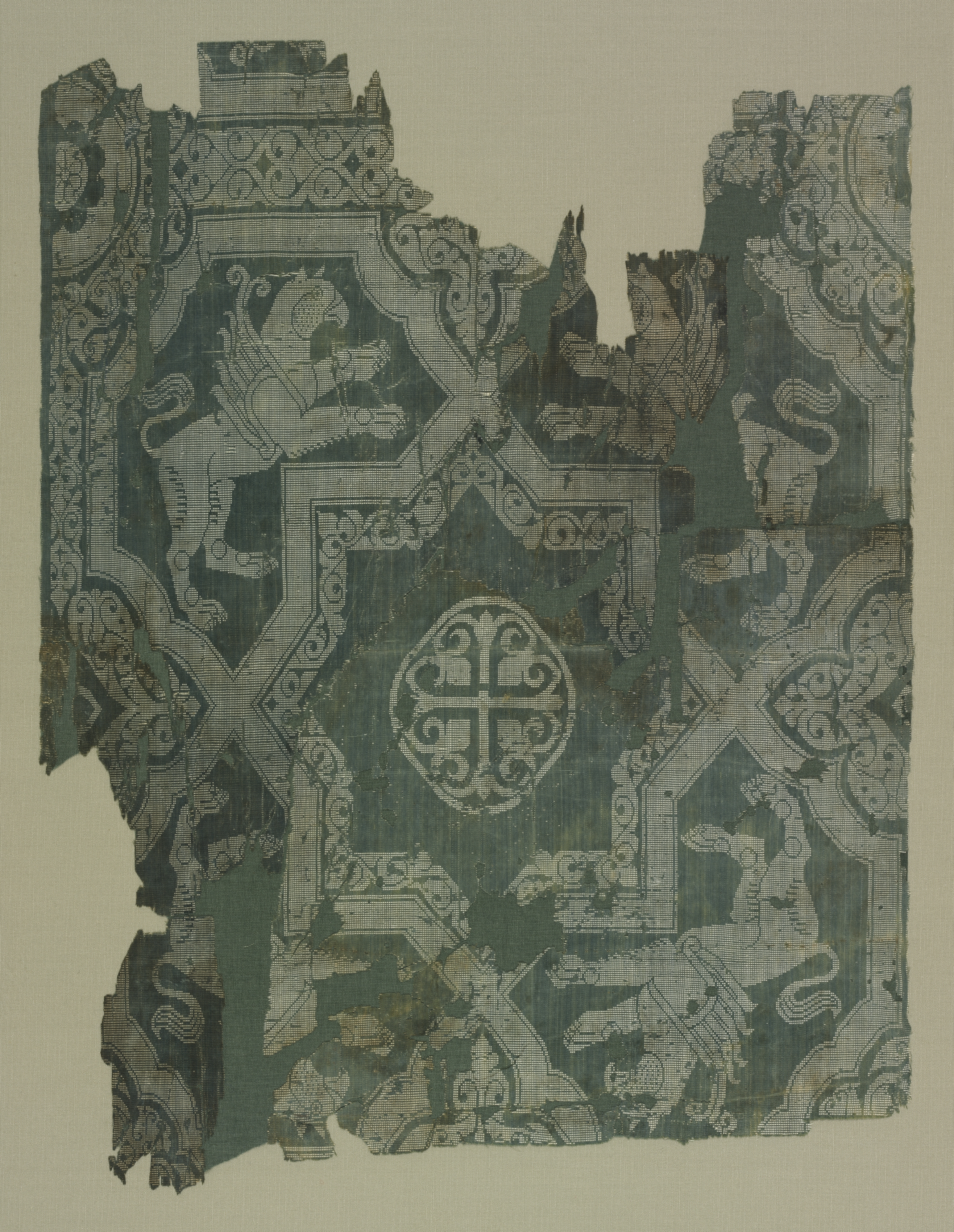
Deconstructing the Digital Tapestry: The Buyid Fragment as Avant-Garde Blueprint
At Zoey Fashion Lab, our mandate extends beyond the mere cataloging of historical textiles. We engage in a process of fabric deconstruction, wherein we isolate the structural DNA of ancient artifacts to extract principles applicable to contemporary avant-garde design. The subject of this analysis—a silk fragment featuring a star pattern and griffins, originating from the Buyid period (934–1062 CE) of Iraq or Iran—presents a particularly rich case study. This piece is not merely an archaeological find; it is a proto-computational matrix, a woven algorithm of power, cosmology, and technical mastery that resonates profoundly with the disruptive ethos of modern fashion.
Our reference point, titled "New DNA Strand," serves as a conceptual bridge. It posits that historical textiles are not static relics but living sequences of information—threads that carry cultural, mathematical, and aesthetic codes. This analysis will deconstruct the Buyid fragment across three primary vectors: Technical Structure, Iconographic Semantics, and Avant-Garde Transposition, demonstrating how a thousand-year-old artifact can inform the next generation of wearable art.
I. Technical Autopsy: The Logic of the Supplementary Weft
The fragment’s construction is identified as a plain weave variation with supplementary weft. At first glance, this appears a modest technical description. However, within the context of Buyid textile production, this technique represents a sophisticated manipulation of the loom that predates modern jacquard programming. The ground weave—a simple tabby of silk threads—provides a stable, utilitarian base. The innovation lies in the supplementary weft, a secondary set of silk threads introduced not to strengthen the fabric but to create a raised, discontinuous pattern on the surface.
This is not embroidery; the pattern is integral to the weaving process. The supplementary weft floats over the ground weave in specific sequences, dictated by a complex system of heddle rods and pattern harnesses. The deconstructionist view identifies this as an early form of binary data storage. Each float, each binding point, is a discrete unit of information. The weaver was, in effect, a programmer, encoding a visual language into the cloth. The choice of silk—a protein fiber with exceptional tensile strength and luster—amplifies this effect. The supplementary threads catch light differently than the ground, creating a shimmering, moiré-like depth that shifts with the viewer’s perspective.
For Zoey Fashion Lab, this technical structure is a direct precursor to contemporary textile engineering. We see in this fragment the blueprint for modern smart fabrics that utilize multi-layer weaving to integrate conductive threads or optical fibers. The Buyid weaver’s mastery of tension and float length is a lesson in precision. In our avant-garde collections, we replicate this logic using recycled metallic yarns and bio-degradable synthetics, creating fabrics that are simultaneously structural and decorative, where the pattern is not printed but architecturally embedded within the cloth’s matrix. The fragment teaches us that surface ornamentation is a function of internal structure, not an external addition.
II. Iconographic Semantics: The Griffin and the Cosmic Star
Beyond the technical, the iconography of the fragment is a dense field of cultural signifiers. The star pattern is not a simple geometric motif. In Buyid cosmology, the star—particularly the eight-pointed star—represents the celestial sphere, divine order, and the intersection of the earthly and the heavenly. It is a symbol of sovereignty, linking the ruler to the cosmic order. The griffin, a mythical creature with the body of a lion and the head and wings of an eagle, is a guardian of treasures and a symbol of power, vigilance, and divine protection. Its presence on a textile of this quality suggests a royal commission, intended for a courtly audience where the fabric functioned as a statement of political and spiritual authority.
The deconstructionist reading, however, moves beyond simple symbolism. We analyze the relationship between the star and the griffin. The griffins are not randomly placed; they are often depicted in symmetrical opposition, flanking a central star or enclosed within its radiating points. This creates a visual tension between the static, geometric order of the star and the dynamic, organic energy of the creature. This is a dialectical composition—a visual argument between order and chaos, the celestial and the terrestrial. The weaver has managed to freeze a moment of mythological narrative into a repeatable pattern, creating a rhythmic cadence across the fabric’s surface.
For the avant-garde designer, this iconography offers a rich vocabulary of disruption and hybridity. The griffin is, in itself, an avant-garde concept—a fusion of disparate species into a new, functional whole. This resonates with contemporary fashion’s obsession with hybridity, gender fluidity, and cultural pastiche. We can extract the griffin’s silhouette, deconstruct its anatomical logic, and re-embroider it onto a deconstructed blazer using laser-cut leather appliqués. The star pattern can be abstracted into a pixelated digital print, referencing the original’s mathematical precision while subverting its sacred meaning. The fragment’s iconography is a license to experiment with mythological futurism, blending ancient archetypes with cyberpunk aesthetics.
III. Avant-Garde Transposition: From Museum Case to Runway
The final stage of our analysis is transposition: how does this Buyid fragment inform the Zoey Fashion Lab’s design philosophy? Our "New DNA Strand" reference is crucial here. We do not seek to replicate the fragment; we seek to mutate its genetic code. The avant-garde is not about nostalgia; it is about radical reinterpretation. We propose three concrete design applications based on this artifact.
First, Structural Deconstruction: We take the concept of the supplementary weft and push it to its extreme. Instead of silk, we use a base of industrial nylon mesh. Our supplementary threads are not continuous but are programmed to be thermoplastic filaments that shrink upon heat application. This creates a fabric that, when activated, puckers and distorts into a three-dimensional star pattern, mimicking the raised floats of the original but with a sculptural, almost brutalist, effect. The garment becomes a living object that changes shape based on temperature—a nod to the original’s responsiveness to light.
Second, Iconographic Subversion: The griffin is deconstructed into its component parts. We isolate the eagle’s talon as a claw-like shoulder pad, the lion’s haunch as a draped, asymmetric hip panel, and the wing structure as a fan-like collar. These elements are not pictorial but tactile and architectural, rendered in molded silicone and recycled aluminum. The star pattern is reinterpreted as a series of laser-cut perforations in the fabric, creating a negative-space constellation that plays with the wearer’s skin as a canvas. This is not a costume; it is a wearable manifesto on power and hybridity.
Third, Digital Resurrection: The fragment’s pattern is scanned and converted into a high-resolution digital file. This file is then used to program a digital jacquard loom, weaving a new fabric that uses the original’s exact thread count and float structure but with a palette of neon acid greens, deep violets, and iridescent blacks. The result is a fabric that is historically accurate in its construction but visually alien. This process honors the technical genius of the Buyid weavers while freeing it from the constraints of historical color and material. The garment becomes a time-traveling artifact, a bridge between the 10th-century court and the 21st-century runway.
In conclusion, the Buyid fragment is far more than a decorative object. It is a technical treatise, a mythological text, and a design manual rolled into one. For Zoey Fashion Lab, it is a source of endless inspiration. By deconstructing its weave, we learn about precision and structure. By decoding its iconography, we learn about power and narrative. And by transposing its logic into modern materials and methods, we create fashion that is not just new but genetically informed by the past. The "New DNA Strand" is not a metaphor; it is a methodology. We take the ancient code, splice it with contemporary technology, and produce a garment that is a true original—a living fragment of a future that has learned from the past.