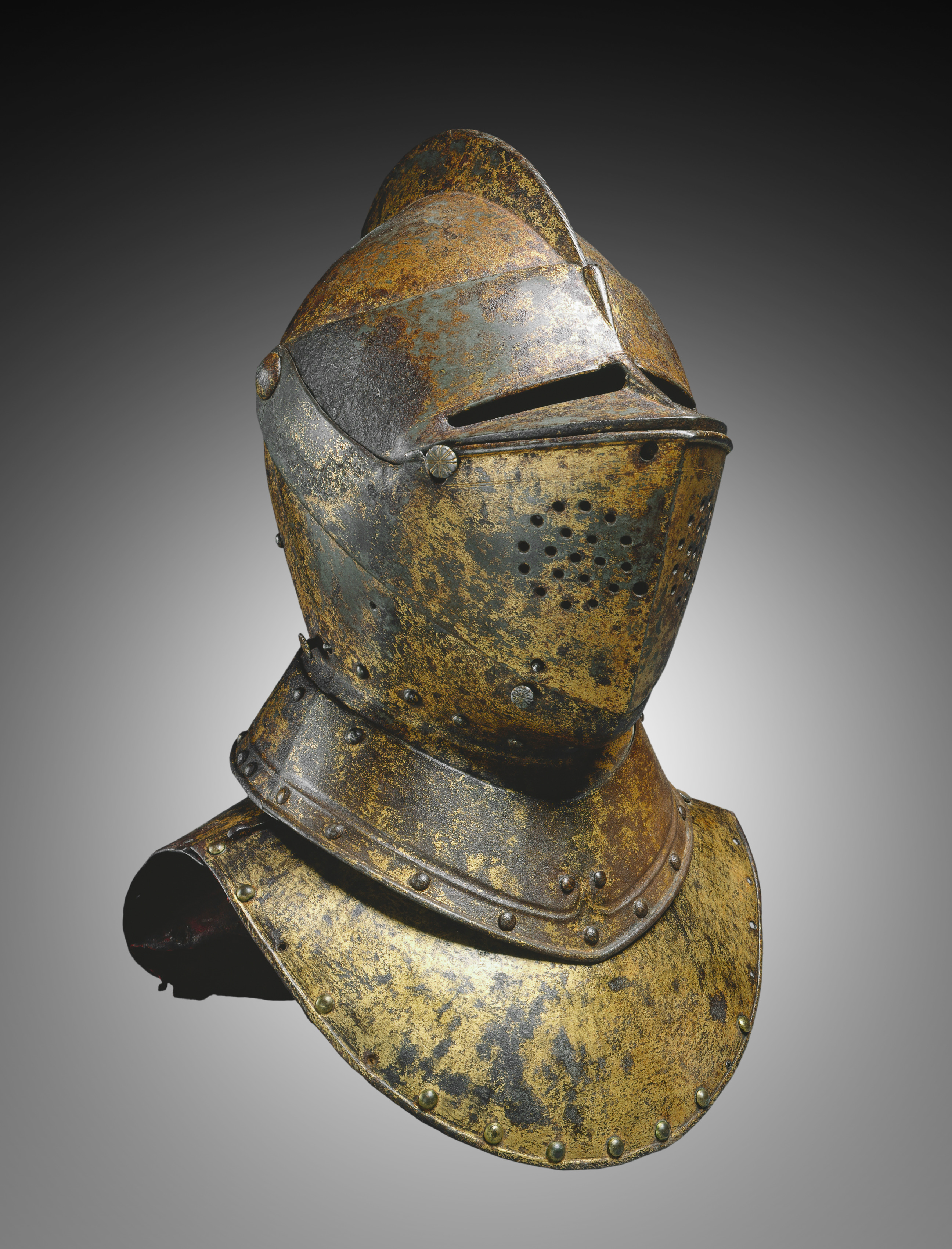
Deconstructing the Ghost: A Material Analysis of the Holland Close Helmet
At Zoey Fashion Lab, our mandate extends beyond the mere cataloguing of textiles. We engage in a dialogue with history, interrogating the objects of the past to extract the skeletal structures of future aesthetics. The subject of this analysis—a late 16th to early 17th-century Close Helmet, purportedly of Dutch origin and associated with a funerary achievement—presents a uniquely potent case study. It is not merely a piece of armor; it is a relic of identity, a metallic carapace designed for both mortal combat and eternal display. For our avant-garde design division, this object is not a historical artifact but a prototype of psychological architecture, a wearable sculpture that predates the modern concept of the fashion statement by four centuries.
Materiality and the Aesthetics of Decay
The helmet’s primary composition is gilded steel, a technical choice that immediately signals a duality. Steel represents resilience, the utilitarian necessity of battlefield survival. The gold gilding, however, elevates the object from mere protection to a symbol of status, wealth, and chivalric honor. In the context of a funerary achievement, this gilding was meant to catch the candlelight of a chapel, projecting an eternal, idealized image of the deceased knight. Yet, our analysis reveals a critical intervention: the invasion of rust. This is not a flaw; it is a narrative agent. The corrosion creeps beneath the gold, creating a topographical map of time’s passage. For the avant-garde, this offers a radical departure from the pristine, sterile perfection of contemporary luxury. We propose a design philosophy of ‘Curated Corrosion’, where decay is not hidden but highlighted, using oxidation as a living texture that evolves with the wearer and their environment. The rust becomes a form of organic embroidery, a testament to the impermanence of all constructs, including identity.
The Interior Life: Velvet and the Psychology of Concealment
Contrasting the cold, deteriorating exterior is the interior: a lining of red velvet. This is a crucial element often overlooked in traditional armor studies. The velvet serves a practical purpose—cushioning, insulation, and a snug fit. But its psychological implications are profound. The wearer’s face, their most expressive and vulnerable feature, would be pressed against this luxurious, blood-red fabric. It is the final sensory experience before entering the metallic void of the helmet. The red velvet is a secret, an intimate luxury hidden from the public eye, known only to the wearer. In our deconstruction, we see this as the genesis of the ‘Concealed Couture’ concept. It posits that true luxury is not about external display but about the private, tactile relationship between the garment and the skin. We are exploring high-fashion pieces where the interior is more opulent and emotionally charged than the exterior—a silk-lined hood with internal beading, a jacket with a hand-painted interior scene. The helmet teaches us that the most powerful statement is often the one whispered against the skin, not shouted to the crowd.
The Plume Holder: A Signal of Kinetic Identity
The presence of the plume holder is the final, and perhaps most avant-garde, component of this helmet. The plume was not merely decorative; it was a functional communication device. In the chaos of battle, the plume’s color and movement allowed commanders to identify their troops and allies to recognize their leaders. It was an early form of biometric signaling, a dynamic extension of the static armor. The plume introduced an element of fluidity, color, and motion to an otherwise rigid, monochromatic form. For Zoey Fashion Lab, this translates into our exploration of ‘Dynamic Adornments’. We are moving beyond static embellishments to create fashion that moves, reacts, and communicates. Imagine garments fitted with kinetic elements—responsive feathers, light-reactive filaments, or modular attachments that shift with the wearer’s velocity. The plume holder is a reminder that even in the most defensive, closed-off state, humanity seeks to project a unique, identifiable signal outward. It is the birth of personal branding in wearable form.
The ‘New DNA Strand’ and the Avant-Garde Synthesis
Our reference to the ‘New DNA Strand’ is not a biological metaphor but a design directive. It signifies the extraction of the helmet’s core genetic code—its structural geometry, its material contradictions, its psychological depths—and the recombination of these elements into a new, unprecedented form. The avant-garde style is not about imitation; it is about transmutation. We are not creating armor for a modern battlefield, but rather garments that embody the helmet’s spirit of protection, concealment, and declaration.
We envision a collection where the helmet’s silhouette is deconstructed into a sculptural neckpiece, its rounded dome and pointed visor abstracted into sharp, asymmetric shoulder pads. The gilded steel becomes a metallic leather with a burnished, distressed finish, echoing the rust’s invasion. The red velvet interior is reimagined as a detachable, hood-like undergarment, a flash of crimson seen only when the outer shell is removed. The plume holder is transformed into a structural clasp for a dramatic, floor-length cape, the ‘plume’ itself becoming a cascade of iridescent, razor-cut fringe.
This analysis concludes that the Close Helmet is a perfect artifact for the avant-garde. It is a closed system that paradoxically speaks of openness to interpretation. It is a symbol of war that is also a masterpiece of art. By deconstructing its functional past, we reconstruct its aesthetic future. The helmet is not a relic; it is a blueprint. It demonstrates that true innovation in fashion lies not in the invention of new materials, but in the radical reinterpretation of existing forms, finding the future hidden within the rust of the past. The ghost in the machine is, in fact, the muse for our next collection.