Deconstructing the Sacred: The Altarpiece as a Proto-Avant-Garde Artifact
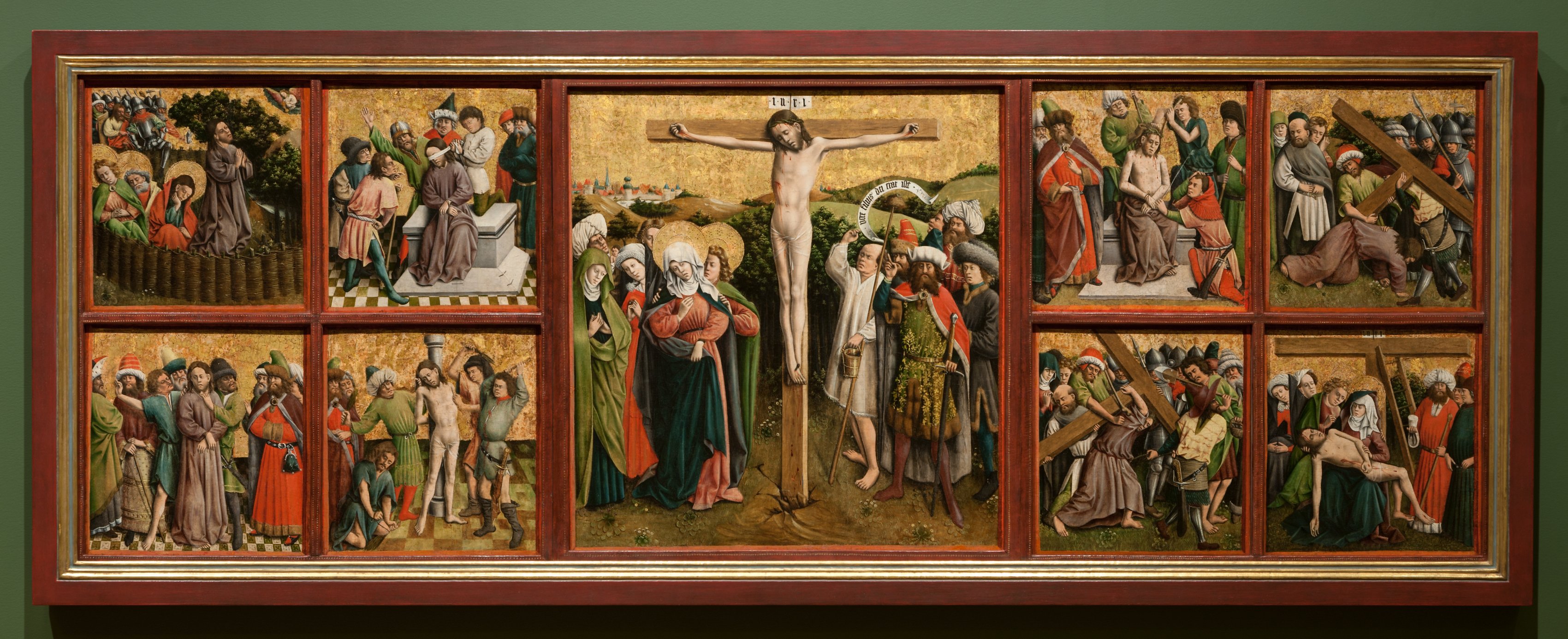
At Zoey Fashion Lab, we do not merely observe historical artifacts; we dissect them, extracting their latent structural codes and translating them into contemporary design language. Our latest subject of analysis, the Altarpiece with The Passion of Christ (Germany, oil and gold on wood), is not a relic to be venerated but a blueprint to be interrogated. When filtered through our avant-garde lens, this devotional object reveals itself as a radical precursor to modern conceptual fashion—a complex system of material contrast, narrative compression, and spatial duality that resonates profoundly with our design philosophy.
The archive resonance provided—“一面是光洁银镜上以黄金镶嵌的纷繁棕叶纹,另一面是冰冷石棺板上以浮雕诉说的生命叙事”—(one side a polished silver mirror inlaid with intricate golden palm fronds, the other a cold sarcophagus slab narrating life through bas-relief)—is not a poetic aside. It is the analytical key. This binary opposition, between reflective surface and tactile depth, between ornamental excess and stark narrative, forms the core of our deconstruction.
Material Antithesis: Gold as Noise, Wood as Signal
The altarpiece’s primary materiality—oil and gold on wood—is a study in deliberate dissonance. The gold leaf, applied with painstaking precision, functions as an optical amplifier. It does not depict light; it is light, reflecting the viewer’s environment and breaking the passive viewing experience. In avant-garde terms, this is akin to using metallicized technical fabrics that disrupt the silhouette’s static form, creating a garment that changes with every angle of the wearer’s movement. The gold is not decorative; it is a disruptive interface.
Conversely, the wood substrate and oil pigments provide the tactile ground. The Passion narrative—the betrayal, the scourging, the crucifixion—is rendered in dense, corporeal brushstrokes. This is not a sanitized illustration; it is a visceral, almost violent application of pigment that mimics the physical trauma of the subject. The contrast is stark: the ethereal, untouchable gold against the gritty, humanistic oil. This antithesis mirrors the avant-garde principle of juxtapositional construction—pairing a razor-sharp, structured shoulder with a fluid, deconstructed drape. The altarpiece teaches us that meaning is generated not in uniformity, but in the friction between opposing materialities.
The Split-Leaf Mirror: A Case Study in Visual Fragmentation
The specific resonance of the “split-leaf” motif—the golden palm fronds on a silver mirror—offers a more precise deconstructive tool. The palm frond, traditionally a symbol of martyrdom and victory, is here fragmented, split, and re-embedded into a reflective surface. This is a cubist operation before Cubism. The altarpiece does not present the Passion as a linear sequence; it compresses time and space into a single, fractured field. The mirror does not merely reflect; it re-contextualizes the viewer, placing them inside the narrative while simultaneously alienating them from it.
In our fashion lab, we translate this into modular garment architecture. Imagine a coat where the back panel is a high-polish, liquid-metal finish (the mirror), but the front is constructed from raw, unbleached canvas with hand-painted, abstracted iconography (the narrative). The “split-leaf” becomes a pattern-cutting principle: a single garment piece is cut into asymmetrical, interlocking segments that are then rejoined with exposed seams, creating a visual rhythm that is both reflective and disruptive. The garment, like the mirror, becomes a site of constant negotiation between the wearer’s identity and the garment’s imposed narrative.
Narrative Compression: The Altarpiece as a “Look”
Traditional altarpieces, particularly those depicting the Passion, function as sequential storytelling devices—a visual chronology from the Last Supper to the Resurrection. However, the German altarpiece often employs a simultaneous narrative, where multiple events occur within a single, unified pictorial space. This is a radical act of temporal compression. It rejects the tyranny of linear time in favor of a synchronic, all-at-once experience.
For Zoey Fashion Lab, this is the ultimate avant-garde gesture. A single “look” should not tell a story from hem to collar; it should present a constellation of references. A dress might feature a high, restrictive neckline (the betrayal), a slashed, open back (the scourging), and a structured, almost architectural bustier (the crucifixion’s rigidity). The viewer does not “read” the garment; they experience it as a simultaneous overload of visual and tactile information. The altarpiece’s compression of sacred history into a single panel is the direct ancestor of the fashion designer’s ability to compress a season’s narrative into a single, powerful silhouette.
The Stone Sarcophagus: From Decoration to Structural Truth
The resonance’s second half—the “cold sarcophagus slab” with bas-relief—offers a counterpoint to the gold’s surface brilliance. The sarcophagus is not a canvas; it is a structural monolith. Its narrative is not painted but carved, physically gouged from the material. This is a shift from representation to presence. The bas-relief is inseparable from its substrate; the story is the stone.
This principle informs our approach to zero-waste pattern cutting and structural knitwear. We move away from appliqué and surface embellishment toward garments where the construction is the narrative. A seam is not a closure; it is a scar. A dart is not a functional necessity; it is a line of text. The “sarcophagus” approach dictates that the garment’s silhouette must be honest to its construction. If the altarpiece’s wood is the truth, then our fabric is the truth. The avant-garde garment, like the sarcophagus, must not lie about how it was made.
Synthesis: The Avant-Garde Altarpiece as Wearable Philosophy
In conclusion, the Altarpiece with The Passion of Christ is not a distant, sacred object. It is a proto-avant-garde manifesto rendered in oil and gold. Its lessons for Zoey Fashion Lab are manifold:
First, embrace material dissonance. Never allow a fabric to be merely functional; make it argue with its neighbor. Pair the reflective with the absorbent, the rigid with the fluid.
Second, practice narrative compression. Do not illustrate a story; present a field of simultaneous events. The garment should be a synchronic experience, not a diachronic sentence.
Third, elevate structural truth. The construction is the message. The seams, the cuts, the joins—these are the bas-relief of our craft. They must speak with the same authority as the gold leaf.
The altarpiece, with its split-leaf mirror and stone sarcophagus, teaches us that the most profound beauty emerges from the collision of opposites. It is a lesson in radical tension. As we move forward, we do not imitate the altarpiece’s iconography; we absorb its structural logic. We create garments that are not worn but inhabited—spaces where the wearer becomes both the viewer and the viewed, both the gold and the stone, both the reflection and the narrative. This is the true legacy of the German altarpiece, and it is now encoded in the very fiber of Zoey Fashion Lab’s avant-garde DNA.