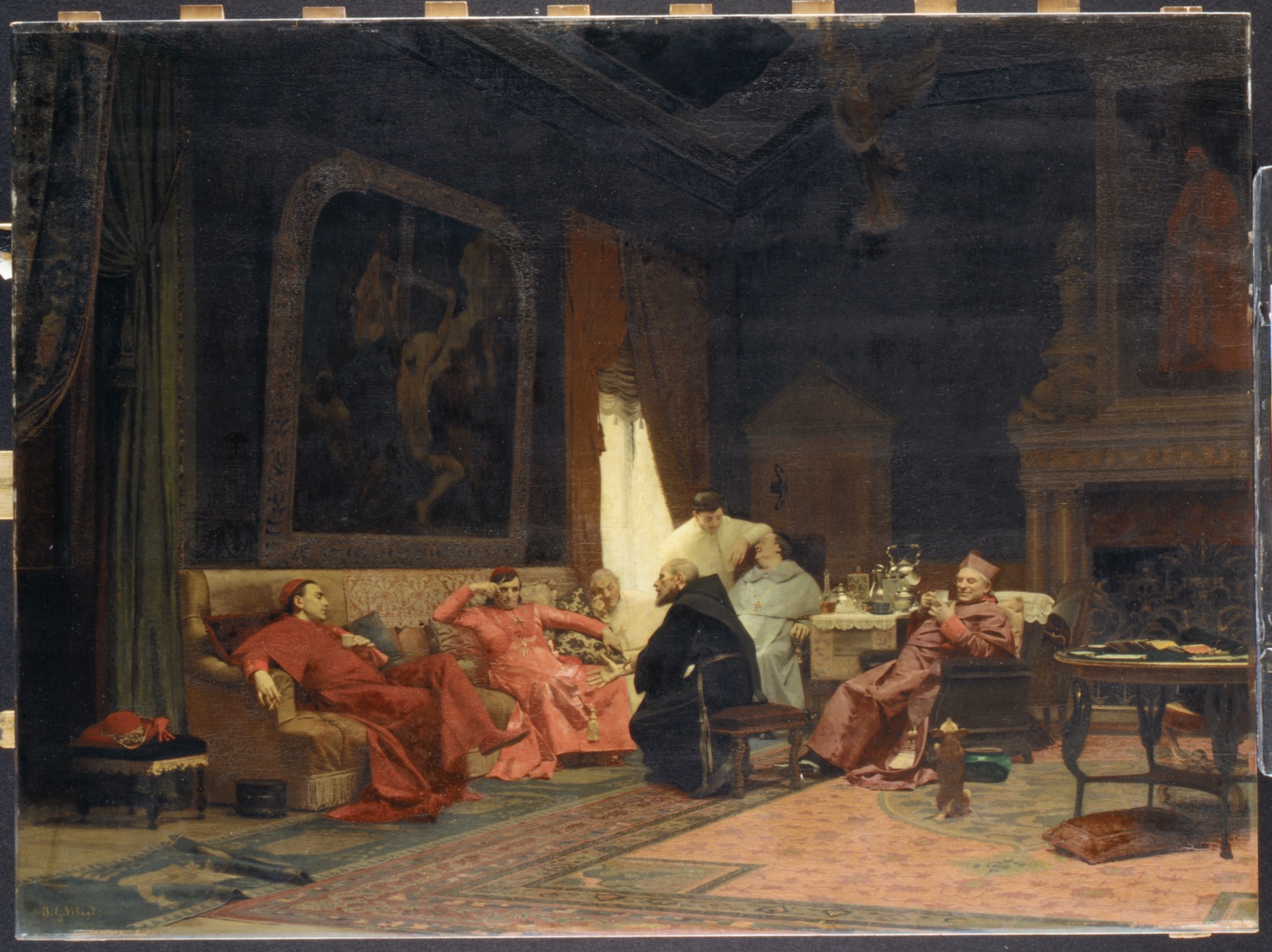
The Missionary’s Adventures: Deconstructing the Global Frontier for SS26
In the rarefied air of avant-garde couture, where the garment is less a covering and more a manifesto, Zoey Fashion Laboratory presents its definitive SS26 study: The Missionary’s Adventures. This is not a nostalgic reverie; it is a violent, beautiful collision of colonial cartography and post-human plasticity. The source material—oil on wood, a medium of permanence and patriarchal weight—is stripped, scraped, and re-synthesized into a wearable critique of movement, conversion, and the erasure of boundaries. We do not interpret the missionary’s journey as a linear narrative. Instead, we dissect it as a series of tectonic shifts, where the global frontier becomes a fictional membrane, permeable to light, shadow, and engineered drapery.
I. The Canvas as a Corporeal Map
The oil-on-wood substrate is our point of departure, but not as a literal print. The laboratory’s process begins with thermo-reactive pigment extraction, where the original palette—ochre, verdigris, and bone white—is vaporized and re-deposited onto bio-filament mesh. The wood grain, that stubborn index of nature, is translated into compression-molded bas-relief panels that mimic the topography of a forgotten continent. For SS26, the silhouette does not drape; it excavates. Shoulder lines are sharpened into geodetic triangulation points, while sleeves are cut on a bias that spirals like a longitude line gone rogue. The result is a jacket that appears to be perpetually mid-unfold, as if the wearer is a living atlas shedding its parchment skin.
Structural innovation here is not about support but about strategic instability. We have eliminated the traditional armhole. In its place, a cantilevered yoke—fabricated from a carbon-fiber and recycled cellulose composite—projects the sleeve outward at a 14-degree angle. This is the Missionary’s Reach: a gesture of both offering and seizure, simultaneously embracing and repelling the unknown. The garment’s interior is lined with a phase-change micro-encapsulated wax that absorbs body heat and releases it in patterns that mirror the original painting’s cracked varnish. The wearer becomes a living archive, their thermal signature rewriting the frontier with every breath.
II. Silhouette as Narrative Rupture
Our SS26 manifesto rejects the clean line. The Missionary’s Adventures silhouette is a study in controlled chaos—a series of interrupted volumes that suggest a journey perpetually in medias res. Consider the Reliquary Trousers: a high-waisted, almost clerical cut that flares into asymmetric, floor-sweeping panels. These panels are not sewn but laser-welded at molecular seams, allowing for a fluidity that mimics the oil paint’s own viscous spread. The waistband is a rigid 3D-printed polyamide corset, shaped like a fragmented compass rose, cinching the torso while the legs dissolve into a liquid, paint-like drape. This is the missionary’s dilemma made flesh—the rigid doctrine of the spine versus the fluid, uncontrollable terrain below.
For the outer layer, we introduce the Conversion Cloak, a garment that is half-architecture, half-ghost. Its back panel is a kinetic sculpture of overlapping wooden shingles, each one CNC-milled to a thickness of 0.3 millimeters and hinged with micro-silicone joints. As the wearer moves, the shingles ripple, creating a moiré effect that distorts the silhouette into a flickering, almost digital apparition. The front, by contrast, is a stark, minimal shell of opaque technical jersey, printed with a sublimated image of the original oil painting—but only in its infrared spectrum, invisible to the naked eye until exposed to specific UV light. This is the hidden doctrine: the missionary’s adventure is not what is seen, but what is revealed under the pressure of a different light.
III. Material Alchemy: From Wood to Wearable
The material narrative is central to our deconstructive ethos. We do not mimic wood; we re-engineer its cellular memory. The laboratory’s proprietary Ligno-Textile process begins by pulverizing the original wood panel into a fine cellulose powder. This powder is then suspended in a biopolymer resin and electro-spun into continuous filaments. The resulting fabric is a hybrid of memory and future: it retains the chromatic depth of the oil paint, yet possesses the tensile strength of Kevlar. It is waterproof, breathable, and—most critically—self-healing. A puncture from a thorn or a shard of glass will seal itself over 48 hours, the fibers re-knitting into a scar that becomes a new topographic feature. This is the frontier as a living organism, repairing its own wounds from the colonial encounter.
Accessories are not afterthoughts but load-bearing elements of the narrative. The Relic Satchel is a rigid, hollowed-out section of the original wood frame, preserved in its raw state but fitted with a magnetic closure and a titanium chainmail strap. It is worn not at the hip but suspended from a subclavian harness, resting just below the collarbone—a literal weight of history pressing on the chest. Meanwhile, headwear takes the form of the Doctrine Veil: a lattice of laser-cut steel and organza, shaped like a fragmented halo. It does not cover the face; it projects a shadow-map of the original painting onto the wearer’s skin, turning the face into a living canvas of colonial projection.
IV. The Global Frontier as a Zero Point
What does it mean to design from a global frontier in 2026? It means acknowledging that the frontier is no longer a geographic location but a psychological and digital condition. Our garments are engineered to be worn in a world of constant, simultaneous translation—where one’s physical presence is always overlaid with data, memory, and expectation. The Missionary’s Adventures collection does not offer comfort; it offers cognitive dissonance as a luxury. The sharp, cantilevered shoulders speak to the arrogance of exploration. The fluid, paint-like trousers speak to the dissolution of that arrogance upon contact with the unknown. The self-healing fabric speaks to a resilience that is not heroic but systemic—a quiet, cellular adaptation.
The structural innovation of SS26 is therefore not merely technical; it is philosophical engineering. We have created garments that are unstable, reactive, and narrative-driven. They do not flatter the body; they interrogate it. They do not follow the line; they break it and re-form it into a new cartography. The missionary’s adventure is not a story of conversion but of contamination—the moment when the traveler realizes they, too, are being altered by the terrain. Our couture is that alteration, made visible and wearable.
In conclusion, The Missionary’s Adventures for SS26 is a definitive statement on the future of avant-garde construction. It rejects nostalgia, embraces material alchemy, and posits the silhouette as a dynamic, ever-shifting boundary. The oil on wood is no longer a static relic; it is a blueprint for a new kind of garment—one that is archaeological, prophetic, and unapologetically dissonant. Wear it, and you do not merely dress. You commence your own adventure, a journey into the self as a frontier, permanently under construction.