Executive Summary: The Temporal Rupture of Material Memory
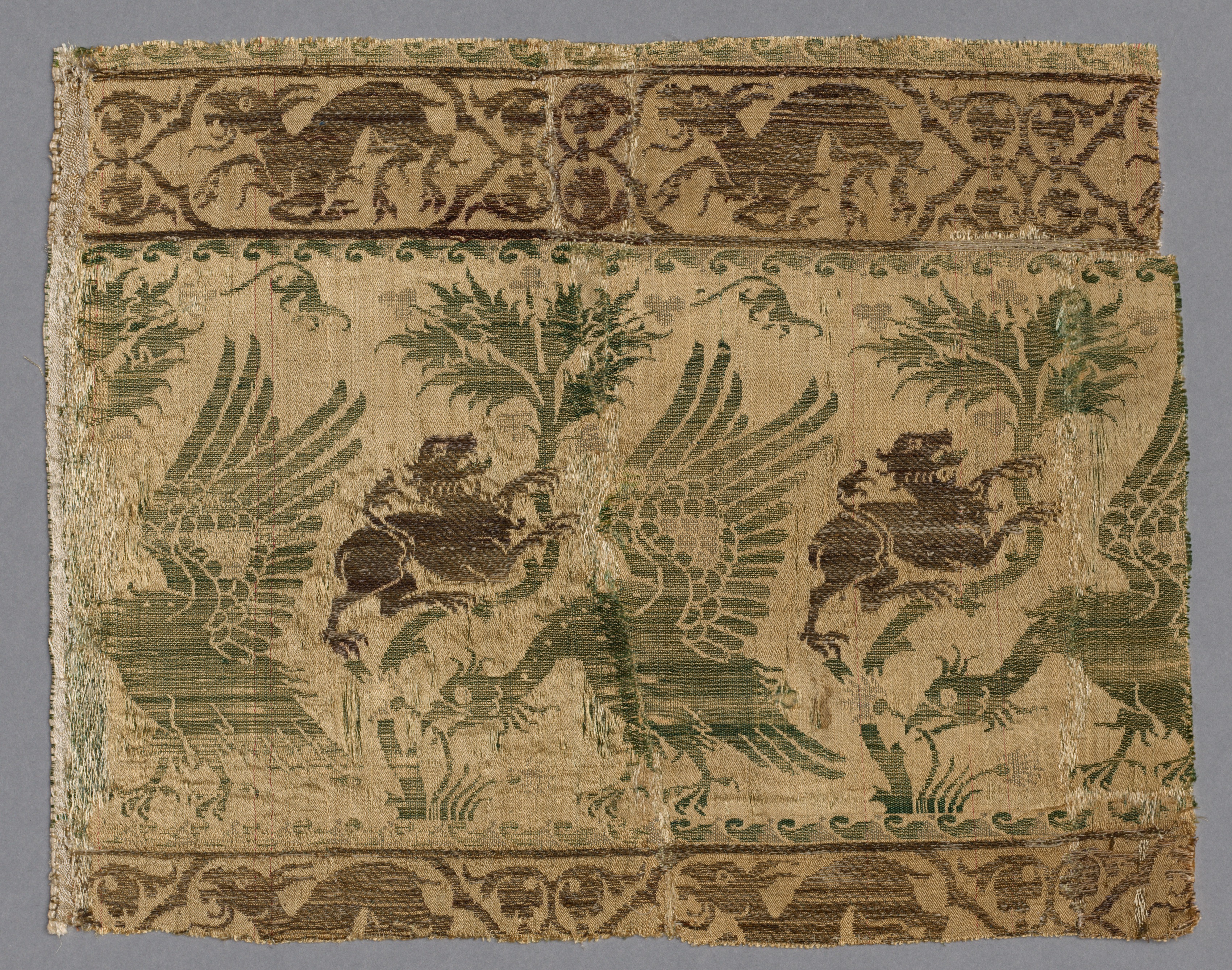
For Zoey Fashion Lab, the analysis of a 14th-century Italian silk and gold lampas is not an exercise in historical preservation but a surgical extraction of avant-garde potential. This textile, originating from the last third of the Trecento, represents a pinnacle of medieval luxury technology—a complex compound weave that interlaces dyed silk warps with gilded silver thread to create a surface of both opulent reflection and tactile depth. The reference to the Mirror with Split-Leaf Palmette—where one side gleams with gold-encrusted foliage and the other narrates life through cold stone relief—provides the conceptual fulcrum for our deconstruction. We do not see a relic; we see a binary system of perception: the luminous, immediate surface versus the embedded, narrative substrate. Our avant-garde mandate is to dismantle this binary, extracting the structural grammar and philosophical tension to forge garments that exist as wearable paradoxes.
Technical Autopsy: The Lampas Matrix as Proto-Code
The lampas weave of this period is a masterclass in hierarchical engineering. Unlike simpler brocades, lampas employs two distinct warp systems and two weft systems. The ground weave—typically a plain or twill silk—provides structural integrity, while the pattern weft, composed of tightly coiled gold thread (often gilt silver over silk or leather core), floats across the surface to create the figurative design. This is not mere embroidery; it is a pre-programmed binary system, where each warp lift and weft insertion is a data point. The resulting fabric is a dense, stiff, and remarkably durable material that holds its shape with architectural rigidity.
For the avant-garde designer, this technical specificity is a launchpad. The gold thread is not decorative; it is a light-management system. Its metallic surface reflects ambient light in a way that shifts with the viewer’s angle, creating a moiré effect that destabilizes the garment’s silhouette. The silk, conversely, absorbs light, creating a matte counterpoint. This is not a static surface but a dynamic optical field. Our reinterpretation will not mimic the weave but will extract its logic: the juxtaposition of rigid, reflective elements against soft, absorptive grounds. We will translate this into contemporary materials—perhaps a base of liquid-cooled technical silk, overlaid with laser-cut, gold-plated titanium scales that are individually articulated to allow for movement while retaining the original’s sense of armored splendor.
Palmettes and Stone: The Dialectic of Surface and Substrate
The Archive Resonance reference is critical. The Mirror with Split-Leaf Palmette presents a profound dichotomy: the polished silver mirror with its gold palmette ornament versus the cold sarcophagus relief. One is a tool of self-projection, the other a record of mortality. The textile embodies this same tension. The gold palmettes—stylized, symmetrical, and radiant—are the mirror: they assert wealth, power, and a celestial, otherworldly perfection. They are the face of the garment. But beneath this shimmering surface lies the stone: the dense silk ground, which in its physical weight and structural complexity, speaks of the labor, the loom, and the terrestrial reality of its creation. The pattern is the narrative; the ground is the history.
Our avant-garde application will invert this hierarchy. Instead of a golden surface over a silk substrate, we will construct garments where the narrative is the surface and the opulence is the hidden substrate. Imagine a deconstructed coat where the outer layer is a digitally printed, high-resolution scan of the original textile’s verso—the often-unseen reverse side with its floating threads and structural chaos—rendered in matte, monochromatic ink. This outer shell appears stark, almost funereal, like the stone relief. But upon movement or a deliberate turn, the interior reveals the recto: a lining of actual gold lamé, not woven but applied in shattered, irregular shards, evoking the fractured mirror. The wearer becomes a living memento mori, a moving monument where the gold is only revealed in moments of deliberate exposure—a gesture of vulnerability and power simultaneously.
Deconstructing the Palmette: From Symmetry to Fracture
The split-leaf palmette is a motif of perfect bilateral symmetry, a visual representation of cosmic order. For the avant-garde, symmetry is a conservative trap. Our design process will fracture the palmette, not as a decorative distortion, but as a structural principle. We will use algorithmic pattern-cutting to slice the traditional motif into non-repeating, asymmetric segments. These segments will then be reconstructed as modular panels within the garment, each panel acting as an independent architectural element. The seams between these panels will be exaggerated, exposed, and filled with a contrasting material—perhaps a translucent, resin-embedded thread that mimics the look of cracked amber or aged varnish.
This approach transforms the garment from a single, unified surface into a collage of temporal moments. One panel might feature the gold thread woven in its original, dense configuration; another might feature the same pattern but with the gold removed, leaving only the negative space of the silk ground—a ghost of the motif. This creates a visual rhythm of presence and absence, mirroring the dichotomy of the mirror and the tomb. The garment becomes a narrative of loss and reconstruction, a commentary on how history is always a fragmented, selective memory.
Material Alchemy: Contemporary Transmutations
To translate this 14th-century technology into a 21st-century avant-garde statement, Zoey Fashion Lab will employ a hybrid material palette that respects the original’s physicality while embracing modern innovation.
1. The "Living" Gold
We reject the static nature of traditional metallic thread. Instead, we will utilize a shape-memory alloy—nitinol—coated in 24-karat gold. This allows the decorative elements to move with body heat. As the wearer’s temperature rises, the gold elements will slowly unfurl or contract, altering the surface pattern in real-time. The palmette becomes a living organism, responding to the biological presence of the wearer. This is the mirror that reflects not just light, but life.
2. The "Stone" Silk
Instead of traditional silk, we will use a 3D-printed silk protein scaffold, infused with mineral particles—marble dust, basalt, and crushed alabaster. This creates a fabric that has the drape of silk but the thermal mass and tactile weight of stone. It will feel cold to the touch initially, warming slowly against the skin. This is the sarcophagus, but one that is breathable and wearable. It is a material that embodies the memory of stone without its immobility.
Silhouette and Movement: The Wearable Architecture
The final avant-garde expression lies in the silhouette. The original textile was used for ecclesiastical vestments and aristocratic gowns—garments of static grandeur, designed for processional display. Our garments will be designed for kinetic dissonance. We will construct a series of exoskeletal frames—corsets and shoulder structures—built from the stone-silk composite. These will be rigid and sculptural, echoing the architectural quality of the original fabric. However, they will be articulated with unseen micro-hinges and connected by the living gold elements. The result is a garment that appears as a monolithic, immobile sculpture when still, but which cracks open into fluid, dynamic motion when the wearer walks. The gold elements will catch the light in a fragmented, stroboscopic effect, while the stone-silk panels will grind against each other with a soft, gravelly whisper.
This is not a costume. It is a philosophical instrument. It asks the wearer and the viewer to confront the duality of our own existence: the polished, projected self (the mirror) and the physical, decaying reality (the tomb). By deconstructing the 14th-century textile’s technical and symbolic codes, Zoey Fashion Lab creates not a homage, but a rupture—a new object that exists in the liminal space between history and prophecy, between opulence and austerity, between the eternal and the ephemeral. The silk and gold are no longer materials of the past; they are vectors for a new future, where fashion is a form of critical archaeology, digging through the strata of human ambition to unearth the raw, uncomfortable, and beautiful truth of our material condition.