Deconstructing the Paracas Mummy Bundle Mask: An Avant-Garde Resonance
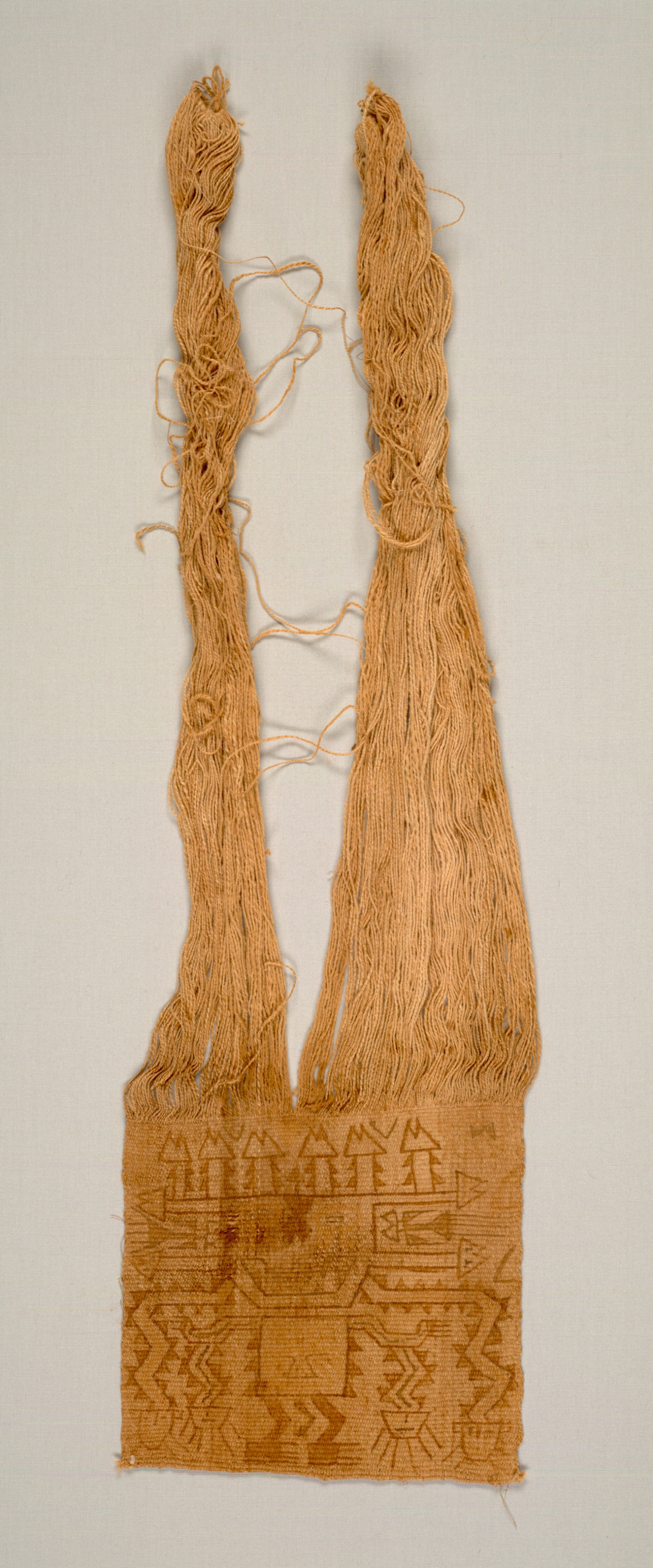
At Zoey Fashion Lab, our mandate transcends mere garment analysis. We engage in fabric deconstruction as a form of archaeological futurism, extracting latent design codes from historical textiles to inform a radical, avant-garde aesthetic. Today’s subject—a painted, plain warp-faced cloth mask from a Paracas mummy bundle, originating from the Ocucaje site in Peru’s Ica Valley—presents a profound paradox. It is a funerary object, yet it vibrates with a graphic, almost modernist energy. This analysis will dissect its technical construction, cultural resonance, and stylistic potential, positioning it not as a relic, but as a proto-avant-garde manifesto woven in camelid fiber.
Technical Autopsy: The Plain Warp-Faced Cloth
The mask’s foundation is deceptively simple: a plain warp-faced cloth. This weave structure, where the warp threads dominate the surface entirely, is a testament to the weaver’s precision. Unlike balanced weaves, warp-faced textiles require immense tension control and a high thread count to achieve their characteristic ribbed, dense surface. The resulting fabric is not soft or draping; it is rigid, architectural, and almost sculptural. For the Paracas culture (circa 800–100 BCE), this cloth was the canvas for a complex visual language. The warp’s verticality provides a natural rhythm, a striated texture that the subsequent painting would either respect or disrupt.
Our deconstruction focuses on the interaction between the weave and the pigment. The painted surface does not sit atop the cloth as a separate layer; rather, it is absorbed into the fibrous matrix, creating a fused composite. This is a critical technical point for the avant-garde designer: the textile is not a passive support but an active participant in the image. The warp-faced structure creates a series of micro-channels that guide the paint, resulting in a characteristic "bleeding" or feathering effect. This is not a flaw; it is a signature of authenticity, a blurring of boundaries that we at Zoey Fashion Lab seek to replicate in our digital and physical textile manipulations.
Materiality and Color: The Ica Valley Palette
The pigments used—typically mineral-based ochres, cinnabar, and carbon blacks—are ground and bound with organic resins. The palette is stark: deep earth reds, sun-bleached yellows, and jet blacks. Applied to the camelid fiber (likely alpaca or llama), these colors possess a matte, chalky finish that absorbs light rather than reflecting it. This is antithetical to modern, glossy synthetics. The avant-garde interpretation here is to embrace light absorption as a design feature. We propose fabrics that mimic this "dead" surface—using micro-porous finishes or un-singed cottons—to create garments that feel ancient, weighty, and introspective.
Iconographic Disruption: The Mask as Interface
The mask’s painted imagery typically features a feline or anthropomorphic deity, often with streaming, serpentine appendages. These are not mere decorations; they are narrative devices encoding shamanic transformation and cosmological order. The face is often divided into geometric zones—triangles, stepped frets, and concentric circles—that fracture the human visage into abstract planes. This is the core of its avant-garde appeal: the mask does not represent a face; it dismantles and reconfigures it.
From a fashion perspective, this is a precursor to Cubist distortion and cybernetic interfaces. The mask's "face" becomes a graphic user interface for the spirit world. The bold, asymmetrical lines and the deliberate distortion of natural proportions are directly translatable to modern pattern cutting. We can envision a garment where the shoulder line becomes a "step fret," or where a jacket’s lapel mimics the angular, disjointed jawline of the painted deity. The mask teaches us that the body is not a sacred silhouette to be draped, but a malleable canvas to be segmented and re-stitched.
Cultural Collision: The Archive Resonance
Our reference notes an "Archive Resonance" spanning the 16th to 17th centuries, a period of violent cultural collision. This is crucial. The Paracas style, while pre-Columbian, was itself a product of regional synthesis. The Ocucaje site reveals a culture in flux, absorbing influences from the Paracas Necropolis and the later Topará tradition. The mask, therefore, is not a pure, isolated artifact. It is a hybrid, a survivor of cultural negotiation. This resonates profoundly with the avant-garde ethos, which thrives on the clash of disparate elements—the ancient and the digital, the sacred and the profane.
In the 16th century, these textiles were ripped from their context and shipped to European cabinets of curiosities. They were seen as "grotesque" or "primitive." Our re-evaluation in the 21st century flips this narrative. We see the mask as a proto-futurist object, its bold geometry and non-naturalistic color prefiguring the works of Picasso and the De Stijl movement. The "resonance" is not a nostalgia for the past, but a recognition of a timeless design logic that bypasses linear history. The mask is not ancient; it is future, waiting for the right technological and aesthetic moment to be re-animated.
Avant-Garde Application: From Funerary to Fashion
How do we translate this analysis into a wearable collection for Zoey Fashion Lab? We propose three directives:
1. The "Warp-Face" Construction Technique
We will develop a high-density, rigid jersey that mimics the warp-faced structure using modern elastomeric yarns. The fabric will have a distinct "ribbed" directionality, and we will use digital printing with a "feathering" algorithm to simulate the pigment bleed. Garments will be cut with zero ease, relying on the fabric’s structural stiffness to create architectural silhouettes—sharp, cylindrical sleeves, and high, mandarin collars that stand away from the neck.
2. The "Deity Fracture" Pattern System
We will deconstruct the mask’s facial planes into a pattern block. The front of a dress will be divided into asymmetrical panels that meet at unexpected angles, echoing the painted divisions of the face. Each panel will be a different shade of the Paracas palette: terracotta, bone white, and obsidian black. The seams will be exposed and top-stitched with a contrasting thread, turning the construction into a visible graphic element.
3. The "Resonance" Layering System
In homage to the cultural collision, we will create a modular outer layer—a cape or poncho—that can be worn over the structured base. This layer will be made of a sheer, deconstructed mesh, printed with a distorted, pixelated version of the mask’s imagery. This creates a palimpsest effect: the ancient solid form is seen through a modern, fragmented veil. The wearer becomes a living archive, embodying the resonance between the 16th-century shock of discovery and the 21st-century thrill of reinterpretation.
Conclusion: The Mask as a Living System
The Paracas mummy bundle mask is not a dead object. It is a compressed data file containing centuries of technical expertise, spiritual belief, and aesthetic rebellion. For Zoey Fashion Lab, it is a source code. By deconstructing its weave, decoding its iconography, and re-contextualizing its cultural trauma, we transform it into a generative force for avant-garde design. The mask’s true power lies not in its preservation, but in its capacity for radical reinterpretation. It challenges us to see the body not as a biological given, but as a constructed, painted, and contested surface—a bundle of meanings waiting to be unwrapped and re-wrapped for a new era.