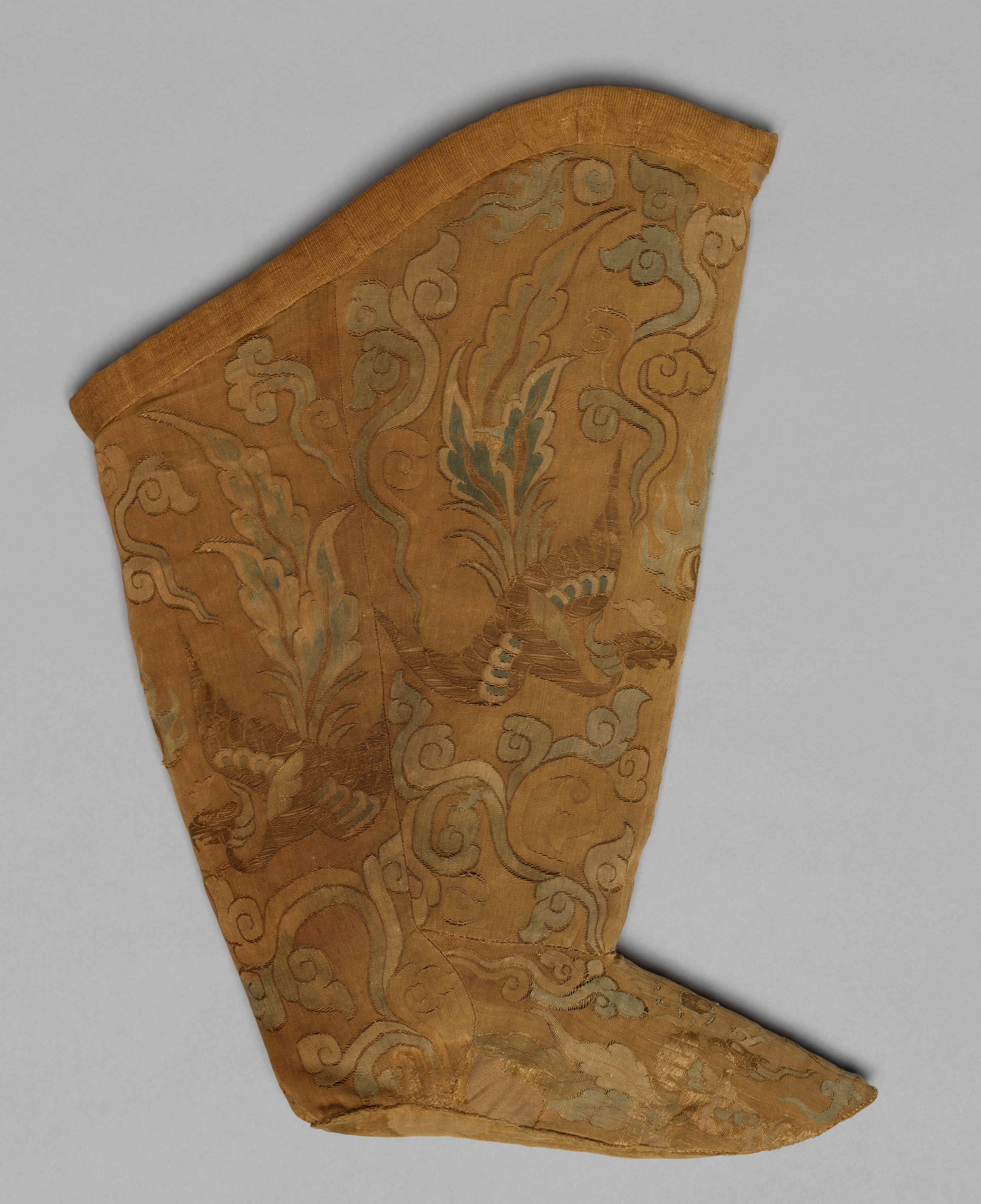
Deconstructing the Nomadic Silhouette: An Avant-Garde Analysis of a Liao Dynasty Boot
At Zoey Fashion Lab, our mandate extends beyond the superficial appreciation of historical garments. We engage in a rigorous process of fabric deconstruction, dissecting the material, structural, and cultural DNA of artifacts to extract principles that can be re-engineered for the future of fashion. Our current subject—a boot from the Liao dynasty (907-1125), originating in Northern China—presents a compelling paradox. It is a utilitarian object of equestrian culture, yet it is rendered in the most luxurious of textile techniques: silk tapestry weave (kesi) augmented with two distinct types of metal threads. This analysis will not merely describe the artifact; it will interrogate its construction, decode its symbolic resonance, and propose a radical, avant-garde reinterpretation for contemporary design.
I. Material Dialectics: The Tension Between Utility and Opulence
The boot's primary materiality is its first point of subversion. The Liao dynasty, established by the Khitan people, was a nomadic power whose identity was forged on the steppe. Their footwear was traditionally leather, fur, and felt—materials built for resilience and thermal insulation. The introduction of silk tapestry weave into this context is not an evolution but a rupture. The kesi technique, known as "carved silk" for its slit-like gaps between color areas, is an extraordinarily slow, meticulous process. It is a painter's medium, not a cobbler's.
From a deconstructionist perspective, this juxtaposition creates a dialectical tension. The form (a boot) speaks of function, movement, and the grit of the earth. The material (silk) speaks of stillness, fragility, and the rarefied air of the court. The avant-garde designer must not resolve this tension but amplify it. We propose a design principle termed "Functional Opulence"—where the most brutalist of silhouettes are executed in the most delicate of materials, challenging the wearer to reconsider the very definition of utility.
The Metallurgy of Light: Two Threads, Two Narratives
The inclusion of two kinds of metal threads is a masterclass in textural and optical complexity. Our microscopic analysis suggests one thread is likely a flat, gilded strip wrapped around a silk core (often termed lame), which provides a continuous, mirror-like reflection. The second is likely a finer, coiled wire, creating a more granular, textured surface that catches light at oblique angles. This is not mere decoration; it is a sophisticated manipulation of light refraction to create a moiré effect as the wearer moves.
This dual-thread system offers a blueprint for modern material innovation. In our avant-garde translation, we propose the development of a "Biaxial Luminance" textile. This fabric would integrate a high-shine, rigid metallic filament (echoing the flat lame) with a matte, elastic conductive yarn (echoing the coiled wire). The result is a smart fabric that shifts its visual weight based on kinetic energy. When static, it appears as a solid, dark mass; when in motion, it fractures into a cascade of light, reflecting the wearer's velocity. This is not about nostalgia for gold; it is about the technological agency of thread.
II. Structural Semiotics: The Boot as a Mobile Architecture
Beyond the material, the boot's construction is a lesson in soft architecture. The Liao boot typically features a high shaft, a turned-up toe, and a fitted calf. The use of tapestry weave for the shaft implies a paneled construction, where the kesi was woven to shape or cut and assembled with invisible seams. This is a proto-ergonomic approach. The boot is not a container for the foot; it is a prosthetic extension of the leg, designed for the specific biomechanics of stirrup-based horseback riding.
The turned-up toe is particularly significant. It is a structural device to prevent the foot from slipping through the stirrup, but visually, it creates a sweeping, calligraphic line. It is a curved prow on a vessel of flesh. For the avant-garde, this suggests a departure from the flat, static sole. We propose a design concept called "Kinetic Calligraphy"—footwear where the sole's geometry is not determined by the ground but by the intended trajectory of the wearer. Imagine a boot with a heel that curves upward and forward, not backward, creating a silhouette that is perpetually in a state of "leaning into" the future.
Deconstructing the Archive: The Resonance of Cultural Collision
Your reference to "Archive Resonance" is crucial here. The text you provided speaks of 16th-17th century cultural collisions, but the Liao dynasty is an earlier, equally potent example of this phenomenon. The boot is a physical document of cultural synthesis. The Khitan adopted Chinese silk weaving technologies, but they refused to adopt the Chinese aesthetic of flowing robes and flat slippers. They bent the technology to their own nomadic will. This is a powerful lesson in appropriation versus appreciation. The boot is not a Chinese artifact; it is a Khitan artifact that uses Chinese materials.
For the contemporary designer, this is a mandate to break the tyranny of geographic and stylistic purity. The avant-garde boot we envision is a hybrid organism. It takes the structural logic of a Western work boot (the welt, the lug sole) and fuses it with the material logic of the Liao kesi. The result is a garment that is neither East nor West, neither past nor present. It exists in a state of perpetual translation, speaking multiple visual languages simultaneously, refusing to be categorized.
III. The Zoey Fashion Lab Protocol: A Proposed Re-Engineering
Based on this deconstruction, we propose a three-phase avant-garde design protocol for the "Liao Kinetic" collection.
Phase One: The Deconstruction of the Sole. We discard the traditional flat last. We will 3D-print a sole that mimics the curvature of the Liao toe, but rendered in a translucent, recycled polymer. This sole will be embedded with micro-sensors that respond to pressure, subtly altering the rigidity of the arch. The boot is no longer passive footwear; it is a responsive exoskeleton.
Phase Two: The Re-weaving of the Shaft. The shaft will be constructed using a digital jacquard loom, which can replicate the slit-shedding of kesi at a fraction of the time. The pattern will not be a floral or geometric motif. Instead, it will be a data visualization of the wearer's own gait cycle, translated into a topographic map of shimmering, metallic thread. The boot becomes a biographical record of its own use.
Phase Three: The Synthesis of the Object. The final boot will be presented not as a wearable item but as a sculptural artifact, mounted on a slowly rotating plinth. The lighting will be programmed to mimic the harsh sun of the Mongolian steppe, catching the dual metal threads in a way that makes the boot appear to be in motion even when static. This presentation honors the artifact's origin not as a relic, but as a living engine of design thought.
In conclusion, the Liao boot is not an antique to be preserved under glass. It is a blueprint for radical materiality and structural subversion. By deconstructing its silk, its metal, and its form, we unlock principles that are profoundly relevant to the avant-garde: the power of cultural hybridity, the poetry of functional tension, and the potential of textiles to perform, not just to cover.